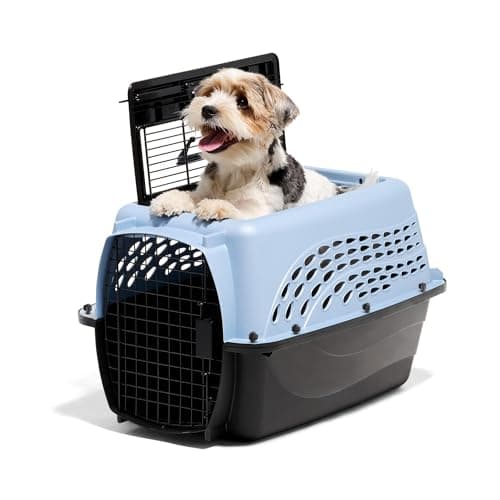
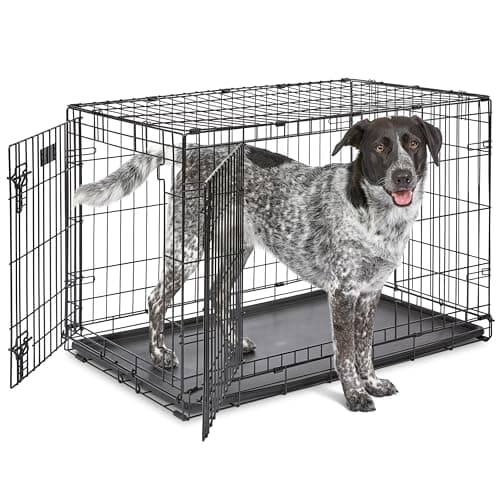
The verdict: buy the MidWest Homes for Pets iCrate in the adult dog's size and use the included divider panel to shrink it to the puppy. That is the whole answer to the puppy-crate problem, which is not "what fits now" but "how do I avoid buying three crates in a year". It folds flat, so unlike every steel crate it genuinely travels. If your puppy is a small breed and the crate's real job is vet trips and the car, the Petmate two-door kennel is the better buy: a rigid shell with a top-loading door, which is how you get a reluctant puppy in without a wrestle.
Two rules decide a crate size before any product does. The airline and IATA standard is that the dog must be able to stand up, turn around and lie down- and for a crate at home, bigger than that is actively counterproductive for a puppy, because a crate with a spare end becomes a crate with a toilet in it. That is the entire reason divider panels exist, and it is why "buy big, they grow into it" is the most common puppy-crate mistake. Our crate size chart covers the measuring method; this page is about which crate to put the measurement into.
A note on what we do and do not know. Crate dimensions and divider inclusion come from the manufacturers' published specs, and the age rules below come from the airlines' own published policies. We have not crash-tested or chew-tested any of these, and anything about your particular puppy's development - when it can travel, how long it can hold on, whether it is ready to fly - belongs with your vet rather than with us.
What a puppy needs that an adult dog does not
A crate that changes size
A divider panel turns one crate into three. You position the panel so the puppy has room to stand, turn and lie down and nothing more, then move it back as the dog grows. The alternative - a correctly sized small crate now, a medium in four months, a large at a year - costs more than the crate you should have bought, and two of them end up in a garage.
A chewing phase, which is temporary and expensive
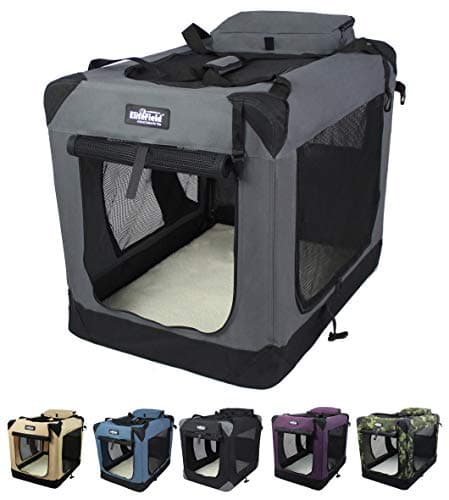
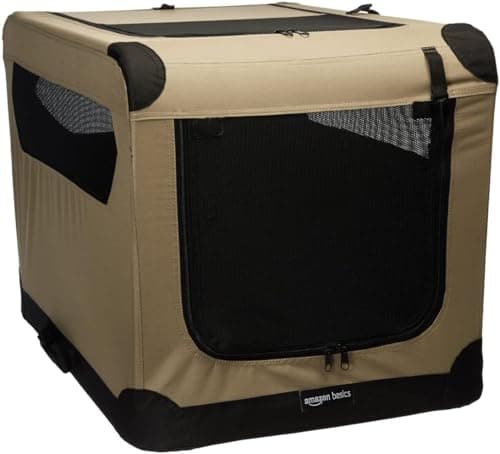
Soft crates are the pleasant way to travel with a settled adult dog and the wrong first crate for a teething puppy: fabric and mesh lose to a puppy with time on its hands, and a dog that learns it can chew its way out has learned something permanent. Both soft crates below carry that warning in their own cons for exactly this reason. Wire deters; hard plastic resists; fabric does neither. Buy the fabric one when the dog has earned it.
House-training, which is why the crate is in the bedroom
A puppy crate gets moved around the house far more than an adult's, which makes folding flat a feature rather than a nicety - the same feature that makes it work in a car boot. A crate that lives in one room because it is a fixed box is a crate you will stop using.
Confinement that is not a crate
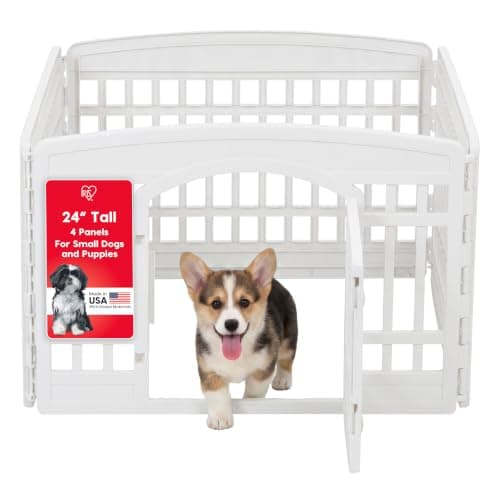
A puppy awake and in need of containment for an hour is a pen problem, not a crate problem. A crate is for sleeping and for travelling; a playpen is for the awkward middle. We rank those properly on best portable dog playpens and set out when each is the right tool on crate vs playpen for travel.
The comparison table
| Crate | Grows with the puppy? | Packs down? | Chew resistance | Best job |
|---|
| MidWest iCrate Double Door Folding Dog Crate | Yes - divider panel included | Folds flat | Deterrence, not containment | The one crate for the first year |
| Petmate Two-Door Top-Load Kennel | No - buy to the adult size | No - a fixed box | Rigid shell, steel door hardware | Small breeds, the car and the vet |
| EliteField 3-Door Folding Soft Dog Crate | No - sized ranges, not dividers | Into its own carry bag | Low - fabric and zips | Hotels, once the dog is crate-trained |
| Amazon Basics Portable Folding Soft Dog Crate | No | Folds flat | Lowest here | The occasional trip, on a budget |
| IRIS USA 4-Panel Dog Playpen | Not a crate - a pen | Lies genuinely flat | Plastic panels, small dogs only | Awake-and-containing, up to about 25 lb |
Prices are live from the Amazon Product API, stamped with the date underneath. Sizes vary widely within each of these product lines, so buy the size from your measurement rather than from the picture.
Flying a puppy: the age rules that are not negotiable
If a flight is in the plan, the age numbers come first and the crate second:
- Eight weeks is the usual floor. Delta and American both publish an eight-week minimum for travel, and that is a floor rather than a recommendation.
- Two puppies in one kennel is a narrow exception. Delta permits it between 8 weeks and 6 months for animals of the same breed and size, charged as one pet; American requires the same species, similar size, under 20 lb each, and the same 8-week-to-6-month window. An adult pair does not qualify - the arithmetic is on flying with two dogs.
- In-cabin means a carrier, not a crate. A puppy small enough for the cabin travels in a soft under-seat bag, which is a different purchase entirely - best airline-approved carriers.
- In the hold means a cargo-compliant kennel. Rigid construction, metal door hardware, four-sided ventilation and live-animal labelling - the checklist is on airline cargo crate requirements, and plastic door fasteners are the most common reason a kennel is refused at a counter.
Policies differ by airline and change, so confirm with yours. The difference between a crate and a carrier, which trips up a lot of first-time buyers, is laid out on dog crate vs carrier for travel.
What we left out, and why
Tube-steel and heavy-duty crates. A puppy that has not learned to escape does not need a crate that cannot be escaped, and these do not travel. They are ranked on best heavy-duty crates for the dog that has already proved it needs one.
Crate covers and "calming" crate kits. A towel over a wire crate does the same job for free, and we are not going to rank a product whose benefit we cannot substantiate.
Puppy car seats and boosters. A different question with a different answer, and the honest version is that a booster is comfort rather than crash restraint - see traveling with a puppy.