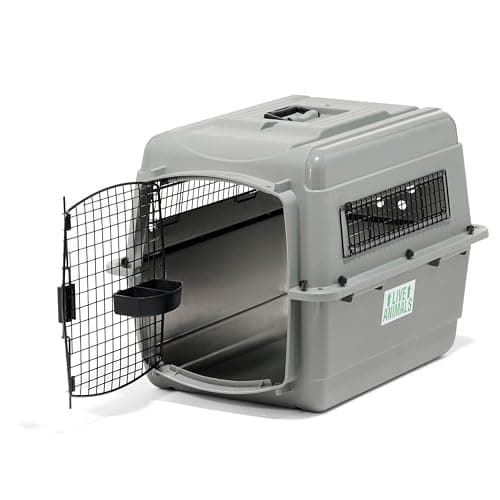
If you ask around about flying a dog in the hold, the Sky Kennel is the answer that comes back most often. It has been the default in the US for years, which matters in a specific and underrated way: it is the kennel counter staff recognize, and recognition removes friction on a day when you do not want friction.
It is also, almost incidentally, a very good crate for a dog that destroys other crates. Solid plastic gives a chewer nothing to grip the way wire bars do, which is why it also appears in our heavy-duty crate roundup.
What it gets right
It is built to the requirement, not adapted to it
Four-sided ventilation, a metal grille door, external rims so cargo cannot block the vents, and fastening points designed for bolts. These are the specifications airlines actually check, and the kennel was designed around them rather than having them retrofitted. Our cargo requirements checklist walks through each one.
The hardware question, answered properly
The single most common reason a kennel gets refused is plastic fasteners where the airline wants metal. The Sky Kennel ships with metal hardware for exactly this reason. Still check what is in your box and check your airline's current wording — but this is the model least likely to fail on that point.
Quietly excellent against chewers
A smooth plastic interior offers no bars to grip and no fabric to shred. For a dog that has escaped a wire crate, a hard kennel is a genuine step up in containment, and this one is available in more sizes and more places than most.
Ubiquity is a feature
Spares, replacement doors and bolt kits are easy to find, and vets, boarding kennels and airline staff all know what it is. On a stressful travel day, the boring familiar option is frequently the right one.
Where it falls short
It does not fold, and that is a real cost
It splits into two halves for storage, which helps, but a hard kennel is a large object that lives in your garage between trips. If you fly more than occasionally, the collapsible SportPet Designs kennel solves this at a higher price and is worth considering.
Ventilation is good for a hold, moderate for a hot campsite
Solid sides with vents ventilate far less than an open wire crate. In a temperature-controlled hold that is fine. In direct sun at a campsite, or in a warm car, it heats up faster than people expect — shade and airflow are not optional if you use it outside an aircraft.
Heavy and awkward to carry loaded
A hard kennel with a dog in it is a two-person lift at the larger sizes, and the carry handles are adequate rather than good. Factor that into how you get it from a car park to a counter.
It is not a car restraint by itself
A rigid kennel is the right shape for vehicle use, but only once it is genuinely anchored. Loose in a cargo bay it is a heavy box that travels with the impact. Our anchoring guide covers doing it properly.
Confirm the size against your dog and your aircraft
Sizes are published against pet weight ranges, but the requirement that actually matters is that the dog can stand without ducking, turn fully and lie naturally. Measure the dog. Then check the kennel's external dimensions against the maximum for your specific aircraft, because that limit is lower on smaller planes.
Who should buy it
Buy it if your dog is flying in the hold and you want the option least likely to cause a problem at check-in, or if you need a hard kennel that also happens to defeat a chewer.
Do not buy itif the crate is only ever going in a hotel room — a soft crate folds flat and this does not. Do not buy it if you fly frequently and storage is tight; the collapsible alternative earns its premium there. And do not assume it is airline-ready without reading your airline's current page, because their wording is the only wording that counts.