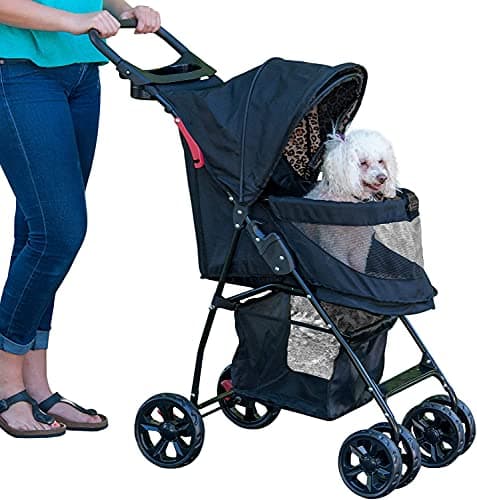
A dog stroller is not a luxury item on a trip — it is the thing that lets a dog who cannot walk five miles still come along for five miles. Senior dogs, small dogs with short legs, dogs recovering from surgery, and any dog on a hot city sidewalk all hit the same wall: the day is longer than their legs. A stroller buys back the rest of the day.
The category is also full of strollers designed for a suburban driveway and sold to people who are going somewhere. That is the split this page cares about. A stroller that lives in your hallway can be any size it likes. A stroller that travels has to fold flat enough to go in a trunk that already has the luggage in it, be light enough to carry up a flight of hotel stairs, and be rated for the dog you actually own — not the one in the product photo.
So we ranked these on the specifications that decide whether the stroller comes on the trip: folded size, stroller weight, and listed weight capacity, then how the dog gets in and out and what stops it getting out on its own. Every figure below is a manufacturer or retailer listing, sourced at the bottom of the page. Where a maker publishes no figure — Pet Gear does not list a folded size for the Lite, VIVO does not list a wheel size — we say so instead of filling the gap.
The four numbers that decide it
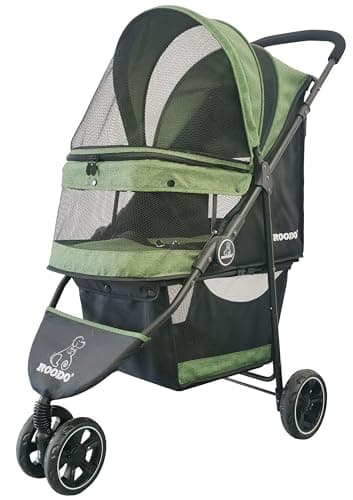
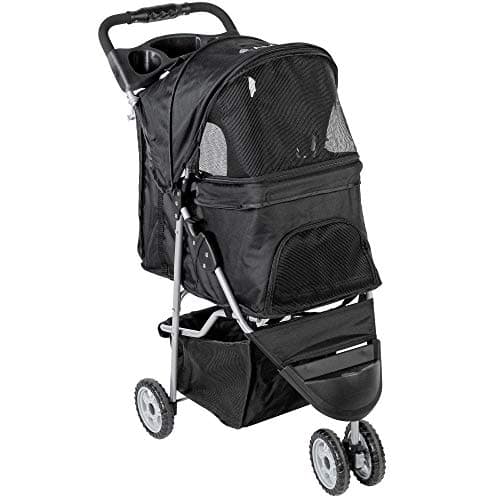
Folded thickness. This is the one that gets ignored and then ruins the trip. Two strollers can have the same footprint open and differ by a factor of two folded: the ROODO folds to 6 inches thick, the VIVO to 12. Six inches slides down the side of a trunk beside the suitcases. Twelve inches is a suitcase.
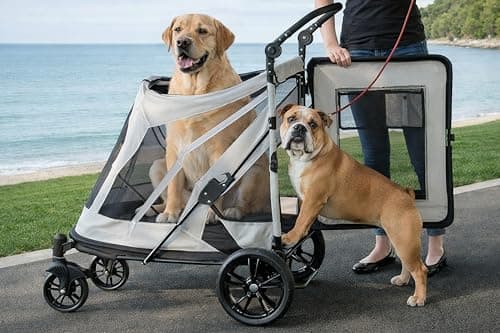
Stroller weight. You lift this in and out of a car at every stop, and up steps at the hotel. Eleven pounds is a one-handed carry. Pet Gear's Expedition is 26 lb before the dog gets in, which is a two-handed job every single time.
Listed capacity. Capacities here run from 17 lb to 150 lb, and they are not suggestions — an overloaded stroller steers badly, brakes worse, and fails at the wheels. Weigh your dog before you shop. If your dog is at the top of a band, go up a model.
How the dog gets in. Zippered doors mean you lift the dog through an opening. No-zip doors mean the panel unlatches and the dog walks in. For an arthritic or post-op dog — the exact dog most likely to need a stroller — that difference is the whole product.
If the wheels are going behind a bicycle instead. A stroller pushed at walking pace and a trailer towed at riding pace are different products with different hitches and different capacities — best dog bike baskets and trailers ranks that field, including the convertible two-in-one units that try to be both.
Strollers are one of four answers to the same underlying problem, and they are the only one that publishes a capacity big enough for a large dog. Whether a stroller, a support harness, a ramp or a pack is the right call for yours is worked through in how to carry a large dog.
How to choose a travel dog stroller
Measure the trunk before you measure the dog
Everyone measures the dog and nobody measures the car. Load your trunk the way it looks on a real trip — suitcases in, cooler in, crate in — then measure what is genuinely left. Compare that against the folded figures: 33 x 18.5 x 6 in for the ROODO, a collapsed 35 x 17.5 x 12 in for the VIVO. Pet Gear does not publish a folded size for the Happy Trails Lite at all; its shipping carton is 34.5 x 14.5 x 7.25 in, which is the closest published number and worth treating as a floor rather than a promise. The Expedition is 32 x 22 x 23 in open and does not pretend to be a small object.
Match the capacity to the dog, then leave headroom
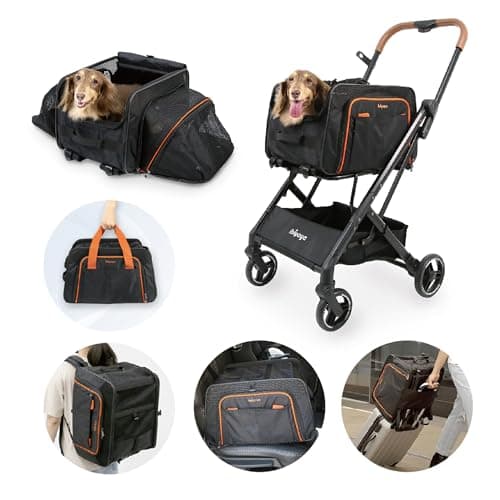
The listed ceilings on our picks are 17 lb (ibiyaya), 25 lb (Pet Gear Happy Trails Lite), 30 lb (ROODO and VIVO) and 150 lb (Pet Gear Expedition). A 24 lb dog in a 25 lb stroller is a bad buy: dogs shift their weight, lean on one side, and stand up as you turn. Aim to sit comfortably inside the band, the same way you would when sizing a crate.
Three wheels turn better, four wheels are steadier
A single swiveling front wheel — the ROODO and VIVO layout — pivots tightly on a crowded sidewalk and rolls better over a lip. Four wheels are more stable on a cambered path or when a big dog stands up suddenly. Neither is wrong. Small dog, tight city streets: three. Bigger dog, campground gravel, uneven ground: four.
Wheel size matters more than wheel count on rough ground. The 6-inch front and 7-inch rear wheels on the Happy Trails Lite are honest sidewalk wheels; the ROODO's 5.5-inch front and 6.5-inch rear are similar. None of these are trail strollers, and no stroller in this price range is a substitute for a backpack carrier when the ground stops being flat.
Brakes and an interior tether are not optional
A parked stroller on a slope with a dog in it will roll, and a dog that sees a squirrel will go over the side of an open one. Every pick here lists rear brakes and at least one interior tether. Clip that tether to a harness, never a collar — the same rule as a car tether, and for the same reason: a sudden stop against a collar is a neck injury.
Zip doors versus no-zip doors
Pet Gear's no-zip designs unlatch with a push button, so the front panel drops and the dog walks in and out. The VIVO uses three zippered access points, which is cheaper and completely fine for a young, light dog who likes being picked up. It is the wrong answer for a stiff senior, a dog with a healing incision, or anyone who has to load the dog one-handed while holding a coffee and a leash.
A detachable carrier changes what you are buying
The ibiyayapick is a carrier that clips onto a wheeled frame, so one purchase covers the flight and the sidewalks. That is genuinely useful on a fly-then-drive trip. What it is not is an automatic in-cabin pass: airline under-seat rules are about the carrier's dimensions and your dog's weight, not about who made it. Check the numbers against our airline under-seat dimensions referencebefore you assume the carrier half will fly with you, and read ibiyaya's own advice, which is to confirm with the airline first.
Do not assume a pet stroller gate-checks like a baby stroller
Delta's published carry-on page lists "strollers, wheelchairs, child safety seats or assistive devices" among the special items that do not count against your baggage allowance. It does not say whether a pet stroller is included, and we could not find a US airline policy that names pet strollers explicitly either way — owner reports differ, with some saying a folded pet stroller was gate-checked without argument and others saying the frame went in as paid checked baggage. Treat free gate-checking as unconfirmed, ask your airline before you book, and get the answer in writing if the trip depends on it. Our cost of flying with a dog page covers the fees that are confirmed.
Where a stroller is genuinely the right answer
Hot ground is the clearest case. Asphalt that fails the seven-second hand test in our hot pavement guide is not made safe by walking faster, and boots are a partial fix; wheels take the paws off the surface entirely. Long airport transfers, cobbled European old towns, farmers' markets, and paved national park paths where dogs are allowed but distances are long are all stroller problems rather than harness problems. So is the last hour of a day out with a senior dog who has done enough.
Where it is the wrong answer
Trails with roots, steps or loose rock: carry the dog instead. Anywhere a sling would do — a 10 lb dog on a short errand does not need 11 lb of wheels. And in the car: a stroller is not a restraint, and a dog travels in a crash-tested harness or a secured crate, never in a parked stroller in the back.
What we would actually buy
For most small dogs on the road, the Pet Gear Happy Trails Lite — published specs, a door the dog walks through, and a price that does not hurt to leave in a trunk. If trunk space is the binding constraint, the ROODO and its 6-inch fold. For a small dog that flies as well as drives, the ibiyaya carrier-and-frame combination. For a large or a second dog, the Pet Gear Expedition, if you have measured the car. And for a stroller you will use twice a year, the VIVO is the honest cheap answer.