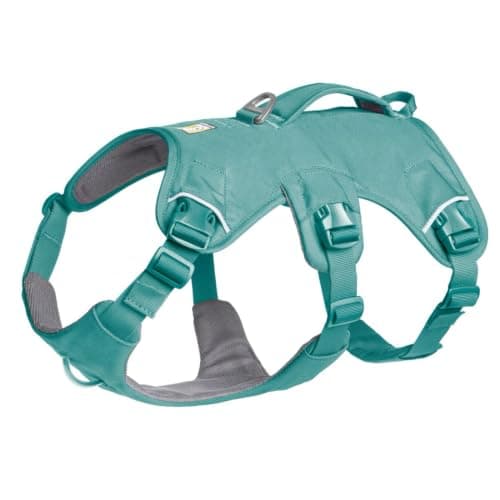
The verdict: buy the Ruffwear Web Master Support Harnessif your dog has ever reversed out of a harness, panicked at an airport, or gone backwards at the end of a leash. It is the only harness on this page with three body straps rather than two, and the third strap sits behind the ribcage where a dog's body is widest — which is exactly what stops the whole harness sliding forward over the shoulders. Everything else here is a good harness that is harder to escape than a collar, which is a different and lesser claim.
Say the uncomfortable part first: no harness sold on Amazon is certified escape-proof. There is no test, no standard and no certifying body for that phrase — unlike car restraints, where the Center for Pet Safety actually crash-tests, which we cover on best crash-tested dog harnesses. So "escape-proof" in a product title is a listing word, not a verified property. What we can do honestly is rank on the published mechanism: how many straps go around the dog, whether the load-bearing buckle is steel or plastic, and how much adjustment there is to close the gaps a slim dog exploits.
This matters more on the road than at home. At home a loose dog is in a yard it knows. At a rest stop on I-80 it is in a place with no scent map, no fence and traffic on two sides — and the thing that most often starts it is a dog shying from a truck brake, going backwards hard, and finding that a two-strap harness simply follows.
Why dogs get out, and what actually prevents it
The reverse-and-duck, which is the common one
A standard harness has two straps: one around the chest just behind the front legs, and a neck or shoulder loop. When a dog plants its feet and reverses, the rear strap slides forward until it is sitting on the narrowest part of the ribs, the shoulder loop rides up the neck, and the dog walks backwards out of both. A third strap further back has nothing narrower to slide onto — the dog's waist is behind it — so the geometry that makes the escape possible is simply not there.
The slim-headed breeds, which are their own case
Greyhounds, whippets, salukis and a lot of rescue mixes have a skull narrower than their neck, so anything that slips up and over comes off. For those dogs, strap COUNT matters less than how tightly the neck opening adjusts; a four- or five-point harness that closes down properly beats a two-point one that is sized for a Labrador.
The hardware, which fails quietly
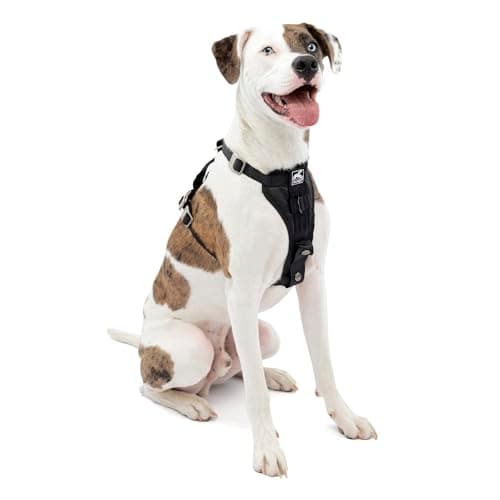
A plastic side-release buckle is fine for walking and is the first thing to go on a dog that hits the end of a leash at speed, or on a buckle that has spent two summers in a car footwell going brittle in UV. Where a maker publishes a steel load-bearing part — the Kurgo Tru-Fit's steel nesting buckle at the chest is the clearest example in this set — that is a real difference and we have weighted it.
How we ranked them
- Straps around the body. Three beats two, full stop. This is weighted highest because it is the only structural difference that changes whether the escape is possible at all.
- Adjustment points. Four and five-point harnesses close the gaps a deep or slim chested dog uses. Two-point harnesses fit the average dog and leak around the edges.
- Load-bearing hardware. Steel where the maker publishes steel; plastic scored as plastic.
- Handle. On a travel harness a real reinforced handle is a containment feature, not a hiking luxury — it is how you hold a dog still at a kerb, a lift door or a vet scale.
- Whether it is honest.We scored down nothing for lacking an "escape-proof" badge, because the badge means nothing.
The straps and hardware, side by side
Built from each maker's published description. Where a listing does not state the hardware material, we say so rather than assuming.
| Harness | Body straps | Adjustment | Load-bearing hardware | Handle |
|---|
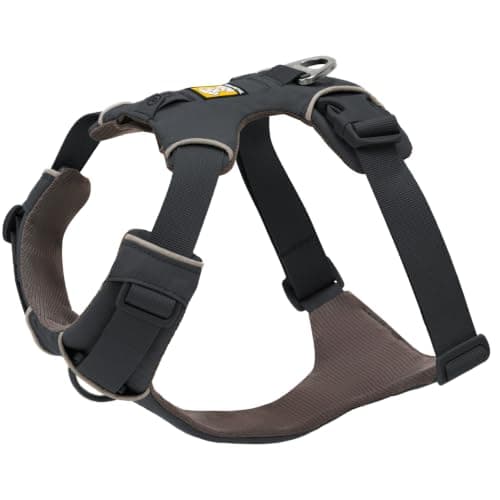
| Ruffwear Web Master Support Harness | Three chest/belly straps | Five points | Not published as steel | Reinforced, rated for lifting |
| Ruffwear Front Range Dog Harness | Two (padded chest + belly) | Four points | Not published as steel | No rigid handle |
| Kurgo Tru-Fit Smart Harness | Two | Five points | Steel nesting buckle at the chest | No |
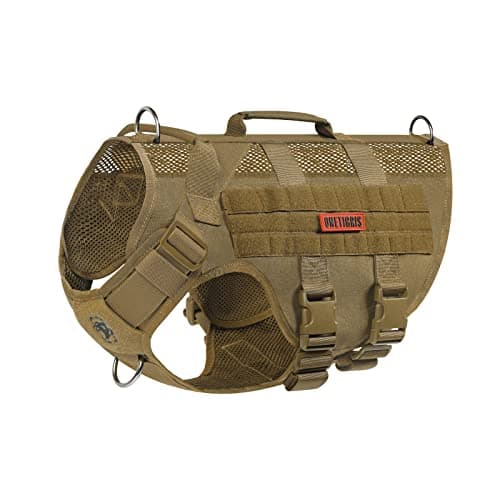
| OneTigris Tactical Dog Harness | Two | Adjustable, count not published | Not published | Top handle |
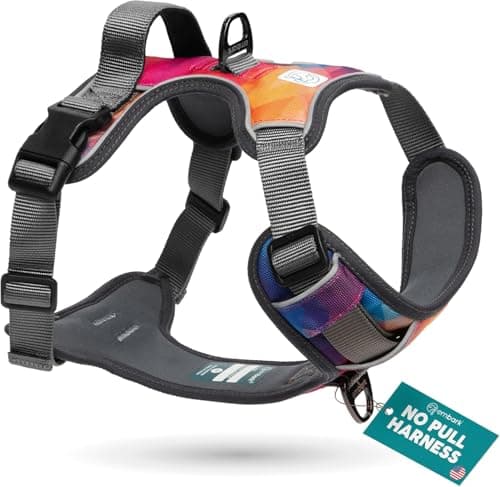
| Embark Adventure No-Pull Dog Harness | Two | Four points | Not published | Handle |
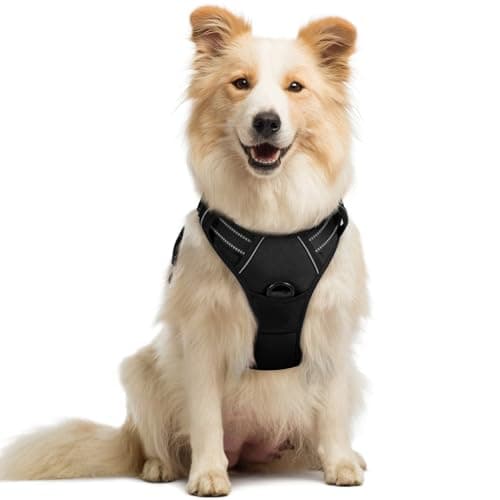
| rabbitgoo No-Pull Dog Harness | Two | Four points | Plastic clips | Top strap, not load-rated |
What we are not recommending, and why
Nothing sold purely on the words "escape proof". The cheap end of this search is unbranded listings whose only evidence is the title. We rank things whose mechanism is published.
A second collar as the backup. People do this and it is better than nothing, but a dog that slips a collar slips both. The backup that actually works is identification the finder can read and a way to see where the dog went: an engraved tag, an AirTag in a collar mount in town, or a cellular GPS tracker if you want live location rather than a last-seen point.
Martingale-style tightening harnesses.Real products, and we are not ranking a harness that works by applying pressure when the dog pulls on a page aimed at anxious dogs in strange places. The site's standing position on correction-based gear is on the tie-out page.