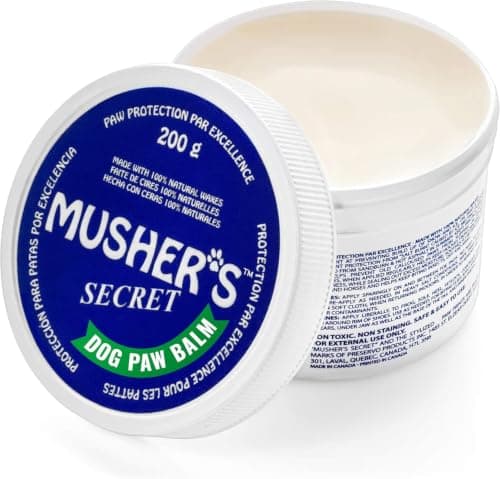
The short answer: the four things that actually end a winter walk are ice balling up between the pads, road salt and de-icer, darkness arriving two hours earlier than you planned for, and a soaked dog sitting in a cooling car. None of them is the cold itself, and all four are solvable for less than the price of a jacket. If you buy one thing, buy a barrier wax like Musher's Secret and put it on in the car park, before the walk - which is the half of paw care almost everybody gets wrong.
This is the cold-weather sibling of two pages we already run: the hot-surface version at protecting paws on hot pavement and the in-vehicle version at keeping a dog cool in the car. Winter has its own in-car page too - keeping a dog warm in the car - because the drive home is where a cold day actually turns unpleasant.
One thing we will not do: tell you a temperature below which your dog should not walk. That number depends on coat, size, age, body condition and acclimatisation, and a gear site that prints a single figure is guessing on your behalf. Watch the dog rather than the thermometer - lifting feet, shivering, slowing down and wanting to turn back are the signals - and take the threshold question to a vet who knows your dog.
1. Ice between the pads is the real enemy
Snow packs into the fur between a dog's toes, compresses into hard pellets, and then the dog is walking on marbles. It is the most common reason a dog starts limping or sitting down a mile from the car, and it has nothing to do with the dog being cold. Two fixes, and they stack:
- Trim the fur between the pads before the season starts. Less fur, less to pack.
- Apply a barrier wax before you set off. A waxed pad gives the snow less to stick to. This is the part people get backwards: a barrier wax goes on before exposure, and a repair balm goes on after damage. They are two different products under one word, and we lay out the split on best dog paw balms.
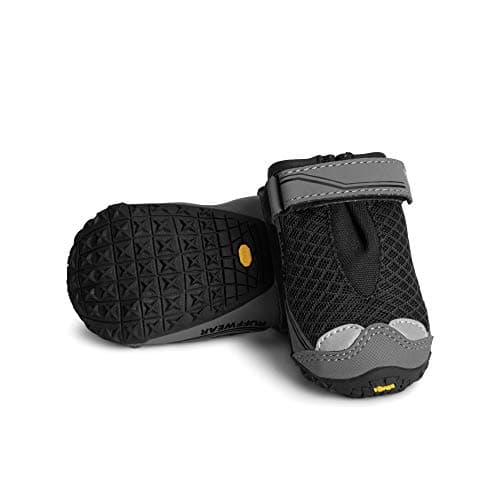
- Boots, if the dog will wear them. They remove the problem entirely rather than reducing it. The catch is that boots stay on or they do not, which is the whole axis our boots roundup ranks on, and sizing is what decides it.
2. Salt and de-icer, which is a car-park problem
The irritant is usually not on the trail - it is on the road, the pavement and the car park at either end. Rock salt and chemical de-icers sting broken skin, and a dog that licks its feet afterwards is ingesting them. Carry water and wipe or rinse the feet before the dog gets back in the car, which is also the moment to notice a cut you would otherwise find at home. A paw cleaner cup or a bottle of water does the job; so does any of the gear on portable dog showers.
3. It gets dark at four o'clock
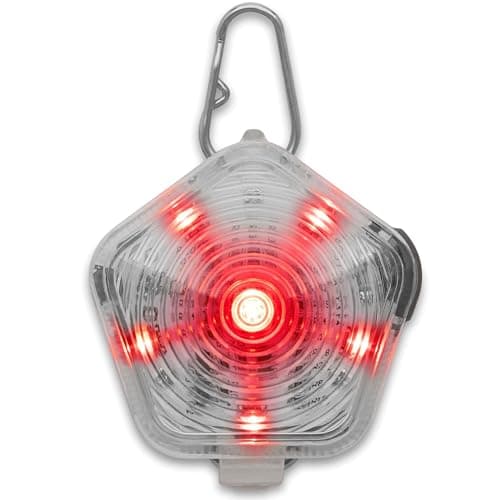
The single most underrated piece of winter dog gear is a light. A dark dog off-lead in dim woods is invisible at thirty metres, and a dog on a verge beside a road in January is invisible to a driver. A clip-on collar light or a lit collar fixes both for very little money, and we rank the field on best dog safety lights. Plan the turnaround on daylight rather than on distance: the walk out always feels faster than the walk back.
4. A wet dog in a cooling car
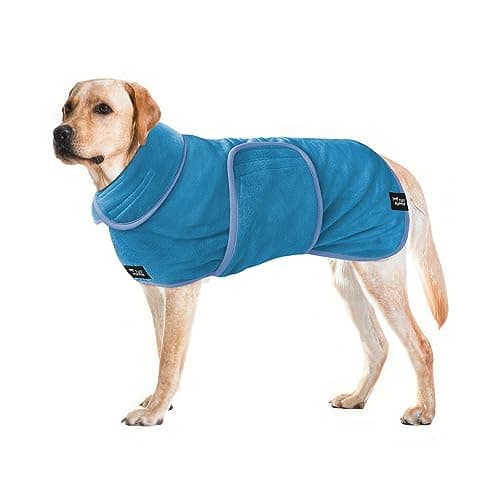
You finish the walk warm because you have been working. The dog finishes it wet. Then it sits still in a vehicle whose heater takes ten minutes to do anything, and that is where a dog actually gets cold on a winter day. Dry the dog before it gets in - a drying coat or a high-absorbency towel takes a minute and removes the whole problem - and put something insulating between the dog and a cold seat or a metal cargo floor. Our drying towels page ranks the field, and travel beds covers the insulating layer.
What changes about the dog, not the gear
Three practical things worth knowing before a cold-weather day out:
- Dogs still need water in winter. They drink less from cold bowls and lose moisture through panting on a climb regardless of temperature. Carry it - a bottle beats hoping for a stream that turns out to be frozen.
- Snow is not water. Dogs eat it and it is a poor substitute, and on a heavily treated surface it is a worse one.
- Frozen ground is hard ground. Older dogs and short-legged dogs feel a frozen rutted track in their joints the way you feel it in your ankles. Shorter, more often beats one long day.
And the obvious one that is worth stating plainly: ice on water is not a surface. A dog that goes through ice on a pond is an emergency that people make worse by following it, and no piece of gear on this page changes that. Keep a lead on near frozen water.
What to carry, in one list
| Problem | What you carry | When you use it |
|---|
| Snow balling between the pads | Barrier paw wax; boots if the dog accepts them | Before the walk, in the car park |
| Salt and de-icer | Water and a cloth, or a paw cleaner | Before the dog gets back in the car |
| Darkness | Collar light or lit collar | From an hour before sunset, not after it |
| Wet dog, cold car | Drying coat or high-absorbency towel; an insulating pad | At the tailgate, every time |
| Cuts and cracked pads | Repair balm; a first-aid kit | After the walk, at home |