A crate is somewhere a dog stays. A carrier is something you carry a dog in. Almost every bad purchase in this category comes from treating those as the same product, and the symptom is predictable: a soft-sided carrier bought for a 40 lb dog because it said "large", or a rigid crate bought for a flight the dog was going to take in the cabin.
The distinction that matters
| Crate | Carrier |
|---|
| Primary job | Containment for hours or overnight | Transport for minutes to hours |
| Typical dog size | Any size | Small - roughly under 20-25 lb |
| Carried by hand? | No, with a dog in it | Yes, that is the point |
| In-cabin flight | No | Yes, if it fits under the seat |
| Hold or cargo flight | Yes, if it meets the specification | No |
| Hotel room | Yes - this is where it shines | Only as a bed for a very small dog |
| Car | Yes, secured | Yes, belted, for small dogs |
The overlap is small dogs, where a decent carrier genuinely can serve as a crate for a night. Above about 25 lb the categories stop overlapping entirely, because nothing you can lift by a shoulder strap is big enough to be a dog's bedroom.
Match it to the trip, not to the dog
Driving, any dog size
A crate, secured - or a harness. That is a genuine decision with real arguments on both sides, and we made it properly in crate versus harness in the car. A carrier belted into a seat is a workable third option for a small dog on a short journey.
Flying in the cabin
A carrier, and only a carrier. It has to be soft-sided enough to flex under the seat and within your airline's published dimensions - see the under-seat table. No crate, however small, is designed for this.
Flying in the hold
A hard kennel that meets the airline's specification, which is a crate and never a carrier. Rigid shell, metal hardware, ventilation on the required faces, and sized so the dog can stand, turn and lie naturally. The details are in the cargo requirements.
Hotels, campsites and staying somewhere
A crate, or a pen. This is the job a carrier cannot do at all beyond the smallest dogs - a dog needs to be able to stand, turn and stretch out for a night, not just occupy a bag.
The short answer
Quick picks
| # | Product | Best for | Score | Price |
|---|
| 01 | | The premium collapsible crate | | $509.99·Amazon |
| 02 | | Most in-cabin flyers | | $46.04·Amazon |
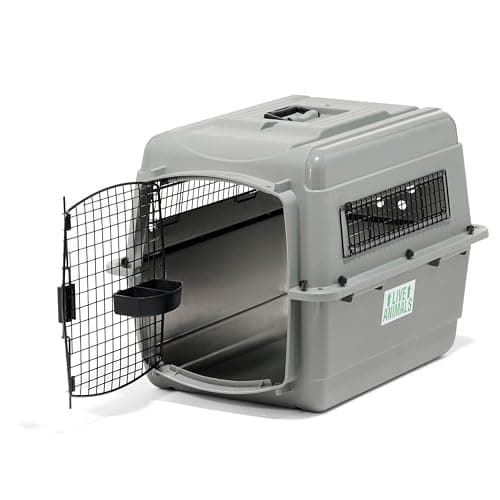
| 03 | Petmate Sky KennelHard plastic with metal hardware, built for an aircraft hold — which makes it quietly excellent against chewers too. | Cargo travel, and chewers that need to fly | | $107.95·Amazon |
#ad · Live prices from the Amazon Product API, as of October 21, 2026. Where we have no verified live price we show none — we would rather leave a gap than print a number that has rotted.
In detail
The picks, in full
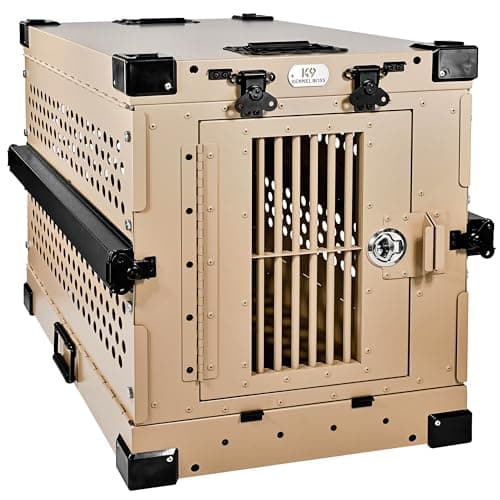
The premium collapsible crate
K9 Kennel Boss Aluminum Collapsible Dog Crate
Folds flat, no toolsPowder-coated aluminum30.6 x 22.8 x 25.7 in (Small)34 lb listed
A metal crate that folds to a suitcase in under a minute. Expensive, and the one to buy when the crate has to travel and still not be fabric.
- Portability
- 8
- Durability
- 9
- Setup ease
- 9
- Chew resistance
- 5
- Value
- 5
Pros
- +Goes from set up to suitcase configuration in under a minute with no tools — the thing you are actually paying aluminum prices for
- +Built-in heavy-duty handles, and molded corners that let like sizes stack, so it loads into a vehicle instead of fighting it
- +Sixteen knurled bolts are supplied to stiffen the corners when it is going to stay assembled for a while
Cons
- −By far the most expensive crate here
- −K9 Kennel Boss states plainly that collapsible crates suit dogs that are settled in a crate, not anxious or destructive ones
Don't buy this if…
…your dog panics or chews in a crate. The maker's own listing rules a collapsible out for destructive dogs — for those, a tube-steel crate or a rigid kennel is the honest answer, not a folding one.
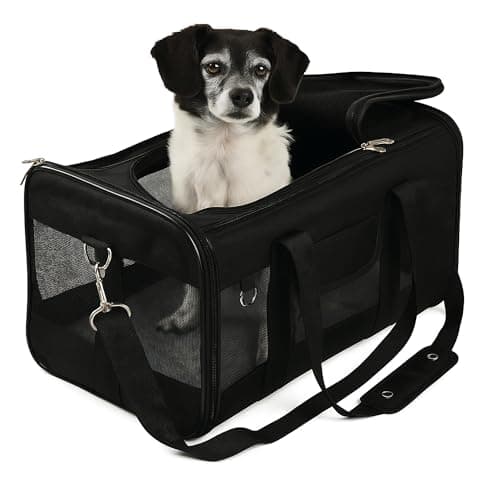
Most in-cabin flyers
Sherpa Original Deluxe Travel Pet Carrier
Soft-sidedSpring wire frameGuaranteed On Board programS / M / L
The default in-cabin carrier, and the only one with a program that gets you rebooked if a specific airline turns it away.
- Fits under seat
- 9
- Ventilation
- 9
- Build quality
- 8
- Dog comfort
- 8
- Value
- 8
Pros
- +The Guaranteed On Board program reimburses your ticket if an airline on its approved list denies boarding — no other carrier here offers that backstop, though Sherpa limits it to flights within and between the US and Canada
- +The spring-wire top frame pushes down, so it squashes into a tight under-seat gap that a rigid carrier won't
- +Mesh on three panels, which is the ventilation an anxious dog needs on a hot jet bridge
Cons
- −Sizing runs small for the weight it lists — a dog at the top of a size's range is a squeeze
- −The base is soft; larger dogs get a floppier floor than a structured carrier gives
Don't buy this if…
…your dog is at the very top of a size band. Sherpa's dimensions are honest but tight, and the carrier that fits the dog but not the seat is the classic gate-agent problem. Measure and size up.
Cargo travel, and chewers that need to fly
Petmate Sky Kennel
Hard plastic shellMetal door and fastenersVentilation on four sides28 in size listed for 15-30 lb pets
Hard plastic with metal hardware, built for an aircraft hold — which makes it quietly excellent against chewers too.
- Escape resistance
- 8
- Build strength
- 9
- Portability
- 4
- Ventilation
- 7
- Value
- 8
Pros
- +Built to airline hold requirements, which means metal hardware and a shell that does not flex open
- +Solid plastic gives a chewer nothing to grip in the way wire bars do
- +Four-sided ventilation is a published airline requirement and a genuine welfare feature in a hot hold
Cons
- −Does not fold at all — it splits into two halves and still takes serious storage space
- −Solid sides mean less airflow than a wire crate on a hot day outside a plane
Don't buy this if…
…the crate is for a hotel room and nothing else. A soft crate folds to a slab and this does not.
The case for owning both
For a small dog that flies, both is usually the right answer, and it is less wasteful than it sounds. The carrier does the airports and the short journeys. The crate does the hotel rooms, the house and the car. Each is cheap relative to the trips it makes possible, and neither does the other's job well.
For a medium or large dog, the carrier question mostly disappears. You need a crate for the car and the room, plus a hard kennel if you ever fly the dog in the hold - and the honest advice there is not to buy the kennel until you have a booked flight, because the specification is fussy and the crate is bulky.
Where people go wrong
- Buying a carrier by weight rating.A carrier rated to 25 lb tells you what the fabric holds. What matters is whether the dog can stand and turn inside it, and whether it clears the airline's limit. Measure the dog, then the carrier's interior.
- Assuming a soft crate can fly. Soft crates are for hotel rooms and car boots. They are not accepted in the hold, and they are not carriers.
- Buying the hold kennel early. Airline requirements differ in detail and change; buy against the specification for the flight you have booked.
- Using a carrier as a permanent bed.Fine for a chihuahua that chooses it. Not fine as a dog's only resting place - the dimensions that make it carryable are the dimensions that make it a poor bedroom.
What we would actually buy
Small dog, flies occasionally, road trips: a soft in-cabin carrier that clears the strictest airline you fly, plus a collapsible crate for hotels and the car.
Medium dog, drives everywhere: one collapsible crate that fits the car boot, secured properly, doubling as the hotel-room crate. Nothing else needed.
Large dog, occasional hold travel: a soft or collapsible crate for daily use, and a compliant hard kennel bought against the specification when a flight is booked.
If you are still deciding which crate type suits the way you travel, how to pick a travel crate works through it, and the size chart covers the measuring.
How we picked
We do not test the gear
We compiled the manufacturers' published dimensions and specs, cross-checked them against airline under-seat limits and published safety certifications, read the owner reviews, and scored each product against a published rubric. The scores are judgments from that research — they are not measurements we took, because we do not own a lab and we are not going to pretend we do. Where we could not verify a fit or a claim, we say so on the page.
Questions
Frequently asked
What is the difference between a dog crate and a dog carrier?+
A crate is somewhere a dog stays - containment for hours or overnight, in any size. A carrier is something you carry a dog in, which limits it to small dogs and short periods. They overlap only for small dogs, where a good carrier can double as a bed for a night. Above about 25 lb they are entirely different products.
Can I use a dog crate as an airline carrier?+
For the cabin, no - in-cabin travel requires a soft-sided carrier that fits under the seat, and no crate is designed for that. For the hold it is the reverse: you need a rigid kennel that meets the airline's specification, and a soft crate or carrier is not accepted.
Do I need both a crate and a carrier?+
For a small dog that flies, usually yes: the carrier handles airports and short trips, the crate handles hotel rooms, the house and the car. For a medium or large dog the carrier question disappears - you need a crate, plus a compliant hard kennel only if you actually book a hold flight.
Is a soft crate the same as a soft carrier?+
No. A soft crate is a collapsible fabric enclosure meant to sit on the ground and contain a resting dog; a soft carrier is a bag with a shoulder strap meant to be lifted with the dog inside. Soft crates are for hotel rooms and car boots and are not accepted for air travel of any kind.
Can a large dog travel in a carrier?+
Not in any meaningful sense. Carriers are sized to be lifted by hand, which caps them at roughly 20-25 lb of dog, and airline under-seat limits cap them further. A large dog travels in a secured crate in a car, or in a compliant hard kennel in the hold.
Receipts
Sources
We do not run a testing lab, and we do not pretend to. Product dimensions and safety claims come from the manufacturer's own listing; airline limits come from the airline's published policy, with the date we checked it. Where we could not verify something, we say so on the page rather than quietly leaving it out. Read our full method.