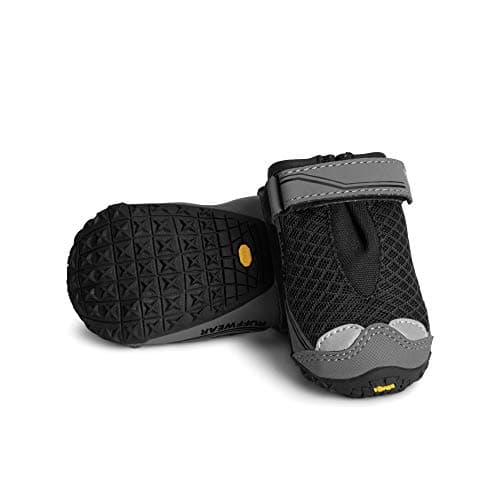
Dog boots have a reputation for being pointless, which comes almost entirely from people buying the wrong ones and giving up. Boots that fall off after 200 meters are pointless. Boots that fit and stay on solve genuine problems: pavement hot enough to burn pads, road salt, ice balls between toes, sharp scree, and healing paws that need covering.
There are two distinct products in this category masquerading as one. A trail boot has a real lugged rubber outsole and grips wet rock; a bootie has a soft anti-slip sole and protects against heat, salt and abrasion on flat ground. They cost very different amounts and they are not substitutes.
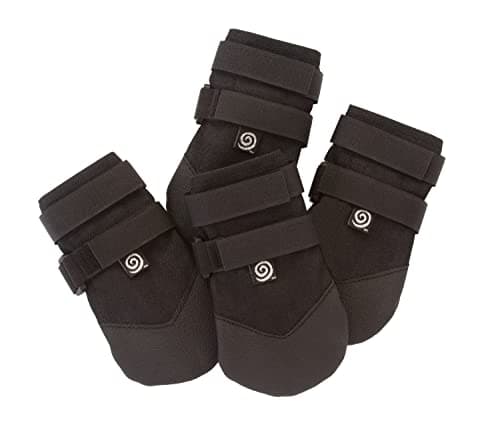
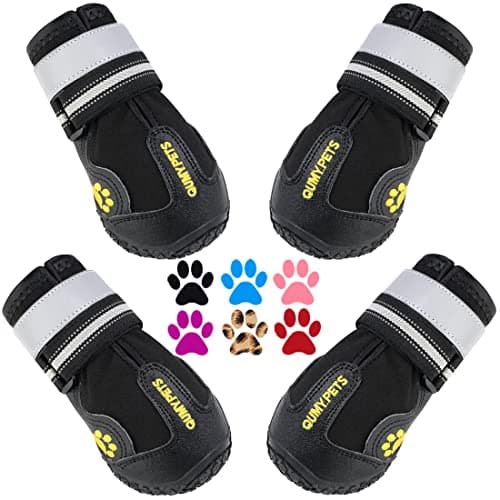
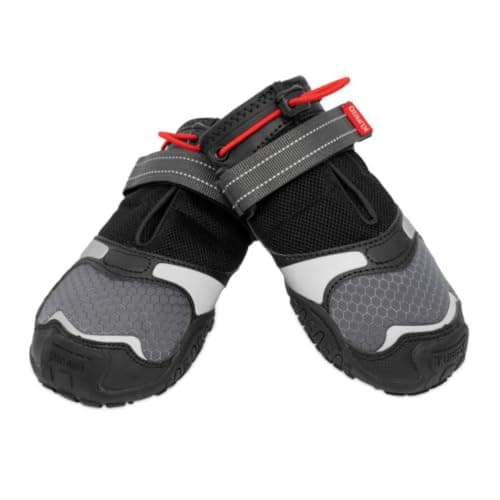
The Ruffwear is the trail boot everything else is measured against. The Ultra Paws is the answer if your specific problem is boots coming off. The QUMY is the sensible four-pack for pavement and sidewalks.
Boots are one answer to winter and not the only one. For the whole cold-weather picture - ice balling between the pads, road salt off a car park, four o'clock darkness and a wet dog in a cooling car - see winter hiking with a dog.
Choosing dog boots
Measure paw width, on a loaded paw
Every boot maker sizes by paw width, and the measurement has to be taken with the dog's weight on the paw — a paw spreads under load, and a boot sized to an unloaded paw will be tight in exactly the moment it matters. Stand the dog on a sheet of paper, mark either side of the widest point, and measure between the marks. Our boot sizing guide walks through it properly.
Two straps beat one, every time
The most common complaint about dog boots is that they come off, and the fix is almost always the closure. A single strap around the ankle pivots and works loose; two straps (Ultra Paws) hold the boot at two points and stop the rotation. If you have already lost a boot on a walk, buy the double-strap design rather than a different brand of single strap.
Sole type is the pavement-versus-rock decision
For hot pavement and salted sidewalks you need thickness and insulation — a thick sole is what stops heat and salt reaching the pad. For wet rock and scree you need tread, and only a genuine lugged rubber outsole (Ruffwear) provides it. A soft-soled bootie on wet granite is worse than a bare paw, because a dog's pads have grip and smooth rubber does not.
Buy in fours, or know why you are not
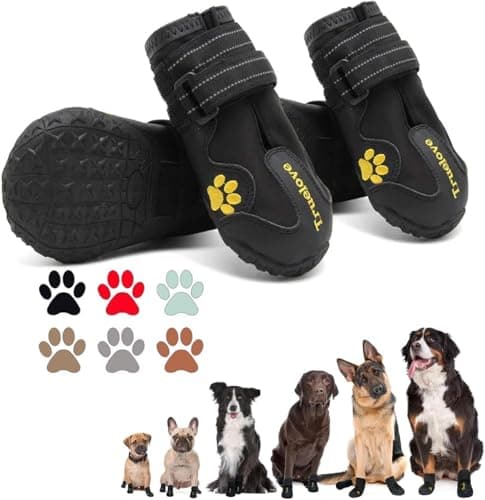
Trail boots are typically sold in pairs, which means a full set is two purchases and roughly double the shelf price. Budget boots (QUMY, Expawlorer) come as sets of four. Two-packs (Kurgo) make sense as replacements — front boots almost always wear out first — but not as a first purchase.
Introduce them properly or the dog will refuse
Put one boot on, reward, take it off. Then two. Build up over several short sessions indoors before the dog ever wears four outside. Dogs walk strangely in boots at first — high-stepping is normal and passes. A dog that has four boots strapped on and is marched out of the door will decide it hates boots, and that decision is hard to reverse.
There is an indoor use most people miss
Older dogs losing grip on hardwood or tile is a common and genuinely distressing problem, and soft anti-slip booties (Expawlorer) fix it cheaply. That is a different job from trail protection, and the cheapest boots here are the right tool for it.
What we would actually buy
Trail hiking on rock: the Ruffwear. Dogs that kick boots off: the Ultra Paws. Hot pavement and winter salt: the QUMY. Replacing the front pair: the Kurgo. Slipping on floors indoors: the Expawlorer.