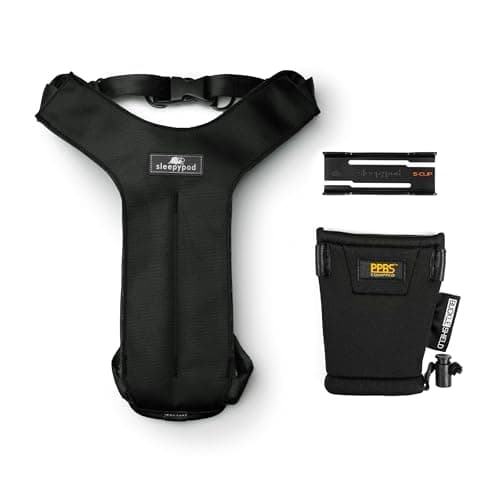
Almost everything sold as a dog car harness has never been crash-tested by anyone. Manufacturers can print "safety harness" on a box without testing anything, and most do. That is the background against which the Clickit Sport should be judged, because it is one of a short list with genuine independent evidence.
The Center for Pet Safety runs the main independent certification program in this space, and Sleepypod's Clickit line carries that certification. That is not a marketing claim we are repeating — it is a published third-party program with a stated protocol, and it is the reason this harness leads our crash-tested harness roundup.
What follows is what that certification does and does not cover, how the design works, and the fitting mistakes that quietly cancel the benefit you paid for.
What it gets right
The three-point design does the actual work
Rather than a single strap running to a seatbelt, the Clickit uses the vehicle's own belt through the harness structure so load is spread across the dog's chest and shoulders and into the car's restraint system. The broad padded chest plate is the part that matters: it distributes force across a wide area of the strongest part of the dog rather than concentrating it on a narrow strap.
Certification you can go and read
The value here is not that Sleepypod says it is safe. It is that an independent organization published a protocol, tested to it, and listed the results. You can check the certified list yourself, which is something you cannot do for the overwhelming majority of this category.
Build quality that matches the claim
Webbing, stitching and hardware are visibly heavy-duty. That matters beyond crash performance: a harness that frays at the load points is one whose tested configuration no longer exists. This one wears slowly.
It works as a walking harness at the other end
Practically important, because a restraint you have to swap out at every stop is a restraint that gets skipped. The dog can step out of the car and straight onto a leash, which is exactly the behavior you want on a long road trip with frequent stops.
Where it falls short
Expensive, and the price is the main barrier
This costs many times what an untested nylon harness costs, and the honest framing is that you are buying evidence rather than features. That is a real thing to buy — but it is also why plenty of people reasonably choose a cheaper certified option or a well-secured crate instead.
Fit is fussy, and a loose fit undoes the testing
Certification applies to the system as tested, which assumes a correctly fitted harness. A loose chest plate, a twisted strap, or the wrong size all move you outside that. It takes real care the first time and a check every few weeks after. If you are not going to fit it properly, the certification is decorative.
Sizing runs specific
Sizes are keyed to chest measurements and the bands are narrower than in walking harnesses. Measure rather than estimating from weight, and expect to exchange once if your dog is between sizes. A harness bought a size large so it is "comfortable" is a harness that no longer performs as tested.
It does not solve a large dog in a small car
There is a ceiling. Above the top of the size range, a properly anchored crate in a cargo bay is the more credible structure — our crate versus harness comparison covers where that line falls.
Fitting it so the certification means something
Measure the chest at its widest and buy to the chart, not to the weight. Fit the chest plate centered and snug — two fingers under a strap, no more. Untwist every strap; a twisted strap concentrates load on an edge. Route the vehicle seatbelt exactly the way the instructions show, not the way that seems easier. Keep the connection short. Then re-check the fit monthly, because straps creep.
Who should buy it
Buy it if your dog rides regularly, if you drive at highway speeds with it, and if you want the option in this market with published third-party evidence. That is a narrow and honest pitch, and it is a good one.
Do not buy it if you will not fit it carefully — buy a cheaper harness and a good tether and accept what that is. Do not buy it for a dog above the size range; anchor a crate instead. And if the dog rides twice a year around the block, the case for the spend is genuinely weaker.