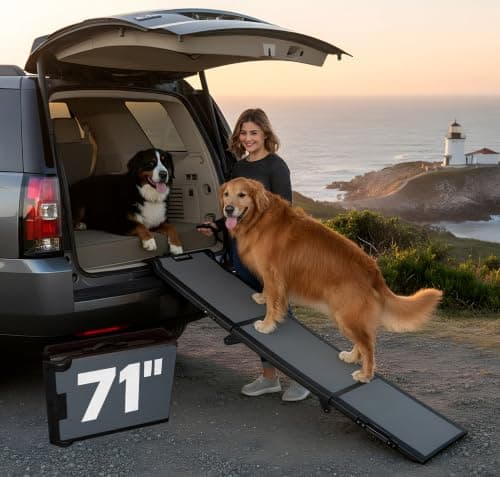
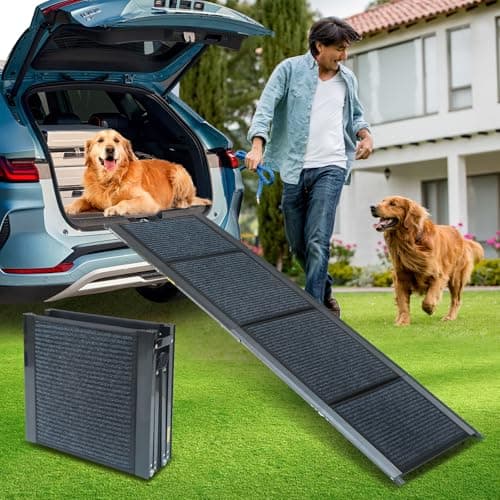
A dog jumping down from an SUV tailgate lands with most of its weight going through the front legs and shoulders. Once or twice is nothing. Twice a day for ten years is a wear pattern, and it is one of the reasons long-backed and large breeds develop joint problems earlier than they need to.
A ramp fixes that, and it is also the difference between a senior dog still coming on trips and being left behind. This is one of the few purchases on this site with a genuine welfare argument rather than a convenience one.
The specification that matters is length, because length sets the angle, and angle is what decides whether a dog will actually use the thing. Everything else — folding style, surface, weight — is secondary. The PetSafe takes the top spot on exactly that basis.
And if your dog flatly refuses a ramp - some do, because a ramp flexes and sounds hollow underfoot - steps are the alternative worth testing before you give up. We put the two mechanisms against each other, with the three step sets whose makers publish a height and a weight limit, in dog car steps vs a ramp.
How to choose a dog car ramp
Measure your tailgate height first, then buy long
A shallow angle is a ramp a dog walks up without thinking. A steep angle is a ramp a dog refuses. As a working rule, the taller your vehicle, the longer the ramp needs to be — a length that is generous on a hatchback is marginal on a pickup. If you are between two lengths and the dog has mobility problems, take the longer one; you can always deploy it at a shallower angle.
Telescoping versus tri-fold
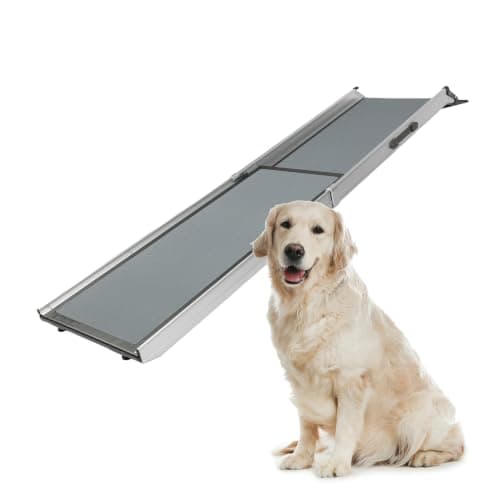
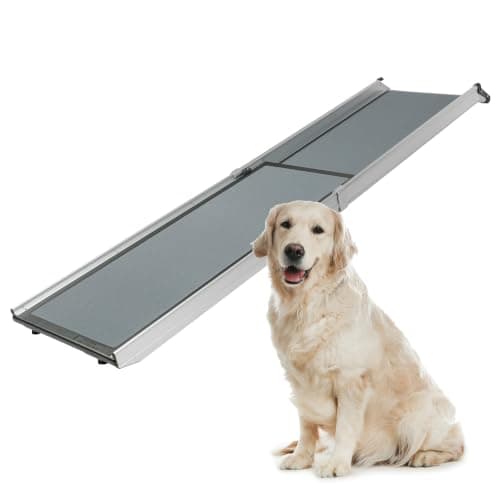
Telescoping ramps (PetSafe, Solvit) slide into themselves — rigid underfoot, and they collapse to roughly half their extended length. Tri-fold ramps (Pet Gear) fold into thirds, which packs a much longer ramp into a much smaller space at the cost of more hinges and a little more flex. If trunk space is your binding constraint, fold. If your dog is nervous about movement underfoot, telescope.
Surface grip is not a detail
A dog that slips once on a ramp may never willingly use it again, and that is an expensive mistake to make. Look for a high-traction textured surface rather than smooth plastic, and check it works wet — most refusals happen in rain. Side rails (Solvit) give a wobbly or partially-sighted dog an edge to feel, which is a genuine help for a senior.
Weight capacity, and your own back
Check the capacity covers the dog plus you steadying it — you will end up with a hand on the dog more often than you expect. Then consider the ramp's own weight, because you lift it in and out every single time. A ramp too heavy to deploy easily is a ramp that stays in the garage, which is worth nothing.
Introduce it flat, on the ground, with food
Do not introduce a ramp by leaning it against a tailgate. Lay it flat on the floor, walk the dog over it for treats, then raise it a few inches at a time over several sessions. Most ramp failures are training failures, not product failures. Take a week over it and you will have a dog that uses a ramp for life.
A ramp is not a step
Steps are a different product and suit different dogs — small dogs getting onto a back seat, mostly. For a large or arthritic dog, a ramp's continuous surface is much easier than asking for a series of controlled hops. Buy for the actual movement problem.
What we would actually buy
Tall vehicle or a dog with real mobility problems: the PetSafe. Long ramp, small trunk: the Pet Gear. Finding out whether your dog will use a ramp at all: the PawStep. A senior that needs an edge to feel: the Solvit with its side rails.