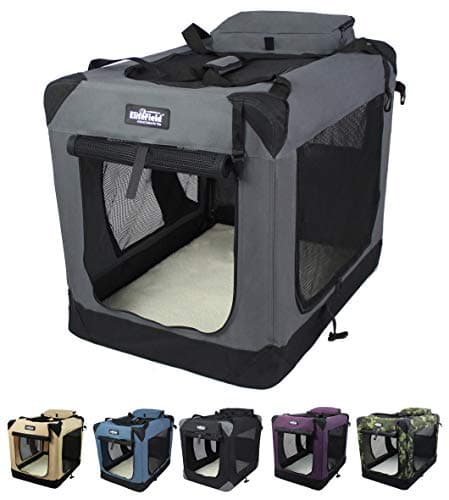
Soft crates are a category where the difference between a good one and a bad one is entirely in the parts you cannot see in a photograph: the zip pulls, the frame joints, and whether the mesh is stitched into a seam or glued to one. The EliteField is the crate we keep coming back to because it gets those right and then puts a two-year warranty behind them.
It is the top pick in our portable crate roundup, and this review is the longer version of why — including the limitation that means a meaningful minority of dogs should not have one at all.
What it gets right
Three doors is not a gimmick
Front, side and top openings sound like a spec-sheet flourish until you are setting up in a hotel room where the crate has to go against a wall and beside a bed. Then the door you can actually reach is the only one that matters. The top door in particular is the one people end up using most: it lets you drop a bed in, retrieve a toy, or reassure a dog without opening a full side.
The fold is genuinely one motion
The frame collapses flat without disassembly, which is what separates a travel crate from a crate you happen to be traveling with. If setting the thing up is a five-minute job with poles, it stays in the garage. This is a one-minute job, and that is the difference between owning a travel crate and using one.
A published two-year warranty
Soft crates live or die on their zips, and almost nobody in this category will stand behind them. A stated two-year warranty is not a guarantee of quality, but it is a commitment with a cost attached, and in a market full of anonymous listings that counts for something.
It comes with the bits
A fleece bed and a carrying bag are included, which sounds minor and is not — the carry bag is what keeps the crate clean between trips, and a crate that arrives grubby out of the trunk is one the dog is less willing to enter.
Where it falls short
It is not for a chewer, and this is the big one
A soft crate is fabric and mesh over a light frame. A dog that chews when anxious, or that has ever worked its way out of a soft crate before, will get out of this one — and the escape attempt is more likely to injure the dog than the crate. If your dog has any history of crate-chewing or separation anxiety, buy a rigid crate and do not treat this as a debate. Our soft versus hard crate comparison covers exactly where the line falls.
It is not a car restraint
A soft crate cannot be anchored meaningfully and provides no structure under crash load. Using one in a vehicle gives you containment, not protection. If crash safety in the car is the objective, that is a different decision and the answer for most dogs is a certified harness.
It is not an airline cargo kennel
Soft crates are not accepted for cargo travel, which requires a rigid kennel meeting the airline's published construction requirements. If your dog is flying in the hold, this crate is for the hotel room at the other end, not for the flight.
Fabric holds smell
After an accident, a soft crate needs a proper wash and a full dry, and it is never quite as clean as hosing down a plastic kennel. Buy a washable waterproof pad to go inside it and the problem mostly disappears.
Who should buy it
Buy itif your dog is crate-trained, settles without chewing, and you want containment that sets up in a minute in a hotel room, a rental, a campsite or a friend's spare bedroom.
Do not buy it if your dog chews when anxious, if it is going in an aircraft hold, or if you are looking for a crash-protective restraint for the car. Those are three different products, and no soft crate is any of them.