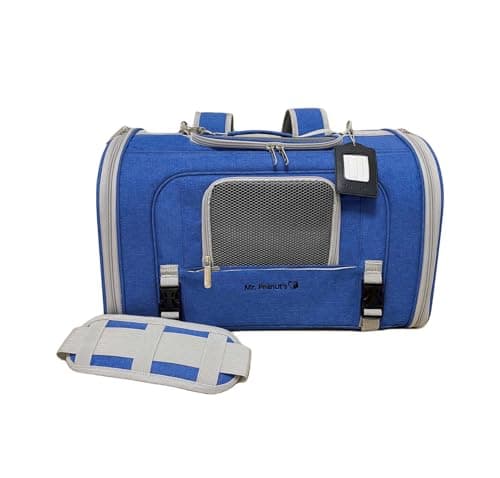
Anyone who has carried a soft carrier on one shoulder from a remote gate to baggage claim understands why backpacks exist. Two free hands, the weight on both shoulders, and the dog high and close to your back instead of swinging into your hip.
The problem is that most dog backpacks were designed as hiking packs and then described as travel gear. A hiking pack is tall, deep and rigid — three properties that make it fail an under-seat check. If the bag must go under an aircraft seat, that is the constraint everything else answers to.
So this list ranks on under-seat fit first and carry comfort second, and it says plainly where a pick is a good backpack that is a doubtful carrier. The Mr. Peanut's Monterey takes the top spot for being an airline-compliant carrier that happens to wear as a backpack, rather than a hiking pack relabelled as travel gear. If the flight is not the point, our hiking backpack carrier roundup ranks the same category on trail criteria instead.
If you have not yet decided that a backpack is the right shape at all, the straight comparison with a conventional shoulder carrier is on carrier vs backpack for flying.
How to choose a carrier backpack for flying
Height is the number that fails
Backpacks are tall by design and airlines are strictest about height — around 11 inches on United, Delta and American, closer to 8.5 on Southwest and JetBlue. Measure the pack's total height including any rigid base or dome, and compare it against the under-seat limits for your airline before anything else. A soft-sided pack can lose an inch under the seat; a rigid one cannot.
Waist support decides whether you can carry it
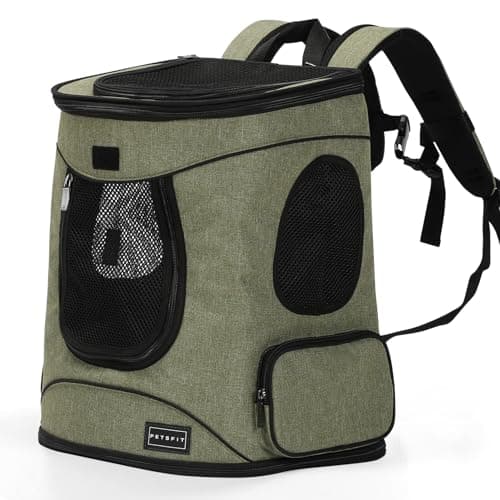
A 15 lb dog on your shoulders is fine for five minutes and grim for forty. A padded waist belt (Petsfit) transfers that load to your hips, and it is the single biggest comfort difference in the category. If your dog is at the heavier end of carry-on, treat a waist belt as a requirement rather than a feature.
Ventilation, and the bubble problem
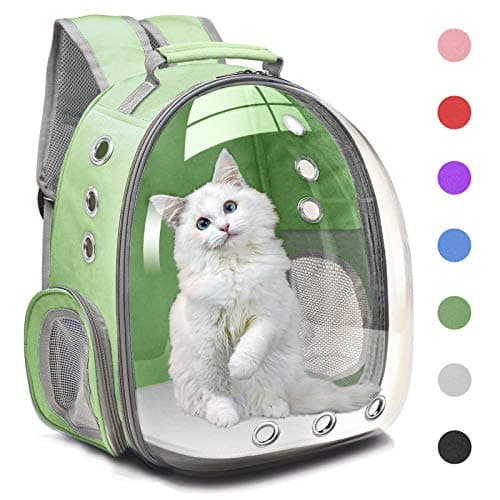
An enclosed pack against your back is a warm place, and your body is one of its walls. Multiple mesh faces are not optional. Be especially careful with clear-dome packs like the Henkelion: the window that helps a nervous dog settle also behaves like a greenhouse in direct sun. They are a good answer to anxiety and a bad answer to heat.
Convertibles earn their keep on a travel day
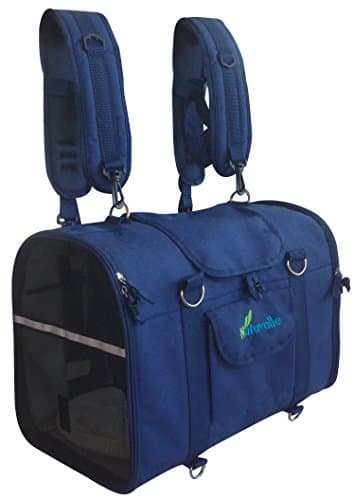
A travel day is rarely one mode of transport. A pack whose padded straps convert to a shoulder carry (Mr. Peanut's) or that doubles as a car seat (Natuvalle) means one purchase covers the terminal, the taxi and the rental car. The cost is weight and complexity, so only pay it if your trips genuinely have those legs.
Check the published weight ceiling
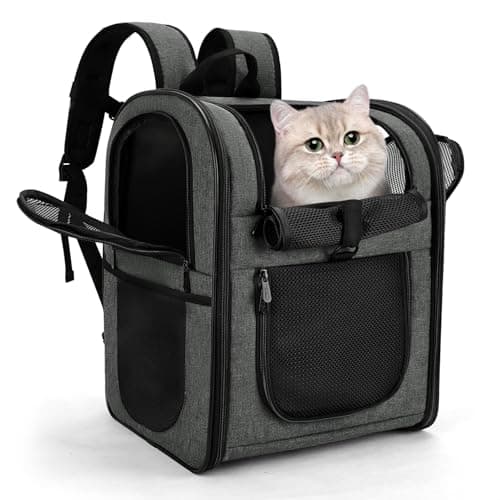
Where a maker publishes a limit — 18 lb on the Petsfit and the Apollo Walker— treat it as real; it reflects the stitching and strap anchors. Where none is published, be conservative. And remember the airline has its own combined pet-plus-carrier limit that has nothing to do with the bag's rating.
What we would actually buy
Flying is the priority: the Mr. Peanut's. Heavier dog or a long terminal: the Petsfit for the waist belt. First backpack on a budget: the Apollo Walker. One bag for every leg of a complicated trip: the Natuvalle. A dog that will not settle unless it can see out: the Henkelion, and keep it out of the sun.