If your dog has a short muzzle - a pug, a French or English bulldog, a boxer, a Boston terrier, a shih tzu, a Pekingese, or a mix of any of them - the rules for flying are different, and the difference is not administrative. Brachycephalic dogs have a disproportionate share of the injuries and deaths that occur in air transport, and the industry has responded by closing the hold to them.
The IATA Live Animals Regulations do not permit brachycephalic dogs and cats in the cargo hold, and the major US airlines apply that in their own policies: Delta does not accept snub-nosed breeds or their mixes, and American excludes brachycephalic dogs of any mix as checked pets. Where hold travel is offered at all elsewhere, seasonal temperature embargoes and aircraft restrictions narrow it further.
Why the airway is the whole story
A dog cools itself by panting - moving air over wet tissue in a long nasal passage. A brachycephalic dog has the same soft tissue packed into a much shorter skull, so the airway is partly obstructed before anything stressful happens. Add heat, add the physical stress of a hold, add a dog that is frightened and breathing hard, and the margin that a long-nosed dog has simply is not there.
The AVMA's guidance on short-nosed dogs and air travel makes the same point and adds the one people get wrong: airline embargoes are mostly about the hold. They do not generally apply to a dog small enough to travel in the cabin, which is why so many snub-nosed dogs fly perfectly happily under a seat.
What that leaves you
- The cabin, if the dog fits.Under roughly 20-25 lb depending on the airline's rule, in a carrier that fits under the seat with the dog able to stand and turn. This is the good option and it is available to most pugs, Bostons and small Frenchies.
- Driving. For a big bulldog or a boxer, this is usually the answer, and it is a better trip than a marginal flight. Heat management in the car matters more for these breeds than for any other - see keeping a dog cool in the car.
- A specialist pet transport company, for international moves where driving is not possible. Ask directly how they handle brachycephalic breeds, what temperature limits they work to, and whether the routing avoids long tarmac waits.
What is not on the list is arguing the point at check-in. Breed restrictions are applied at the counter, and a mix that looks brachycephalic is treated as brachycephalic. If your dog is a mix and you are relying on hold travel, get written confirmation from the airline before you buy anything.
Worth separating two worries that often arrive together. The airway risk in this page is documented and breed-specific; the ear-pressure worry people raise alongside it is much less well evidenced, and we set out what is actually verifiable - starting with the FAA rule that caps cabin pressure altitude at 8,000 feet - in do dogs' ears pop on planes.
The short answer
Quick picks
#ad · Live prices from the Amazon Product API, as of October 21, 2026. Where we have no verified live price we show none — we would rather leave a gap than print a number that has rotted.
In detail
The picks, in full
Frequent flyers who fly different aircraft
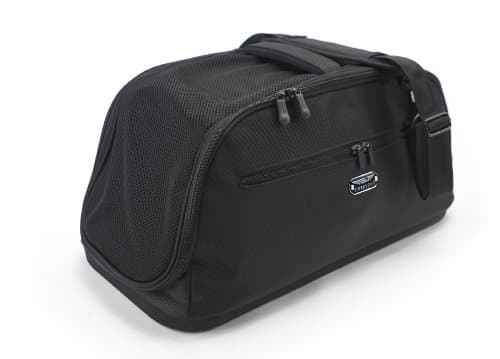
Sleepypod Air In-Cabin Pet Carrier
Compresses at both endsIn-cabin designLuggage strapPremium price
The premium in-cabin carrier: it squeezes at the ends to meet a smaller seat instead of forcing you to buy a smaller bag.
- Fits under seat
- 9
- Ventilation
- 8
- Build quality
- 10
- Dog comfort
- 8
- Value
- 6
Pros
- +The ends compress, so one carrier adapts to different under-seat depths instead of fitting one airline and failing the next
- +Materials and hardware are a clear step above the budget field, and the shell holds shape rather than sagging onto the dog
- +Sleepypod is a safety-first brand with a published testing program on its car restraints, which is rare in a category full of unverified claims
Cons
- −Costs several times what a budget expandable does for the same basic job
- −No expansion panels at all — on a long layover the dog gets the flight footprint and nothing more
Don't buy this if…
…you fly once a year on the same airline. Buy the carrier that fits that one seat and keep the difference; the Air earns out on variety, not on a single route.
Long layovers on a budget
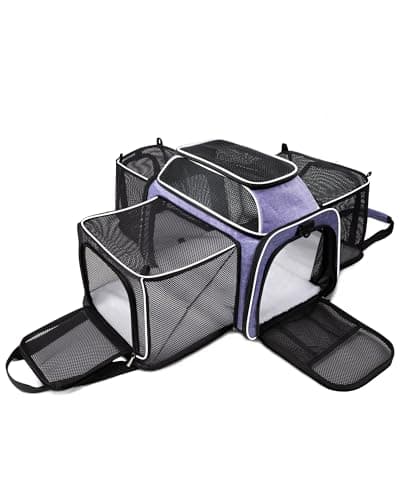
BATOTOR 4-Sides Expandable Pet Carrier
Four-side expansionFive opening doorsSoft-sided and foldableFleece pad included
The most expansion per dollar in the category — all four sides unzip, not just one or two.
- Fits under seat
- 8
- Ventilation
- 8
- Build quality
- 6
- Dog comfort
- 9
- Value
- 9
Pros
- +Four expanding panels means a dog can turn around and stretch out at the gate, which two-side carriers only half-manage
- +Five opening doors let you load the dog whichever way the seat, the aisle or the security bin forces you to
- +Comes in under the Petsfit, MASKEYON and Pecute expandables while offering more expansion panels than any of them
Cons
- −Four zippered panels are four more seams to fail — that is the trade you make for the expansion
- −Listed for cats and small dogs, and the listing publishes no weight limit — measure your dog against it rather than assuming
Don't buy this if…
…your dog is anywhere near the top of a small-dog weight range. Four expanding sides do not add height, and height is what a mid-size dog runs out of first.
Flying one in the cabin, sensibly
Book cool
Early morning and late evening departures, non-stop wherever possible, and avoid summer routings through hot hubs. The cabin is climate-controlled; the jet bridge, the terminal and a delayed pushback are not.
Buy ventilation, not features
For these breeds, mesh on three or four sides is the specification that matters. Under a seat, a carrier gets pressed against a seat leg and a bag; a single mesh panel can end up blocked. Airflow from more than one direction is the fix, and it is why our two picks here are chosen on ventilation rather than on capacity or looks.
Never sedate
The AVMA is direct about this: sedation increases the risk of respiratory and cardiovascular problems in animals traveling by air, and for a dog whose airway is already compromised that is exactly the wrong intervention. If your dog cannot cope with a carrier, the answer is weeks of acclimation, a cooler flight, or not flying.
Know your own dog's baseline
Many snub-nosed dogs breathe noisily when they are perfectly fine, which makes it hard to spot when they are not. Learn what your dog sounds like at rest, at home, when it is calm. On the day, the signals that matter are breathing that is getting worse rather than staying the same, an inability to settle at all, drooling with distress, or gums that look dark or dusky rather than pink. Those are reasons to get the carrier open and get help, not to wait for landing.
Before you book anything
- Weigh the dog and measure it standing - shoulder height and chest-to-tail length. Compare against the carrier's internal dimensions and against your airline's under-seat limit.
- Read the airline's current pet policy yourself. Breed lists differ between airlines and change; the list on a forum is not the list at the counter.
- Talk to your vet, particularly if your dog has had airway surgery, is overweight, or has ever collapsed or turned blue during exertion. That conversation should happen before the booking, not the week of the flight.
- Have a plan B. For these breeds, the trip that gets refused at check-in is more common than average, and knowing what you will do instead removes most of the pressure to push a marginal flight through.
Handled properly, a small snub-nosed dog is a completely ordinary cabin passenger. The mistakes that hurt these dogs are the hold, the heat, and sedation - and all three are avoidable decisions rather than bad luck. If your dog is a French bulldog specifically, our Frenchie carrier ranking works through the fit problem in detail.
How we picked
We do not test the gear
We compiled the manufacturers' published dimensions and specs, cross-checked them against airline under-seat limits and published safety certifications, read the owner reviews, and scored each product against a published rubric. The scores are judgments from that research — they are not measurements we took, because we do not own a lab and we are not going to pretend we do. Where we could not verify a fit or a claim, we say so on the page.
Questions
Frequently asked
Which breeds count as snub-nosed for airline purposes?+
The lists vary by airline but generally include pugs, French and English bulldogs, boxers, Boston terriers, shih tzus, Pekingese, Lhasa apsos, chow chows and Brussels griffons - plus mixes of any of them. Airlines apply the restriction to mixes as well, and it is assessed at the counter, so check the specific airline's published list before you book.
Can a pug fly in the cabin?+
Usually yes, if it meets the airline's weight and carrier rules. Airline brachycephalic restrictions are aimed at the hold, not the cabin, and most pugs are inside in-cabin weight limits. Book a cool time of day, use a carrier with mesh on several sides, and do not sedate.
Why are snub-nosed dogs banned from cargo?+
Because their shortened airways make it much harder to cool themselves and to cope with stress, and they account for a disproportionate share of injuries and deaths in air transport. The IATA Live Animals Regulations do not permit brachycephalic dogs and cats in the hold, and airlines including Delta and American apply that in their own pet policies.
Can I give my bulldog a sedative for a flight?+
No. The AVMA warns that sedatives can increase the risk of respiratory and cardiovascular problems at altitude, and a brachycephalic dog has less respiratory reserve to start with. Use acclimation, cool-hour flights and a well-ventilated carrier instead, and talk to your own vet if the dog has any airway history.
What if my dog is a mix and only looks brachycephalic?+
Airlines apply breed restrictions to mixes, and the assessment happens at the counter by a person looking at your dog. If any part of your plan depends on hold travel, get written confirmation from the airline in advance rather than arriving and hoping. For cabin travel it is generally not an issue.
Receipts
Sources
We do not run a testing lab, and we do not pretend to. Product dimensions and safety claims come from the manufacturer's own listing; airline limits come from the airline's published policy, with the date we checked it. Where we could not verify something, we say so on the page rather than quietly leaving it out. Read our full method.