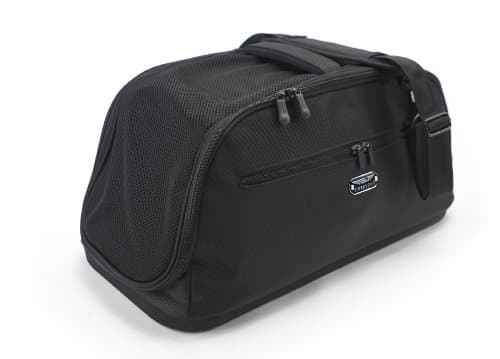
Most in-cabin carriers solve the fit problem by being soft enough to squash. The Sleepypod Air solves it differently: the ends compress, so you shorten the carrier to the space rather than crushing it into the space. It is a genuinely different mechanism, and it is the reason this carrier exists at its price.
Whether that mechanism is worth the money depends almost entirely on one thing — how varied your flying is. This review covers what the compression actually does, where the build quality shows up, and the specific reader who should close the tab and buy a Sherpa instead.
What it gets right
Compression is the feature
Under-seat spaces differ by aircraft, not just by airline. A widebody gives you depth a regional jet does not, and the same carrier can clear one and foul the other. The Air's ends compress, which shortens the carrier along the dimension that varies most between aircraft. A soft carrier squashed downward loses height; this loses length, which is often the constraint that actually matters.
It holds shape rather than collapsing onto the dog
The flip side of a soft carrier is that a heavier dog ends up in a fabric hammock with the sides pressing in. The Air keeps its structure, so the dog gets the interior volume the spec sheet claims for the whole flight rather than just when the bag is set down empty.
Build quality that shows up in the parts you touch
Zips, webbing, the luggage pass-through and the way the panels are finished are all a visible level above the sub-$100 field. This is not a subtle difference. Over two flights a year you will not care; over two flights a month it is the difference between one carrier and three.
A safety-first brand, stated carefully
Sleepypod publishes a testing program on its car restraints, and the Clickit harness line is independently certified — that is why it appears in our crash-tested harness roundup. We are deliberately not extending that claim to this carrier: what we can say is that the company has a documented safety engineering culture, which is rare here. We have not verified a crash certification for the Air itself and we are not going to imply one.
Where it falls short
The price is the headline objection and it is fair
This costs several times a carrier that will clear the same seat. For an occasional flyer on one airline, that difference buys nothing you will notice. The honest framing is that you are buying adaptability and longevity, and if your travel does not stress either, you are buying neither.
No expansion at all
The Air is fixed-volume by design. On a five-hour layover your dog gets exactly the flight footprint. If long ground time is a feature of your trips, an expandable carrier will treat the dog better for a fraction of the money — a real trade against build quality, but a real trade.
No boarding guarantee
Sherpa backs specific carriers on specific airlines with its Guaranteed On Board program, and reimburses your ticket if the carrier is the reason you are refused. Sleepypod offers no equivalent. If the fear you are trying to buy away is being turned back at the gate, the cheaper carrier is the one with money behind that promise.
Structure costs you some squish
Holding shape and squashing into a gap are opposites. On a flight where the gap is genuinely smaller than advertised, a soft Sherpa has a trick the Air does not. Compression helps with length; it does not help with a low seat bar.
Who should buy it
Buy it if you fly monthly, if you fly a mix of aircraft types and airlines, or if you have already replaced one cheap carrier and would rather not do it again. Those three cases are exactly where the compression and the build earn out.
Do not buy it if you fly once or twice a year on the same route — buy the Sherpa and put the difference toward the pet fee. Do not buy it if your trips involve long layovers; buy expansion instead. And if a gate refusal is your specific worry, buy the carrier with the written guarantee. Our head-to-head comparison lays that choice out in full.