There is a specific moment this whole product category exists for: you pour water into a bowl, put it on the back seat or in the footwell, pull out of the parking lot, and take the first corner. A collapsible bowl is superb at packing flat and hopeless at this. It has thin walls, a low rim and no weight, so the water leaves before the dog does.
No-spill bowls are the rigid answer. They are not packable, they are not for hiking, and they will not replace the bowl in your daypack. They stay in the vehicle, the crate or the RV, and the only thing they are judged on is whether the water is still in them after an hour of driving. There are three different mechanisms competing to do that, they suit different dogs, and the price gap between them is bigger than the performance gap — so this page is mostly about matching the mechanism to your dog rather than finding the "best" one.
A bowl only helps a dog that will drink from it. For the dog that refuses water in a car park and ignores dinner in a hotel room, the fix is usually the delivery rather than the bowl - worked through in when a dog will not eat or drink while traveling.
The three mechanisms, and which one you need
Everything sold as "no-spill" uses one of three approaches. They are not equally good, and they are not good at the same things.
1. Shape only — a tapered lip and a weighted or wedged base
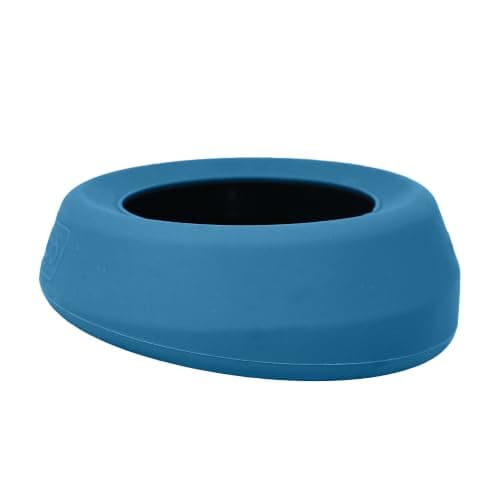
The simplest approach: high sides, a rim that curls inward so a wave breaks against it instead of over it, and a base shaped to sit flat on a surface that is not flat. The Kurgo bowl is the clean example — Kurgo lists a wedge base specifically so the bowl sits level on a sloping car seat, which is the real cause of most in-car spills. Nothing moves, nothing detaches, and it goes in the dishwasher.
Choose it if you want one thing that works, cleans easily and also holds kibble. Its limit is that shape alone cannot stop a hard surge — it reduces splash rather than eliminating it.
2. A floating plate or disk
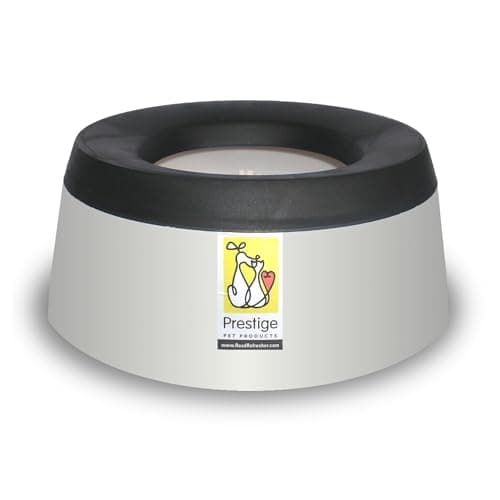
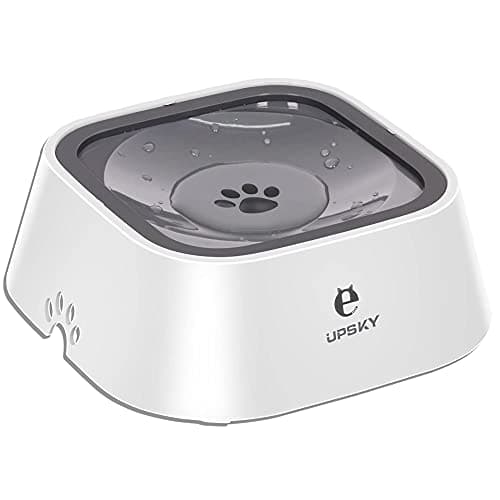
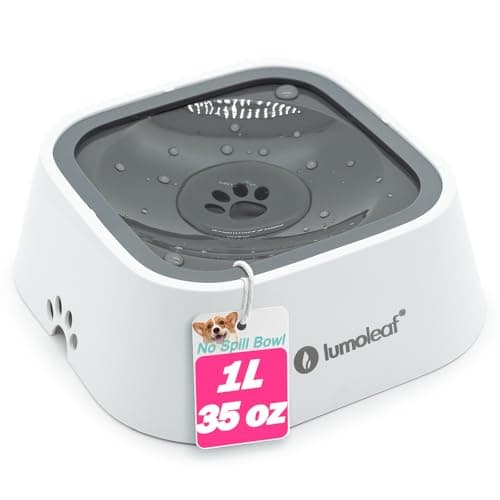
A loose insert sits on the surface of the water. The dog's tongue pushes it down and drinks normally; the moment the car brakes or corners, the plate caps the water and chokes the flow. Prestige's Road Refresher Non-Spill Water Bowl is the long-standing version, and the UPSKY and LumoLeaf bowls are the commodity take on the same idea.
This is the most effective mechanism in a moving vehicle, and it has a second benefit that gets undersold: it keeps a spaniel's ears and a schnauzer's beard out of the water, which is the difference between a dog that drinks and a dog that redistributes water around your car. Prestige also states a large slobber reduction for the design — that is the manufacturer's claim, not a figure we measured.
Choose it if your dog slobbers, has long ears, or the water genuinely has to ride in a moving car. Its limit is that the plate is a part you can lose, and kibble fouls it — this is a water-only bowl.
3. A sealed reservoir that meters water out
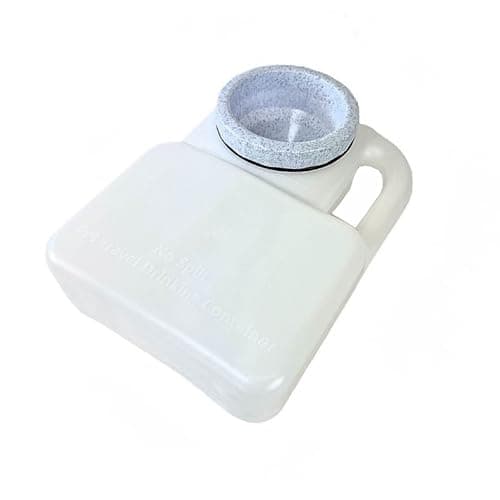
The largest-capacity approach. A jug holds the water; a shallow tray fills only to the level of the reservoir when you lay the unit on its side, so there is never enough standing water to slosh. Stand it back up and the tray drains into the jug. The Heininger Waterboy is the one we rank, at a listed three quarts.
Choose it if you have a big dog, a long drive, or you camp and do not want a separate water container. Its limit is bulk and cleaning — it is a rigid jug with parts, not something you throw in a bag.
How we ranked these
Spill control is the whole job, but capacity decides the trip
A bowl that never spills a drop and holds eight ounces is not solving a road-trip problem; it is solving a kitchen problem. We weighted spill control highest, then capacity, because a bowl you have to refill at every stop is a bowl you will stop using by lunchtime.
Cleaning is the reason people abandon these
Every mechanism above adds a surface that water sits against. A floating plate that does not lift out, a reservoir that does not come apart, a tray with a lip you cannot get a cloth into — these grow a film, and a bowl that has grown a film gets thrown away. Where a maker states that the insert separates for cleaning, we say so, because it is genuinely the difference between a two-year bowl and a two-month one.
Stability is separate from spill control
A bowl can be brilliant at containing water and still slide the length of a boot liner. Rubber feet help on carpet and do nothing on a plastic cargo tray. Fixing pads or a hook-and-loop base — which the Prestige bowl ships with — are the only real answer for a smooth surface. If your dog also shoves its bowl around, weight the stability column heavily.
Where these bowls actually live
In the footwell, not on the seat
The rear footwell is flatter, lower and enclosed on three sides. A bowl there has less distance to travel and less to spill onto. On the seat, you are relying entirely on the bowl; in the footwell, the car is helping. If the dog rides in a booster seat or a hammock, the footwell is usually still the right place for the water.
In the crate
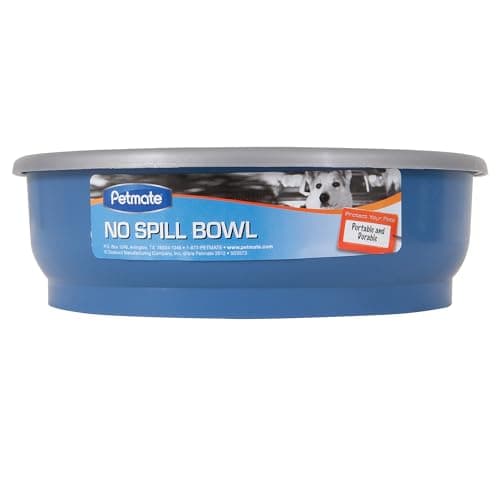
A crated dog on a long drive needs water it cannot tip, and this is where the plain deep bowls with a good rim — the Petmate being the biggest here — earn their place. Crate-clip bowls are the alternative, but they hold very little. If you are crating in the car, read how to secure a dog crate in a car first, because an unsecured crate is a bigger problem than a wet one.
In an RV or at a campsite
Here capacity beats everything and spill control matters mostly for the floor. A reservoir unit is the obvious answer, and it doubles as the water container you would otherwise pack. The wider setup is covered in traveling with a dog in an RV.
Do not leave water out for a dog in a parked car
It needs saying on a page about water in cars, because a full bowl reads as a safety measure and is not one. Water does not stop a parked car from overheating, and a dog left in one is at risk regardless of how much it has to drink. The temperatures and the timeline are on how to keep a dog cool in the car. Bowls are for driving, not for leaving.