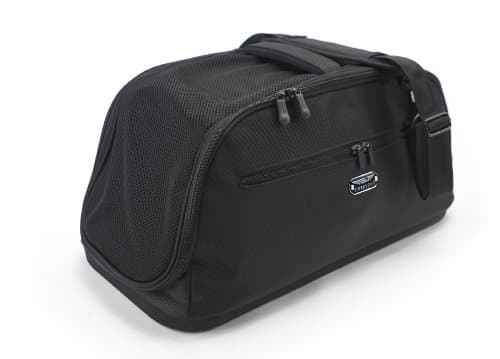
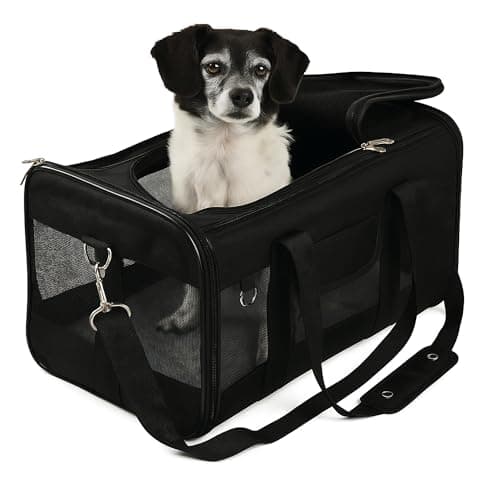
These are the two carriers people agonize over, and the price gap between them is large enough that the decision feels heavier than it is. The short version: the Sherpa is the right answer for most people, and the Sleepypod is the right answer for a specific person — someone who flies often, on varied aircraft, and wants one bag that never needs replacing.
They are aiming at the same problem from opposite directions. Sherpa sells a soft, squashable bag and backs it with the Guaranteed On Board program: if an airline on its approved list denies boarding, Sherpa reimburses your ticket. Sleepypod sells a structured carrier whose ends compress, so the same bag meets a generous under-seat gap on a widebody and a mean one on a regional jet.
Neither is a magic pass. Both still have to fit the seat in front of you, and no manufacturer can promise a gate agent's judgment. Check the under-seat limits for your airline before either goes in a basket.
The comparison, section by section
| Consideration | Sherpa Original Deluxe | Sleepypod Air |
|---|
| Structure | Soft with a spring-wire top frame that pushes down | Structured shell whose ends compress |
| Fit strategy | Squash it into the gap | Shorten it to the gap |
| Airline denial | Guaranteed On Board program on its approved airline list | No equivalent program |
| Price bracket | Mid — the mainstream in-cabin price | Premium — several times the Sherpa |
| Best suited to | Occasional flyers on one or two airlines | Frequent flyers across varied aircraft |
Fit: squash versus compress
The Sherpa's spring-wire frame lets the top bow downward, so an inch of overheight is usually survivable — that flexibility is the single most useful property a cabin carrier can have and it is why soft carriers dominate this category. The Sleepypod does something different: the ends genuinely compress, so you are shortening the carrier rather than crushing it. Compression is the better mechanism when the constraint is depth rather than height, which is exactly the situation on a lot of narrow-body aircraft.
The guarantee is worth more than it sounds
Sherpa's Guaranteed On Board program is the only thing in this category that puts money behind a fit claim. It applies to specific carriers on specific airlines and it has conditions — read them rather than assuming — but no other manufacturer offers anything comparable. If the fear keeping you awake is being turned away at the gate, that program is the feature you are buying.
Build quality and who notices it
The Sleepypod is plainly the better-made object. The materials, the zips and the way it holds its shape rather than sagging onto the dog are all a level above. Whether you notice depends entirely on frequency: over two trips a year the Sherpa will feel fine for a decade. Over two trips a month, the difference shows up in the zips first.
Neither one expands
This is worth saying because it is the most common reason people end up disappointed with either. If your dog faces a five-hour layover, the carrier that will make that easiest is not on this page — it is an expandable carrier, which unzips into extra floor space on the ground. Both carriers here are fixed-volume by design.
The verdict
Buy the Sherpa unless you can name a concrete reason not to. It is the category default for good reasons: it fits, it flexes, it is backed by the only real fit guarantee in the market, and it costs a fraction of the alternative. Buy the Sleepypod if you fly monthly, if you fly a mix of aircraft types, or if you have already replaced one cheap carrier and do not intend to do it again.