Every dog-travel plan has the same hole in it. You have solved water, food and ID, and then you are on the fourteenth floor of a hotel at two in the morning with a dog who has decided that the strip of gravel by the loading dock is not a bathroom. Or the rest area is closed. Or the rental is a city apartment with no yard. Or you are eleven hours into a drive and the dog has not gone since breakfast.
A portable dog potty is a surface you can put down anywhere, indoors, that a dog will actually use. That is the whole job. It is worth saying plainly because searching for one is confusing: most of what ranks for "portable dog potty" is written for apartment house-training, where the product lives in one corner forever and never has to be carried, packed, or disposed of two states away. Those are legitimate products and mostly the wrong ones for a trip. This page ranks them the other way round — on what happens when you have to put it in a car, use it in someone else's room, and leave.
Seven picks below, across three genuinely different product types. We have not lived with these on a trip and we do not claim to have; the ranking comes from published manufacturer specs, the live retail listings, and the constraints of travel we do know. Where a figure is a maker's claim, we say whose claim it is.
Three different products, one name
"Portable dog potty" covers three things that solve the problem in incompatible ways. Picking the right type matters more than picking the right model within a type.
1. Disposable substrate trays — bark or real grass
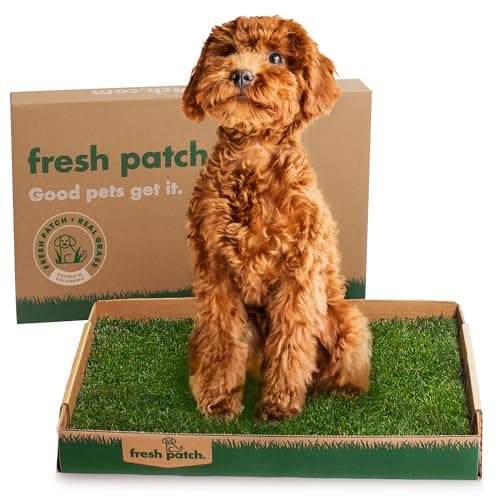
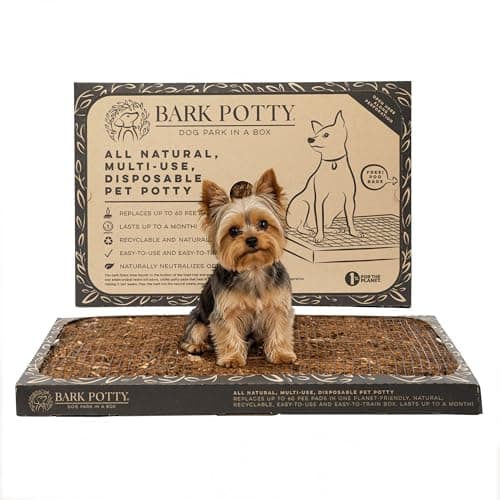
A tray of natural material with a sealed base. The dog goes on it; you throw the whole thing away. Bark Potty uses bark and lists two sizes, 24 x 16 in and 30 x 20 in; Fresh Patch uses hydroponically grown real grass and publishes a full size ladder from a 16 x 12 in Mini up to a 24 x 48 in XL, matched to dog weight.
Choose it if you are staying in places you do not own and your dog is grass-trained. It is the only type where the end of the trip involves a trash can rather than a hose. Its limit is that you are buying a consumable — the cost is per trip, forever, and a rigid tray does not fold.
2. Reusable frames and trays
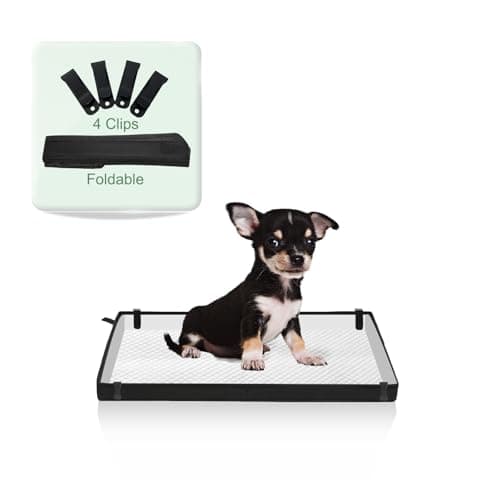
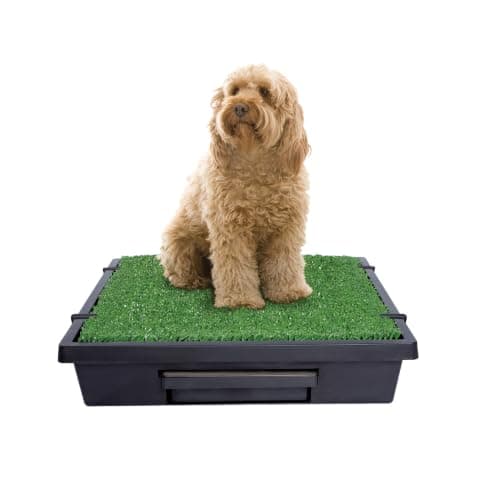
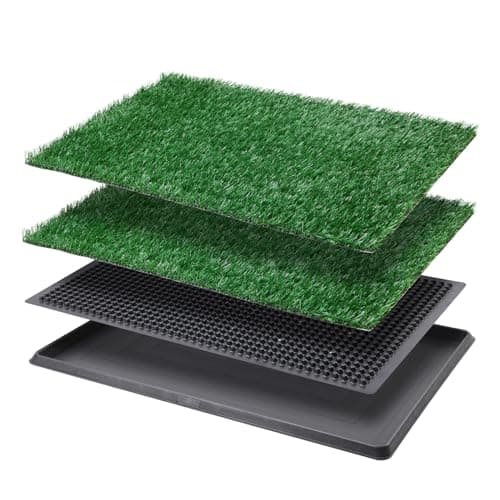
Everything from a HQ4US clip-in base that holds a pad flat, to a LOOBANI artificial-turf mat over a catch tray, to the PetSafe Pet Loo, which slopes so urine drains off the mat into a pod of gelling powder underneath. One purchase, used indefinitely.
Choose it if you travel often enough that per-trip consumables add up, or you are going somewhere you will stay put — a rig, a boat, a month-long rental. Its limit is the thing nobody mentions in the reviews: it has to be cleaned, somewhere, and then dried before it goes back in the car. That is easy at a campsite with a spigot and genuinely unpleasant in a hotel bathroom the morning you check out.
3. Pads — disposable or washable
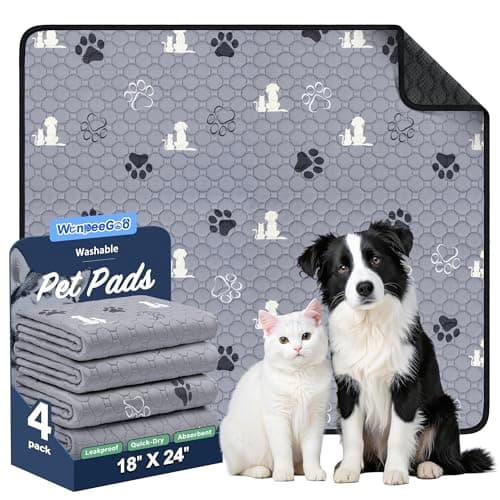
The flattest and cheapest answer, and the one most people are actually traveling with. A pad has no walls and no surface texture, so it is weakest at the two things that matter most: convincing the dog, and containing the result. It is strongest at fitting in a bag.
Choose it if your dog is already pad-trained, or you want a backstop rather than a bathroom — a liner under a crate, in a footwell, or in the bottom of an under-seat carrier. Its limit is that a bare pad on a hard floor slides, bunches, and overshoots.
How we ranked these
Whether your dog will use it decides everything else
A potty your dog refuses is luggage. This is the metric that separates the types more than any spec: a dog house-trained on lawn has learned a surface, not an idea, and asking it to switch to plastic in a strange room is a training problem you cannot solve at 2am. That is why the two real-substrate picks — bark and grass — sit at the top for acceptance, and why we rank a nothing-fancy bark tray above a much more sophisticated draining unit.
The real test is what happens after
Every product here works on the way in. They differ enormously on the way out. Disposable trays end in a trash can. Turf mats and draining units end in a rinse, a dry, and a decision about where a damp mat rides for the next four hours. Washable pads end in a sealed bag until you find a laundry. We weighted cleanup on the road heavily because it is the step that decides whether the thing gets used again on day three or stays in the trunk.
Packed size is a constraint, not a preference
Nothing on this page collapses to nothing except the pads and the HQ4US base. A tray is a tray — flat, rigid and roughly the footprint of a baking sheet, which is fine in a trunk and impossible in a carry-on. If you are flying, the honest shortlist is a folded pad in the carrier and a fresh tray bought at the destination. The rest of this page is for people driving. Our in-cabin packing list covers what fits under the seat.
Odor is a hotel problem, not a home problem
At home a smell is your business. In a rental it is a cleaning fee and a review. The mechanism matters here: a flat pad holds liquid against the surface the dog stands on, while a sloped or draining design moves it away. PetSafe sells a gelling powder for its pod specifically because a tray of standing urine is the failure point. Bark and grass absorb into the substrate, which is why they hold up over days without a rinse.
Where a travel potty actually earns its place
On a road trip
Not usually at rest stops — those have grass. It earns its place when the schedule breaks: an overnight in a motel with a parking lot and no lawn, a closed rest area, a stretch of interstate with nothing but shoulder. Keep it flat in the trunk with the rest of the kit and it costs you nothing until the night you need it. The rhythm the rest of the day should run on is in how often to stop on a road trip with a dog.
In a hotel room or a rental
This is the core case. High floors, elevators, a dog that will not settle, and a 2am decision about whether to get dressed. A tray by the bathroom door removes the decision. Put it down when you arrive rather than when you need it, so the dog has seen it in daylight. The rest of the room routine — crate placement, what not to leave out, the deposit — is in staying in a hotel with a dog.
In an RV, a van or a boat
The one place a heavy reusable unit beats a disposable one. You are parked, you have water, and the potty has a permanent corner — exactly the conditions that make the PetSafe Pet Loo's maintenance routine reasonable instead of miserable. See traveling with a dog in an RV for how it fits the rest of the setup.
At the airport
You will not be putting a tray down in a terminal. Airlines are required to provide animal relief areas for service animals in cooperation with the airport operator under 14 CFR 382.51, and in practice larger US airports signpost these as pet relief areas both before and after security — which is what you should be looking up, not packing. What travels with you is a folded pad in the carrier. TSA screening with a dog covers where the relief areas sit relative to the checkpoint.
For a puppy, a senior, or a dog on restricted movement
A puppy mid-vaccination course should not be using a shared patch of grass at a rest stop, and a senior dog with a long drive ahead may not manage the walk from a parking space to a lawn. Both cases turn a travel potty from a convenience into the actual plan. See traveling with a puppy and traveling with a senior dog.
Teach it before the trip, not during it
The single most common way this gear fails is that it comes out of the box in an unfamiliar room on the first night. Set it up at home a week out, in the spot the dog already heads for, and let it be boring before it has to be useful. A dog that has used the surface once at home will use it in a hotel; a dog meeting it for the first time on a strange floor, in the dark, after a long drive, mostly will not.
The corollary is that a travel potty does not replace getting the dog out. It covers the gaps — the closed rest stop, the high-rise, the middle of the night — and nothing else. A dog that has been in a car all day needs the walk regardless.
What to pack alongside it
Whichever type you choose, the same three things make it work: more waste bags than you think you need (solid waste comes off the tray with a bag, always), an enzyme cleaner or a pack of wipes for the paws and the surface, and a sealable bag for anything you are carrying wet. Where all of this sits in the wider kit is on the dog travel kit.