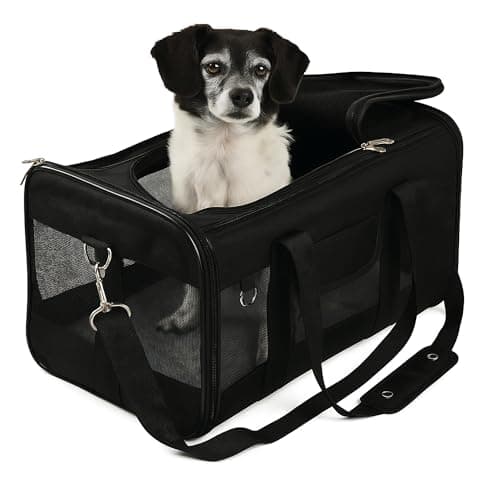
The verdict: a healthy puppy can fly in the cabin from eight weeks oldon the major US carriers — Delta publishes "Your pet must be at least 8 weeks old for domestic travel" — and the flight itself is usually the easy part. What catches people is the other number: any dog ENTERING the United States must be at least 6 months old, under CDC rules, so a puppy bought or adopted abroad cannot come home before then no matter what the airline says. The gear that matters is small: a soft carrier the puppy already likes, a pad in the bottom of it, wipes, and a bowl.
Everything else is preparation. A puppy that has spent two weeks learning that the carrier is a good place flies fine; a puppy that meets the carrier at the airport does not. That is the whole difference, and no product on this page substitutes for it.
The age rules, and which one applies to you
Domestic US flights: 8 weeks
Delta's published pet policy sets eight weeks for domestic travel. Other US carriers publish their own minimums and they are not identical, so check the airline you are actually booked on — the number is always on the airline's pet page and it is the first thing to confirm before you buy a ticket.
Entering the United States: 6 months, with no exceptions for pets
The CDC requires that all dogs entering or returning to the US are at least six months old, are microchipped with a chip readable by a universal scanner, appear healthy on arrival, and have a CDC Dog Import Form receipt. This applies to US citizens bringing their own puppy home. It is the single most common plan this rule destroys: a puppy collected abroad at eight weeks cannot board a flight to the US. Full detail on the document side is on flying internationally with a dog and do dogs need a passport.
Into the EU: 15 weeks, because of how rabies vaccination works
Delta states pets must be at least 15 weeks old for travel to the European Union. The arithmetic behind it is the rabies schedule: a puppy cannot be vaccinated before 12 weeks, and a 21-day wait follows the vaccination. That is a published sequence, not a guideline, and it cannot be compressed.
Two puppies in one carrier
Delta publishes a narrow exception: "2 pets of the same breed and size between the ages of 8 weeks and 6 months may be allowed to travel in 1 kennel", charged as one pet. It is the only place in airline pet policy where two dogs in one bag is permitted, it is airline-specific, and it still has to fit under the seat. More on the general case at flying with two dogs.
Cabin or cargo for a puppy
Cabin, if the puppy fits. A puppy that will grow into a 70 lb dog may be small enough today to fly under the seat, and that is the easiest flight it will ever have — which is a real argument for doing the move now rather than next year. If the puppy is already too big, the hold is a different decision with different risks, and the honest version of it is on flying with a dog in cargo. Carriers set their own minimum ages for hold travel, and they are generally higher than the cabin minimum.
The under-seat space is the constraint either way. Delta recommends a soft-sided kennel no larger than 18 x 11 x 11 in, requires it to be leak-proof, and requires ventilation on three sides for domestic travel and four sides for international. Our airline under-seat dimensions reference holds the per-airline table, and how to measure a dog for a carrier is the measuring method — for a puppy, measure again the week of the flight, because they grow while you plan.
What goes in the carrier
Four things, and the order matters. The picks below sit under this section rather than at the top of the page because for a puppy the preparation outranks the shopping.
- A soft carrier bought early. Early enough that the puppy has slept in it at home a dozen times. A spring-wire frame that compresses is what gets a borderline bag under a tight seat.
- A pad in the bottom, plus a spare. A puppy with an eight-week bladder on a three-hour taxi, flight and baggage hall will have an accident, and a leak-proof pad is the difference between changing a pad in a lavatory queue and carrying a wet dog through an airport.
- Wipes. For the above.
- A collapsible bowl. Water after security, water on landing. Not in the carrier in flight, where it will spill.
The three things that actually go wrong
The puppy has never been in the bag
By far the most common. The fix is a two-week acclimation plan, and we have written it out step by step on how to get a dog used to a carrier. Start it the day the carrier arrives.
The vaccination schedule collides with the socialisation window
Puppies are part-way through a vaccination course at the age people fly them, and airports are busy, loud, heavily trafficked places. This is a question for your vet about your specific puppy and the specific trip — what is safe to expose it to and when — not something to settle from a website, ours included.
Nobody checked the destination's rules
Domestic flights have destinations with their own rules. Hawaii is the big one: it is rabies free and runs its own quarantine program with a FAVN blood test and a 30-day wait, which makes a puppy under the required age ineligible on arithmetic alone. We cover it at taking a dog to Hawaii.
What we are not going to tell you
Whether to sedate. That is a veterinary decision and a particularly significant one in a young animal. Ask the vet who has examined your puppy. The drug-free options are on best calming gear for dog travel anxiety.
That a specific airline will accept your puppy. Airline pet policies change and vary by route, aircraft and season. We publish what a carrier currently states and we tell you to confirm it with the airline before you buy the ticket, every time.