French bulldogs are the hardest common breed to fly, and it is not because of the rules about Frenchies specifically. It is the arithmetic. A typical adult is 16-28 lb, short in the body but deep and wide through the chest, and brachycephalic - which on most airlines closes the hold entirely. So the cabin is the only route, and the cabin has a 20 lb combined weight limit on several airlines.
Read that again, because it is the whole problem: the one place a Frenchie is allowed to fly is also the place with the tightest weight rule. A 24 lb Frenchie plus a 4 lb carrier is 28 lb, which is over the published limit on American Airlines and JetBlue. On United and Delta, which publish no in-cabin weight number and judge on fit instead, the same dog may be fine. Airline choice comes before carrier choice for this breed, every time.
Why the hold is closed
Brachycephalic dogs and cats are not accepted for transport in the hold under the IATA Live Animals Regulations, and the major US airlines apply that directly - Delta does not accept snub-nosed breeds or their mixes at all, and American excludes brachycephalic dogs of any mix as checked pets. The reasoning is physiological: a shortened airway makes heat and stress far harder to shed, and a cargo hold is where both spike.
The practical consequence for you is that there is no fallback. With a Labrador you can say "too big for the cabin, we will check her". With a Frenchie there is no second option, so the carrier has to work. If the numbers do not come out, the trip becomes a drive. Our guide to flying with a snub-nosed dog covers the health side and the seasonal embargoes in full.
What a Frenchie needs from a carrier
- Ventilation on more than one side. A brachycephalic dog is working harder to breathe and to lose heat than a long-nosed dog of the same weight. Mesh on three or four faces means airflow no matter which way the bag ends up wedged under the seat; a single mesh end pressed against a seat leg is no airflow at all.
- Width, not length. Frenchies are short front to back and broad across the shoulders. A long, narrow carrier that suits a dachshund leaves a Frenchie unable to turn. The internal width and the shape of the base matter more than the stated length.
- A firm, flat floor. A heavy, low-slung dog sinks into a soft base until it is effectively lying in a hammock, which costs headroom you measured for and did not get.
- Weight you can defend. Every ounce of carrier is an ounce of dog you do not get on the airlines that weigh the pair. This is the one category where a lighter, simpler bag can be worth more than a feature-rich one.
None of this is exotic. It just filters the market hard: the carriers that suit a Frenchie are the well-ventilated, wide-based ones, and several popular models fail on shape alone.
French bulldogs are not the only breed where one measurement overrules the weight band. For a long, low dog the deciding figure is floor length rather than ventilation - carriers for dachshunds ranks on that instead.
The short answer
Quick picks
#ad · Live prices from the Amazon Product API, as of October 21, 2026. Where we have no verified live price we show none — we would rather leave a gap than print a number that has rotted.
In detail
The picks, in full
Frequent flyers who fly different aircraft
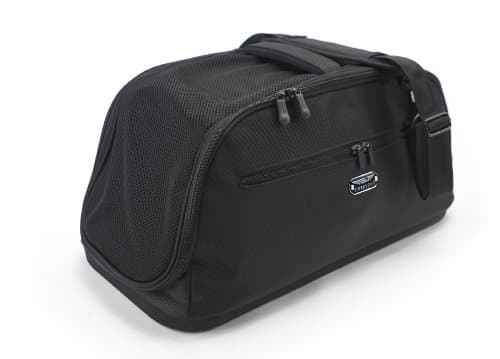
Sleepypod Air In-Cabin Pet Carrier
Compresses at both endsIn-cabin designLuggage strapPremium price
The premium in-cabin carrier: it squeezes at the ends to meet a smaller seat instead of forcing you to buy a smaller bag.
- Fits under seat
- 9
- Ventilation
- 8
- Build quality
- 10
- Dog comfort
- 8
- Value
- 6
Pros
- +The ends compress, so one carrier adapts to different under-seat depths instead of fitting one airline and failing the next
- +Materials and hardware are a clear step above the budget field, and the shell holds shape rather than sagging onto the dog
- +Sleepypod is a safety-first brand with a published testing program on its car restraints, which is rare in a category full of unverified claims
Cons
- −Costs several times what a budget expandable does for the same basic job
- −No expansion panels at all — on a long layover the dog gets the flight footprint and nothing more
Don't buy this if…
…you fly once a year on the same airline. Buy the carrier that fits that one seat and keep the difference; the Air earns out on variety, not on a single route.
Long layovers and connections
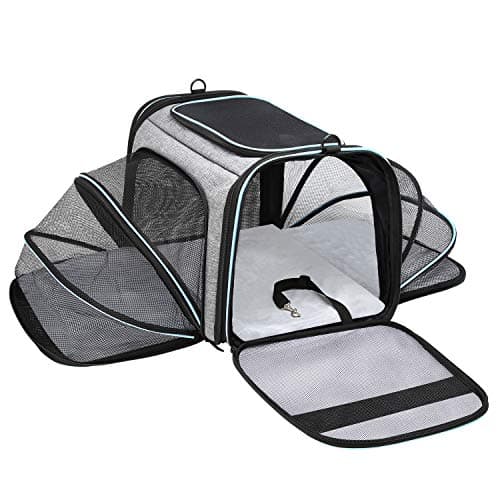
Petsfit Expandable Airline-Approved Carrier
Two-side expansionSoft-sidedFleece pad includedAirline-approved footprint
Zips flat for the plane, expands to a room once you land. The best answer to a long layover.
- Fits under seat
- 8
- Ventilation
- 8
- Build quality
- 7
- Dog comfort
- 9
- Value
- 8
Pros
- +Both sides unzip into extra floor space, so a dog stuck in a carrier for a five-hour layover can actually turn around
- +Collapses to a standard under-seat footprint for the flight itself
- +Fleece mat and a safety leash clip come in the box, which the cheaper carriers skip
Cons
- −The expansion panels are the first thing to wear — the zips take the stress
- −Bulkier when packed than a plain soft carrier of the same rated size
Don't buy this if…
…you only ever fly direct short-hauls. The expansion is the whole point of paying more, and on a 90-minute flight you'll never unzip it.
Long layovers on a budget
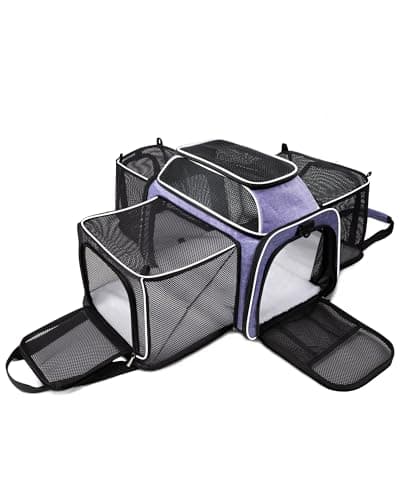
BATOTOR 4-Sides Expandable Pet Carrier
Four-side expansionFive opening doorsSoft-sided and foldableFleece pad included
The most expansion per dollar in the category — all four sides unzip, not just one or two.
- Fits under seat
- 8
- Ventilation
- 8
- Build quality
- 6
- Dog comfort
- 9
- Value
- 9
Pros
- +Four expanding panels means a dog can turn around and stretch out at the gate, which two-side carriers only half-manage
- +Five opening doors let you load the dog whichever way the seat, the aisle or the security bin forces you to
- +Comes in under the Petsfit, MASKEYON and Pecute expandables while offering more expansion panels than any of them
Cons
- −Four zippered panels are four more seams to fail — that is the trade you make for the expansion
- −Listed for cats and small dogs, and the listing publishes no weight limit — measure your dog against it rather than assuming
Don't buy this if…
…your dog is anywhere near the top of a small-dog weight range. Four expanding sides do not add height, and height is what a mid-size dog runs out of first.
Keeping paperwork and treats to hand
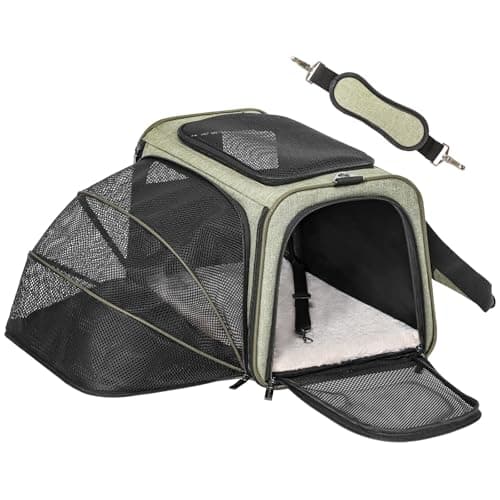
MASKEYON 2-Sides Expandable Airline Carrier
Two-side expansionFour doorsThree pocketsRemovable pads
Two expansion panels, four doors and real pockets — the best-organized expandable at a normal price.
- Fits under seat
- 8
- Ventilation
- 9
- Build quality
- 7
- Dog comfort
- 8
- Value
- 8
Pros
- +Four doors means you can load the dog whichever way the seat, the aisle or the security bin forces you to
- +Three exterior pockets swallow the health paperwork, a leash and a bag of treats without a second bag
- +Two expansion panels rather than four keeps the seam count down while still buying the dog room on the ground
Cons
- −Expands to less floor space than a four-side carrier for similar money
- −The pockets add bulk, which is the last thing you want in a tight under-seat gap
Don't buy this if…
…you are optimizing purely for the smallest packed size. The pockets and extra doors are useful on the ground and dead weight in the air.
People who hate how pet carriers look
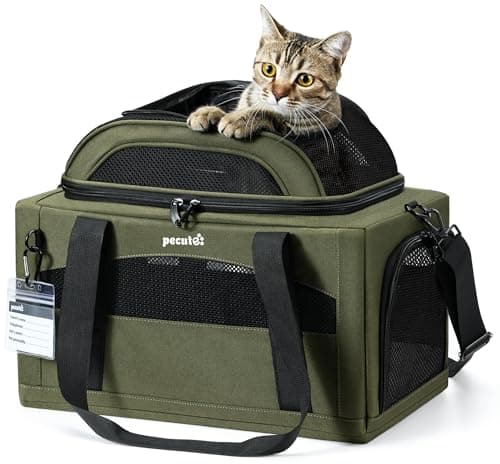
Pecute Expandable Airline-Approved Pet Carrier
Expandable panelSoft-sidedListed as airline approvedCats and dogs
The tidiest-looking expandable here, and the one that reads least like pet gear in a terminal.
- Fits under seat
- 8
- Ventilation
- 8
- Build quality
- 7
- Dog comfort
- 8
- Value
- 7
Pros
- +Muted olive shell and clean lines — it passes as luggage rather than a mesh box on a strap
- +Expands for the ground portion of a trip without the four-panel bulk
- +A current listing with current materials, rather than a decade-old design coasting on old reviews
Cons
- −Too new to have the long-run owner feedback the Sherpa and Petsfit carriers have accumulated
- −The listing does not name a specific airline approval list, so verify against your own airline
Don't buy this if…
…you want a carrier with years of documented owner reports behind it. On a flight, the boring known quantity has real value.
Pick the airline first
For a Frenchie under about 16 lb, most US airlines are open to you and the exercise is normal carrier shopping. Between roughly 16 and 22 lb, the airlines that publish a 20 lb combined cap fall away and you are realistically looking at United or Delta. Above that, you are relying on a fit judgment at the counter, and the honest advice is to have a plan B rather than a hope.
Whatever the number, check the current published rule on the airline's own pet page before booking, then match the carrier to that airline's under-seat limit using our dimensions table.
Heat is the risk that actually matters
The cabin removes the hold's temperature problem but not all of it. Jet bridges, delayed pushbacks and a hot terminal in July are all real, and a stressed brachycephalic dog in a zipped bag has very little margin. Practical measures:
- Book early morning or late evening flights in summer, and prefer non-stop.
- Offer water in the terminal right up until boarding. A collapsible bowl in your pocket is the whole apparatus.
- Keep the carrier off hot asphalt and out of direct sun through terminal windows while you wait.
- Learn what labored breathing looks like on your own dog when it is calm, so you can tell when it is not. Noisy breathing that gets worse, a dog that will not settle at all, or gums that darken are reasons to get the bag open and get help - not to push through.
Do not sedate. The AVMA is explicit that sedatives can worsen respiratory and cardiovascular function at altitude, and for a dog whose airway is already compromised that is precisely the wrong direction. If your dog panics in a carrier, the fix is weeks of acclimation beforehand, not chemistry on the day.
Fit-checking a Frenchie at home
Measure standing height at the top of the shoulder and length from the front of the chest to the base of the tail, then compare against the carrier's internaldimensions rather than the external ones. The difference is often two inches, and two inches is the whole margin.
Then do the dry run. Set the carrier up at home two or three weeks before the flight, feed the dog in it, and leave it open as furniture. A Frenchie that already sleeps in the bag will settle at 35,000 feet. One that first meets it at the airport will not, and a dog that is panting and scrabbling is both a welfare problem and the thing that draws attention at the gate.
If the flight is not going to work
There is no shame in the conclusion that this dog does not fly. Between the hold ban, the weight caps and the summer heat, a lot of Frenchie trips are better as drives - and a Frenchie is a genuinely good road-trip dog, given a proper restraint and a stopping schedule that respects the heat. Our car heat guide is written with exactly this dog in mind.
How we picked
We do not test the gear
We compiled the manufacturers' published dimensions and specs, cross-checked them against airline under-seat limits and published safety certifications, read the owner reviews, and scored each product against a published rubric. The scores are judgments from that research — they are not measurements we took, because we do not own a lab and we are not going to pretend we do. Where we could not verify a fit or a claim, we say so on the page.
Questions
Frequently asked
Can French bulldogs fly on planes?+
In the cabin, yes, on airlines whose weight and size rules your dog meets. In the hold, generally no - brachycephalic breeds are not accepted for hold transport under the IATA Live Animals Regulations, and Delta and American both exclude snub-nosed dogs from checked pet travel. That means the cabin is usually the only route, so the carrier and the airline choice have to work together.
What size carrier does a French bulldog need?+
Measure your own dog rather than shopping by breed. Take standing shoulder height and chest-to-tail-base length, then compare to the carrier's internal dimensions - external figures typically overstate the usable space by an inch or two per axis. Frenchies need width and a firm flat floor more than they need length, because they are short-bodied and broad-chested.
How much does a French bulldog have to weigh to fly in cabin?+
It depends entirely on the airline. American Airlines and JetBlue publish a 20 lb limit for pet plus carrier combined, so with a 4 lb bag the dog needs to be under about 16 lb. United and Delta publish no in-cabin weight cap and judge on whether the dog fits and can stand and turn in a carrier that fits under the seat, which is why heavier Frenchies usually fly with them. Always confirm the current rule on the airline's page.
Should I sedate my French bulldog for a flight?+
No. The AVMA warns that sedation can increase the risk of heart and breathing problems in animals at altitude, and a brachycephalic dog already has less respiratory margin than most. The safe approach is acclimation - weeks of short, positive sessions in the carrier at home - plus a flight booked at a cool time of day.
Is a hard or soft carrier better for a Frenchie?+
Soft, for the cabin. It flexes under the seat, it is lighter (which matters where pet and carrier are weighed together), and the good ones have mesh on three or four sides, which is the ventilation a short-nosed dog needs. Hard kennels are for the hold, and the hold is closed to this breed on most airlines anyway.
Receipts
Sources
We do not run a testing lab, and we do not pretend to. Product dimensions and safety claims come from the manufacturer's own listing; airline limits come from the airline's published policy, with the date we checked it. Where we could not verify something, we say so on the page rather than quietly leaving it out. Read our full method.