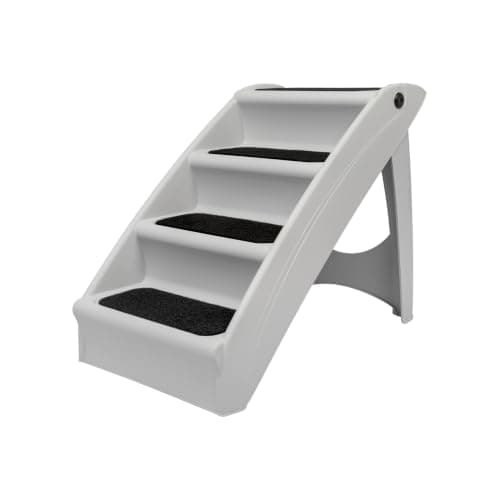
The verdict, before any product: for a tall vehicle and a big or arthritic dog, a ramp wins and it is not close. Length is what makes an incline gentle, and no step set fixes a load floor that is higher than the steps are. Steps win in three specific situations — a dog that refuses to walk a ramp, a parking situation with no room to deploy one, and a trip where the same object has to serve a hotel bed as well as a car. If you are in one of those, buy the PetSafe CozyUp Folding Pet Steps, 25 in: it is the only pick here whose maker publishes a height (25 in), a weight limit (200 lb) and the car as an intended use.
We are leading with that because the search that brings people here is often the wrong search. "Dog car steps" sounds like a product category and mostly is not one. When we resolved live listings for this page on 2026-10-18, nearly every branded pet step in the catalog turned out to be furniture — sold for beds and couches — and the step sets marketed specifically for cars and SUVs were almost all unbranded listings with no published weight rating. Gen7Pets even sells a vehicle product called the Natural Step, and it is a 72-inch ramp. The brands that take "getting a dog into a vehicle" seriously build ramps, which is why our ramp roundup has four picks and this page has three.
The actual difference, in one paragraph
A ramp is a continuous surface: the dog walks up, four feet on the ground, weight evenly spread, and nothing has to be hoisted. Steps are a series of controlled hops: each rise is a small jump and a small landing, taken with the front end doing most of the work. For a young dog that is nothing. For a dog with hip dysplasia, a long back, a cruciate repair or just fourteen years on the clock, a repeated hop is the exact movement you bought mobility gear to avoid — which is the reasoning behind our senior dog travel guide and worth one conversation with your vet before you choose. If a specific joint is the reason you are shopping, ask which movement they want the dog to stop making.
Measure before you choose, because height decides it
Take a tape measure to the ground and to the surface the dog has to reach — the sill of the back seat, the load floor behind the tailgate, the bed of the truck. That one number rules most of this out:
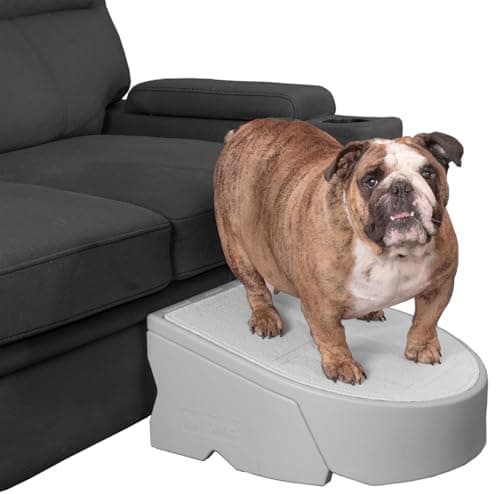
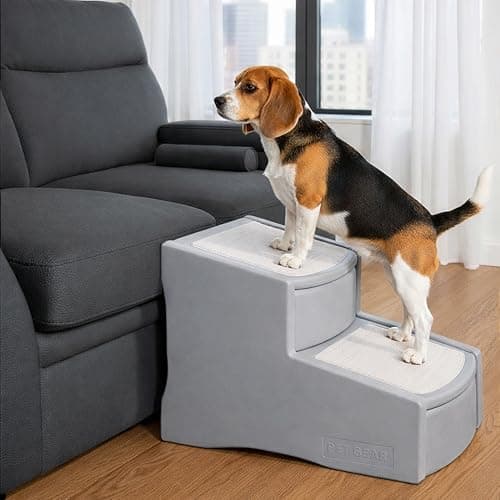
- Up to about 16 in: a low sedan sill, a bench seat with the door open, a couch at a rental. Two or three steps reach this comfortably. The Pet Gear Easy Step II Pet Stairs and the Pet Gear StRamp Stair and Ramp Combination (retailer listings quote 16 in of height on the StRamp) are in this band.
- Up to 25 in: a tall back seat, a crossover bench, most hotel beds. This is the PetSafe CozyUp Folding Pet Steps, 25 in's band — PetSafe publishes 25 in of height on the larger size and 20 in on the smaller one.
- Above 25 in: SUV load floors, lifted vehicles, pickup beds. Nothing on this page reaches it. This is ramp territory, and a long ramp at that — the whole point of a 71-inch tri-fold or an extra-long telescoping ramp is that length is what makes a tall reach a shallow angle instead of a climbing wall.
Note what that means for the common search: "dog car steps for large dogs" usually describes a big dog and a big vehicle, and the second half of that is what rules steps out. A 200 lb weight rating is plenty for any dog alive; 25 in of height is not plenty for an SUV.
The three cases where steps genuinely win
1. The dog refuses the ramp
Plenty of dogs will not walk a ramp. It flexes underfoot, it sounds hollow, it is narrow, and one bad slip teaches a dog never to try again. Those same dogs will often hop a step without thinking about it, because hopping onto something is a movement they already own. This is the single best reason to buy steps, and it is also the argument for the stair-and-ramp hybrid: you find out which one your dog accepts without buying twice.
2. There is nowhere to put a ramp
A 71-inch ramp needs roughly six feet of clear ground behind or beside the vehicle. On a driveway, fine. Parallel parked on a city street, at a busy trailhead, or in a tight garage, not fine — and the "side door" version of this search is exactly that problem, because a ramp into a rear door has to sit at an angle across a traffic lane. A step set needs two feet of ground and works at the door you are standing at.
3. It has to do more than one job on the trip
A step set that reaches a hotel bed, an RV bunk or a rental sofa is doing work no ramp does — which matters if the dog sleeps on the bed at home and is going to try regardless. That is also the honest reason the tall folding steps are our pick: PetSafe lists them for bed, couch and car, and on a trip they will be used for all three. Our hotel guide and the vacation rental kit cover the rest of that setup.
How we ranked the steps
- Published height, published limit. A maker that prints 28 x 18 x 25 in and 200 lb outranks one that prints neither. Weighted highest, because height is the spec that decides whether the product works at all.
- Tread width and surface. A nervous dog uses a wide step long before a narrow one, and a removable, washable tread is the difference between a step you still use in mud season and one in the garage.
- Stability under a real dog. Hollow plastic on a smooth floor slides. The steps that need to be braced against something are marked as such.
- Does it travel? Folding flat or snapping apart without tools matters on a road trip, where the step has to share a trunk with everything else.
- Honesty about what it is not.No step product here is scored up for "for cars" in a listing title. The ones that say it and publish nothing to back it are the ones we did not rank.
Steps and ramps, side by side
| Option | Published reach | Published limit | Ground needed | Best for |
|---|
| PetSafe CozyUp Folding Pet Steps, 25 in | 25 in high (28 x 18 in footprint) | 200 lb (150 lb on the 20 in size) | About 2 ft | Tall back seats, hotel beds |
| Pet Gear StRamp Stair and Ramp Combination | 16 in high (retailer listings) | 150 lb (retailer listings; varies by model) | About 2.5 ft | A dog whose preference you do not know |
| Pet Gear Easy Step II Pet Stairs | Two steps; height not published on the listing | 150 lb (listed) | About 2 ft | Low sills, couches, small dogs |
| Tri-fold or telescoping ramp | Up to about 71 in of ramp length | Varies by model; see the ramp roundup | About 6 ft | SUVs, trucks, arthritic and large dogs |
What we are not ranking, and why
Unbranded "dog steps for car, truck, SUV" listings. There are plenty, some with five folding steps and a quoted 200 lb capacity, and we will not rank a load-bearing product whose maker we cannot name. The capacity claim on a listing with no brand behind it has nobody standing behind it either. Our rule across this site is that a product has to be faithful to a named brand and model, and these are not.
Foam steps for high beds. A real category and a reasonable buy for a bedroom. In a car they are the wrong material: foam absorbs rain, mud and dog, and then it lives in your trunk.
Truck-bed step systems and pet loaders. The genuinely tall answers here are direct-to-consumer products we cannot price honestly through this site, which is the same position we have held on crash-tested kennels since 2026-09-07. We would rather name them than rank them.
Steps as a fix for a dog that jumps anyway. A dog that has launched itself into a tailgate for eight years will keep doing it with a step set in the way, and it will sometimes land on the step instead of the floor, which is worse than either option alone. Equipment only helps if the dog is taught to use it and the jump is made unavailable while it learns — door closed until the step is set, leash on, treats at the top. If you cannot control the jump, a ramp placed flat against the opening at least blocks the launch path.
Lifting the dog.Not a product, and worth saying anyway: if you are lifting a 70 lb dog into a tailgate twice a day, that is your back as well as the dog's joints. Our how to carry a large dog guide goes through the mechanisms, including the support harness that makes an assisted climb possible.