No.A dog travelling in the cabin stays inside its carrier, and the carrier stays stowed under the seat in front of you for the whole flight. Delta's published pet policy is explicit on both halves: "The kennel must fit fully underneath the seat directly in front of you," and you are told to keep the pet "calm and secured inside the kennel at all times... while on board the aircraft". There is no lap option, no seat of its own, and no in-flight cuddle that the rules anticipate. The one practical consequence: the carrier is not a boarding formality, it is the dog's space for the duration, which is why we rank the bags that fit the footwell properly rather than the ones that look nicest on a shoulder.
If the honest version of your trip is "the dog needs to be held", this is the page that should change your plan rather than your shopping list. A long drive with the dog restrained properly beside you is a better trip for that dog than a flight it spends in a bag under a seat - flying vs driving with a dog is the decision page for that, and it is not a consolation prize.
What the published policies actually say
The wording differs slightly between airlines and the substance does not:
- The kennel goes under the seat in front of you. Not beside you, not in your lap, not in the overhead bin - an overhead bin is unventilated and it is not a place a live animal is permitted to travel.
- The dog stays in the kennel.Delta's policy extends that to the airport, check-in, boarding, deplaning and its Sky Clubs, not just the cruise portion of the flight.
- One pet per kennel. Delta allows narrow exceptions for a nursing mother or for compatible young animals of the same breed and size - the detail is on flying with two dogs, where the arithmetic usually comes out as two carriers and two passengers.
- The dog must be able to stand, turn around and lie down in the kennel. That is the IATA standard, and it is the reason a bag that technically fits the footwell can still be the wrong bag.
Policies change and they differ by aircraft, so confirm yours with the airline you are flying. The dated per-airline dimension and fee table we maintain is on airline under-seat dimensions.
Why the rule exists, and why it is not negotiable at the gate
Two reasons, and neither is about pets. The first is evacuation: in an emergency the cabin has to be cleared through the aisles in seconds, and an unrestrained animal in a footwell or on a lap is a hazard to the dog and to everyone behind it. The second is that the space under the seat in front of you is the only enclosed, ventilated, fixed volume in the cabin that is yours. That is why airlines describe the carrier as a kennel and count it as your personal item.
The practical version: gate agents and cabin crew enforce this consistently, and "my dog is small" or "she is an emotional support animal" does not change it. Emotional support animals have not been treated as service animals under the US Department of Transportation's rules since 2021, which means an ESA travels as a pet on US carriers - under the seat, in a kennel, for a fee. Trained service dogs are a genuinely different legal category with different rules, and we do not give advice on that: ask the airline directly.
What this means for the carrier you buy
If the dog is in the bag the whole time, three things stop being cosmetic:
| What changes | Why it matters once the bag is under the seat |
|---|
| Ventilation on more than one face | A footwell is a three-sided box. Mesh on one end only means airflow stops when the bag is pushed in. |
| Height, and whether it compresses | Height is the dimension that fails. A bag that gives at the top clears a shallow footwell without squashing the dog. |
| A floor the dog can lie flat on | Hours, not minutes. A sagging floor is tolerable to carry and unpleasant to lie in. |
| A zip you can open one-handed from a seat | You will want to reach in. Doing it blind, in a 17-inch gap, with a bag you cannot see. |
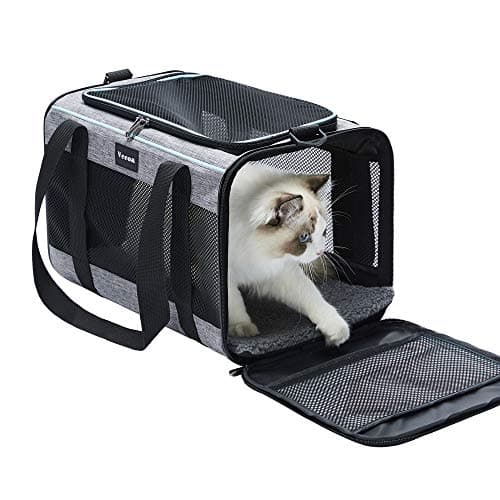
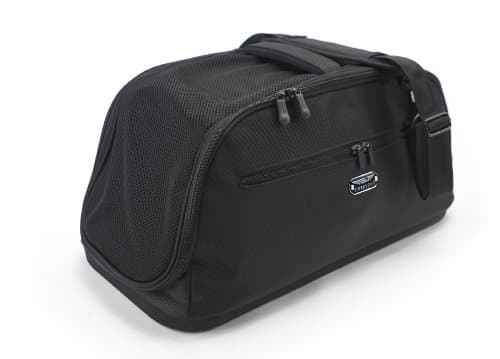
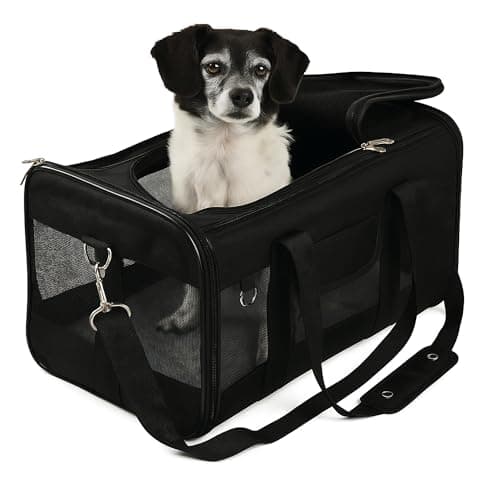
The three carriers below are the ones on this site that answer those four points best. The full ranked field is on best airline-approved dog carriers, and if your dog is at the top of the weight range, start instead with carriers for larger dogs.