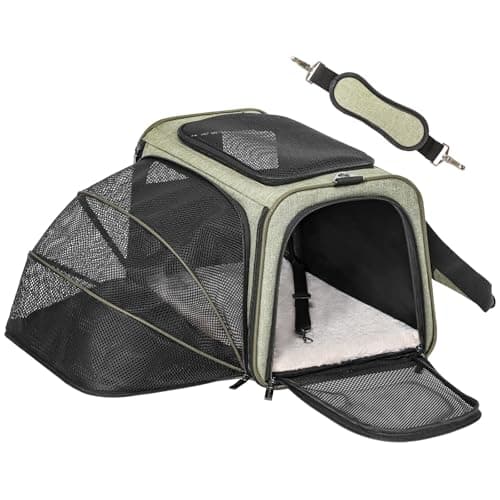
The Petsfit is the carrier we point most people at when they say the words "long layover". It flies at a normal under-seat footprint and then unzips at the gate into something closer to a small crate, which changes what a five-hour connection is like for the dog inside it.
It leads our expandable carrier roundup, and this review is the longer version of why — including the honest accounting of what those extra zippers cost you in reliability.
What it gets right
The expansion is real floor space, not a marketing diagram
Both sides unzip into usable extra area, and the difference on the ground is not subtle: a dog that could only sit hunched can turn around and lie flat. On a long connection that is the difference between a dog that arrives frazzled and one that arrives fine. This is the whole product and it delivers on it.
The hardware is the best in the expandable field
Expandable carriers live and die on their zips, because the panels carry the dog's weight when open — a load ordinary carrier zips never see. Petsfit's are visibly heavier than the budget expandables, and the brand has a long enough owner record that this is a documented pattern rather than a first impression.
It collapses to a genuinely standard footprint
Some expandables are simply large carriers with panels, and they fail an under-seat check collapsed. This one folds down to a footprint that clears the common US limits. That said, height is still the number to check against your specific airline — Southwest and JetBlue are far stricter than United, Delta and American.
The pad and the safety clip come in the box
A removable fleece pad and an internal tether are included. The pad matters because the pad is what gets soiled, and one you can pull out and wash is the difference between a clean carrier and a permanently unpleasant one. The tether matters the moment you unzip a door in a terminal.
Where it falls short
Every panel is a failure point, and this has two
We rank Petsfit first partly because it has fewer panels than the four-side carriers — but two is not zero. The expansion zips are the first thing to wear on any carrier of this type, and they wear faster than the main zips because they take weight. If you fly monthly, expect these to be the part that eventually ends the carrier's life.
Bulkier packed than a plain soft carrier
Folded expansion panels have to go somewhere, and that somewhere is the carrier's walls. It stores larger than an equivalent plain carrier and weighs a little more empty, which counts against your own carry-on allowance on strict airlines.
Sizing is for small dogs, genuinely
The expansion adds floor area, not height. A dog that is tall for its weight runs out of headroom before it runs out of floor, and no amount of unzipping fixes that. Measure the dog standing — our measuring guide covers the two numbers that matter — rather than trusting a weight rating.
No boarding guarantee
Like almost everything in this category except Sherpa, Petsfit offers no financial backstop if an airline refuses the carrier. If that specific fear is what is keeping you awake, that is an argument for the Sherpa rather than for this.
Who should buy it
Buy itif your itinerary has a layover longer than about two hours, or multiple legs, or a long stretch at the destination where the carrier doubles as the dog's space. That is where the panels pay for themselves several times over.
Do not buy it if you fly direct short-hauls — you will never unzip it, and a plain soft carrier is lighter, cheaper and has fewer things to break. Do not buy it if your dog is tall for its weight. And if you fly monthly and want the bag that simply will not fail, the simplest carrier is still the most reliable one.