Crate sizing is two measurements, and almost everybody takes the wrong ones. It is not the dog's shoulder height and it is not its weight - weight is a rough proxy that manufacturers publish because it is easier to ask for than a tape measure, and it is why so many crates arrive too small for a long-bodied dog or absurdly large for a compact one.
The two measurements
- Length: nose to the base of the tail - where the tail joins the body, not the tip. Add a few inches so the dog can lie stretched out without touching both ends.
- Height: from the ground to the top of the head with the dog standing. Add a few inches of clearance. For breeds with upright ears, measure to the top of the ears instead, because that is what will brush the roof.
That is MidWest's own method and it is the standard across manufacturers. Round up to the next available size rather than down, and if your dog sits between two sizes, take the larger one for home use and think harder about it for travel - see below.
The standard size ladder
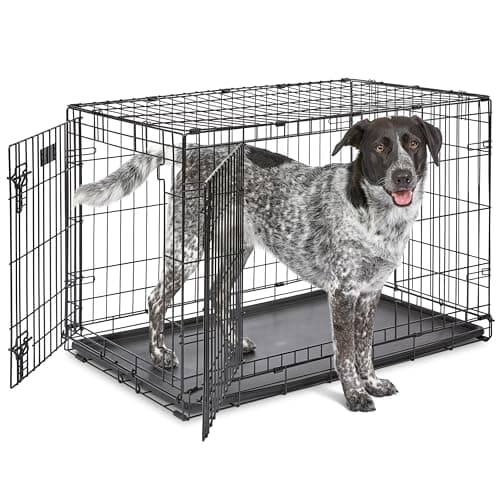
Wire and folding crates are sold by length in inches, and the ladder is broadly consistent across brands - typically 22, 24, 30, 36, 42 and 48 inches, with a 54-inch option from some makers for giant breeds. Manufacturers publish a breed and weight guide against each size; use it as a starting point and confirm with your own two measurements, because breed averages hide enormous variation.
Two things that are not on any chart:
- Buy for the adult dog, with a divider. For a puppy, look up the adult size for the breed, buy that crate, and use the divider panel to shrink the usable area during house training. A puppy given a whole adult crate will use one end as a toilet.
- Bigger is not automatically better. A crate is a den. Too much space makes it less settling, not more, and in a car an over-large crate lets a dog get thrown about inside it during a stop.
Where travel changes the answer
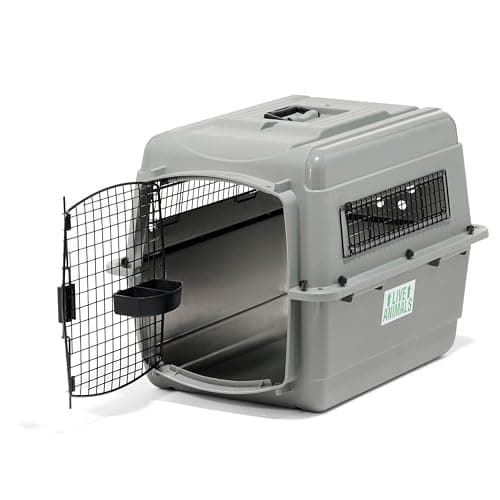
For air travel in the hold, the sizing rule is not a chart at all - it is a requirement. The dog must be able to stand up fully without its head touching the top, turn around, and lie down in a natural position. That is the language airlines apply and it is assessed at acceptance. It usually produces a crate one size larger than the one you would buy for a living room.
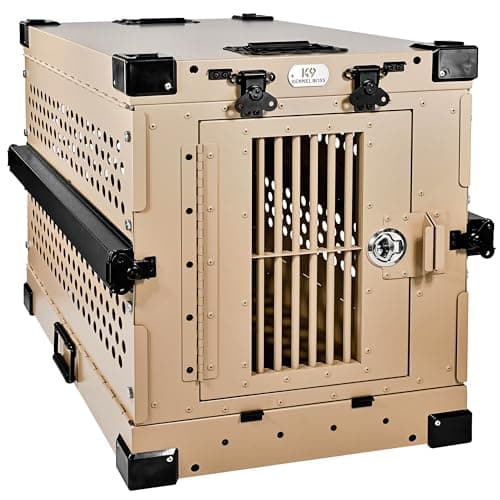
It also has to be the right kind of crate - rigid, ventilated on the required number of sides, with metal hardware and a working door latch. A folding wire crate is not acceptable for the hold no matter what size it is. The full specification is in airline cargo crate requirements, and it is worth reading before you buy rather than after.
For a puppy, this measurement has a shelf life of about four months. The way round that is a crate with a divider panel, sized to the adult dog and partitioned down - travel crates for puppies.
Sizing for a car, which is different again
In a car, the constraint is usually the vehicle rather than the dog. Measure the cargo area at its narrowest - between the wheel arches, not across the widest point - and the height under a closed tailgate, before you shop. A crate that fits the dog but not the boot is the most common expensive mistake in this category.
For car use specifically, err toward a snugger fit than you would at home. A dog braced against the walls of a well-fitted crate is safer in a sudden stop than one with room to be thrown. And whatever size you land on, it has to be anchored - an unsecured crate is a heavy object with a dog inside it.
Quick reference: which size problem do you have?
- Dog stands with its head bowed: the crate is too short. Height is the dimension people under-buy, because they measured to the shoulder rather than the head.
- Dog cannot lie fully stretched: too short in length. Fine for a nap, wrong for a night or a flight.
- Dog sleeps at one end and toilets at the other: too large for its current stage. Fit the divider.
- Dog is thrown around in the car: too large for vehicle use, even if it is right at home.
- Crate was refused at the airline counter: almost always height, or the crate type rather than the dimensions.
Soft, folding or hard - size interacts with type
The same nominal size behaves differently by construction. A soft crate's usable interior is smaller than its external dimensions suggest once the frame and padding are accounted for. A hard kennel's walls eat more space again but give you the rigidity the hold requires. A folding wire crate is the most space-efficient and the least travel-capable.
Match type to trip first, then size within it: soft versus hard covers the trade-off, how to pick a travel crate works through the decision, and the portable crate roundup ranks what is actually buyable.
One crate or two?
Plenty of people end up with a folding wire crate at home and a soft or hard travel crate for the road, and that is a reasonable outcome rather than a failure of planning. The home crate is sized for comfort and the travel crate is sized to a rule - an airline's, or a car boot's. Trying to make one object satisfy both usually produces a crate that is awkward in the house and marginal at the airport.