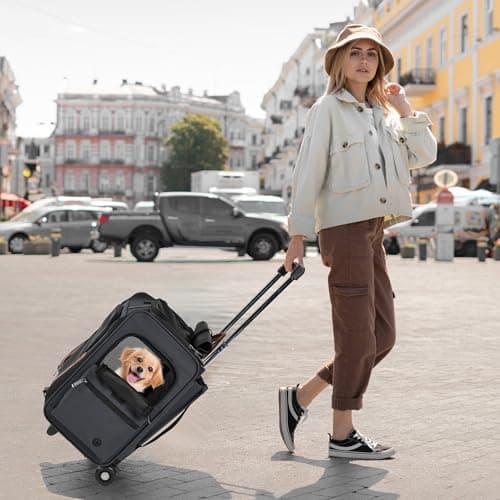
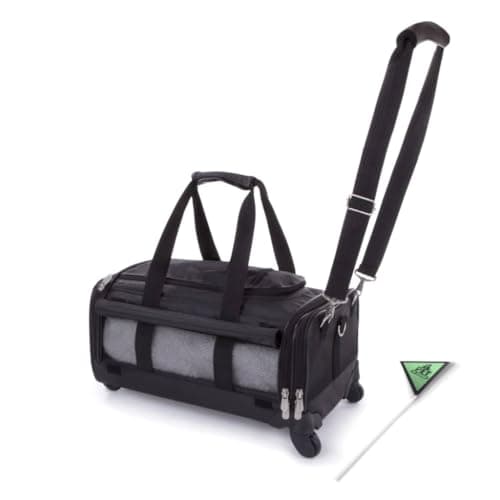
A carrier with a dog in it weighs between 8 and 25 pounds, and an international terminal can be a mile end to end. Anyone who has hauled a soft carrier on one shoulder from a remote gate to baggage claim understands immediately why wheels exist.
But wheels come with a real cost, and most roundups do not say it plainly: a wheeled base adds height, and height is the dimension airlines are stingiest with. Roughly 11 inches on United, Delta and American; closer to 8.5 on Southwest and JetBlue. A wheeled carrier that clears one of those may not clear the other, and no amount of squashing fixes a rigid wheel housing.
So this list ranks two things at once: how well each carrier moves through an airport, and how honest its under-seat fit is. The Sherpa takes the top spot on build quality and brand track record — with one caveat about the Guaranteed On Board program we spell out on its card.
Choosing a rolling dog carrier
Decide first whether it actually has to go under the seat
This is the fork in the road. If the carrier must fit under an aircraft seat, wheels are working against you and you should be shopping our standard carrier roundup instead. If the dog is traveling by train, car, cruise or a road trip with airport transfers — or if you are checking the carrier and flying the dog another way — wheels are close to a free upgrade. Be honest about which situation you are in before you buy.
Wheels or backpack straps, or both
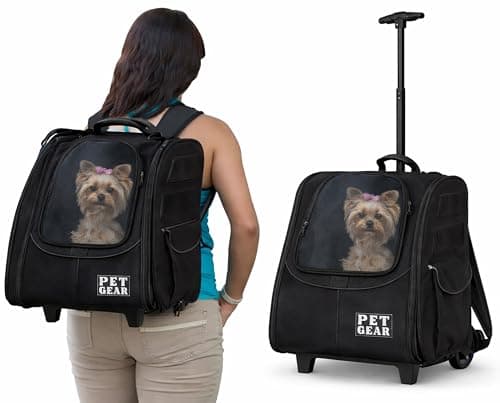
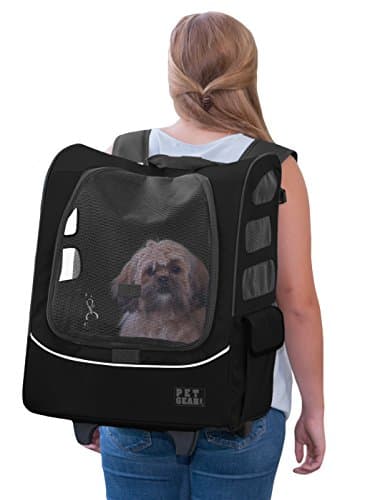
Pure rollers are the smoothest option on flat terminal floors and useless on stairs, curbs, cobbles and shuttle-bus steps. Convertibles (Pet Gear) let you switch, at the cost of carrying the wheel assembly on your back for the stretch where it does nothing. If your route is airport-taxi-hotel on smooth ground, buy the pure roller. If it includes a train station or a walk-up apartment, buy the convertible.
Watch the handle, not just the wheels
Cheap rolling carriers fail at the telescoping handle long before the wheels give out — the tube flexes, the lock stops holding, and you end up carrying the thing anyway. This is the strongest argument for paying for a known brand here. Sherpa and Pet Gear both have long enough production runs that their weak points are documented rather than a surprise.
Weight limits are published for a reason
Sherpa publishes both a size and a 22 lb ceiling, which is unusually specific for this category. EliteField publishes its dimensions and then tells you to check your pet against them, with no weight number at all. Treat an unpublished limit as a warning rather than an absence of one: a bag with no stated capacity has not been designed around a specific load. And where a ceiling is printed, remember it includes the dog, not the dog plus your ambitions.
What we would actually buy
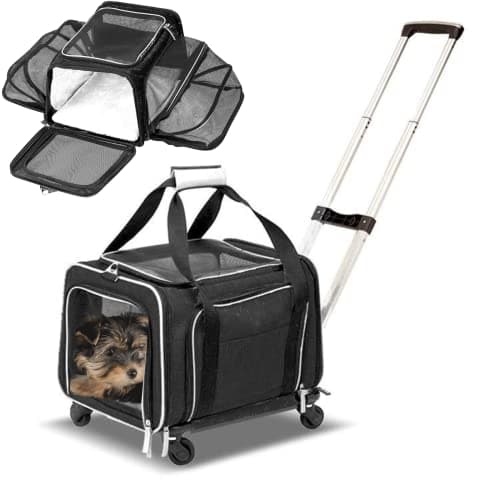
For most travelers: the Sherpa, because the failure modes of a Sherpa are known quantities. For a long connection where the dog will be in the bag for hours, the Ruff Life 101 — it is the only pick here that rolls and expands. For mixed terrain, the Pet Gear. And when the under-seat height is the thing that decides it, the EliteField — a listed 9 inches tall, the lowest profile of anything here, and it still takes backpack straps.