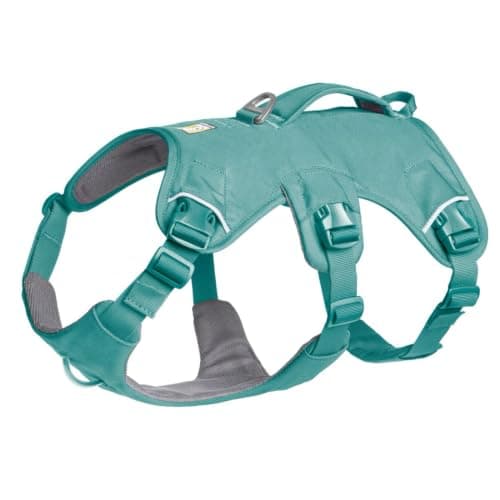
Most dog harnesses are two straps: one around the neck, one around the chest. The Web Master is three, with the extra one sitting behind the ribcage, and it has a padded, reinforced handle across the back. Those two decisions are the entire product. Everything else — the ripstop shell, the aluminum V-ring, the reflective trim — is Ruffwear doing competent Ruffwear things.
We rank it first on escape-resistant harnesses and it is the technical-terrain pick on best dog hiking harnesses. This page is the long version: what Ruffwear publishes, what it conspicuously does not, and which dogs are better served by something cheaper.
What Ruffwear publishes
Read off Ruffwear's own product page on 2026-10-18, because this is a category where retailer listings paraphrase badly:
- Three-strap design, four points of adjustment.Ruffwear's own copy calls it "great for houdini dogs".
- A neck buckle, so the harness does not have to go over the head — which matters more than it sounds for head-shy and ear-sensitive dogs.
- Shell: 150-denier polyester ripstop with a PU coating, 40% recycled content, bluesign approved. Lining: polyester knit mesh. Padding: closed-cell foam, with a breathable perforated foam and molded back panel.
- Buckles: ITW Nexus Airloc. Back leash attachment: an anodized 6061-T6 aluminum V-ring. Front attachment: nylon webbing in molded TPU, for redirecting a pulling dog.
- Reflective trim plus a light loop, and a nylon tow loop.
- Sizes by girth:XXS 13-17 in, XS 17-22 in, S 22-27 in, M 27-32 in, L/XL 32-42 in. Ruffwear's between-sizes advice is explicit: choose the smaller size.
- Care: hand wash, mild detergent, air dry.
And the part that matters most on a harness sold with a lifting handle: Ruffwear publishes no weight for the harness and no lifting or load limit of any kind. The page describes "balanced lift and assist support". It does not say how many pounds, and we are not going to supply a number it declines to publish. If you need a rated lifting system — for climbing, for technical rescue, for hauling an unconscious dog — this is not a rated lifting system and nothing sold in a pet store is.
What it gets right
The third strap is a geometry fix, not a marketing feature
A two-strap harness is escaped the same way every time. The dog reverses, the rear strap slides forward onto the narrower part of the ribs, the neck loop rides up and over the ears and the dog is loose with the harness still fastened. The Web Master's third strap sits behind the ribcage, so there is nowhere for the rear strap to slide forward to. That is why it is the harness we recommend for a flight risk in an unfamiliar place — a new city, a trailhead, an airport curb — and we have written the plan for when it goes wrong anyway.
The handle changes what you can do with a dog
A padded handle over the back, with a strap either side of it, lets you take a dog's weight briefly and in balance: up a rock step, over a stile, out of a boat, into the back of a vehicle. Compare that to a handle sewn to a two-strap harness, which concentrates the lift on the chest strap and tips the dog forward. If you own a senior dog whose back end is going, this is the single piece of gear that extends the walks you can still do — and it pairs with the ideas on traveling with a senior dog.
The neck buckle
Nothing goes over the head. For a dog that has learned to dislike being dressed — common in rescues and in dogs with ear problems — this alone is the reason the harness goes on without a negotiation.
Build quality where the load is
An anodized aluminum V-ring on the back rather than a stamped steel D-ring, Airloc buckles, ripstop shell. The things that fail on cheap harnesses are the hardware and the stitching at the attachment point, and that is where Ruffwear spends the money.
Where it falls short
It is more harness than most walks need
On flat ground, with a dog that does not pull and has never tried to escape, you are paying for a strap and a handle you will not use. We say this on the comparison page and we will say it here: the Front Range is the better value for ordinary trail walking.
Three straps take longer to fit
Four points of adjustment is a genuine first-fit session — ten minutes with the dog standing still, then a check after the first walk. Done badly, the third strap sits too far back and rubs; done well, you never think about it again. Budget the time.
No published lift rating, on the product whose selling point is lifting
Covered above, and it is the honest limitation of this review: we can tell you the handle is reinforced and padded and that Ruffwear describes it for lift and assist. We cannot tell you a load limit, because Ruffwear does not publish one. Treat it as assist for a dog that is still bearing some of its own weight.
Hand wash
Ruffwear specifies hand washing. On a harness that will spend its life in mud, salt water and wet sand, that is a real chore — and a machine cycle is how the foam and the shell coating get wrecked early.
Not a car restraint
This is the misuse we see most. A hiking harness is not crash-tested and clipping a seat belt tether to its back ring in a car is not a restraint system. Buy a tested car harness for the drive; our crash-tested harness roundup exists for exactly this, and crate vs harness in the car covers the wider decision.
Who should buy it
Buy it if your dog has ever backed out of a harness, if your walks involve scrambling, water, boats or stiles, if your dog needs a hand getting into the car, or if you travel with a dog in unfamiliar places where getting loose is the worst thing that could happen. The third strap and the handle are both insurance, and insurance is worth most exactly where you are least at home.
Buy something else if your dog is young, sure-footed and reliable on a flat trail (Front Range), if you need a car restraint (crash-tested harness), if you need a no-pull training tool specifically (a front-clip harness and a trainer), or if the real job is carrying a small dog rather than assisting a big one — which is what our how to carry a large dog guide splits out.