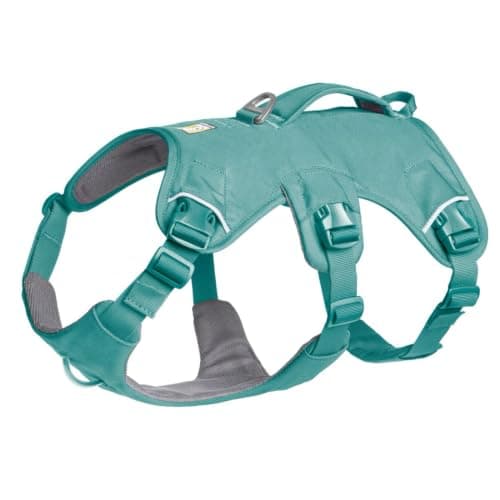
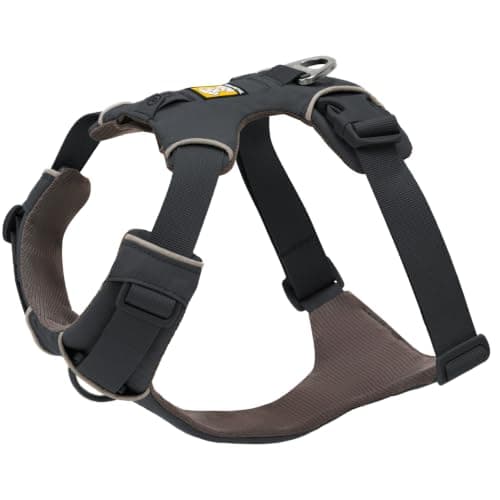
These two come up together constantly, and the confusion is understandable: same brand, similar look, meaningfully different price. They are not competing products so much as products for different jobs that happen to overlap in the middle.
The short version: the Front Range is an everyday harness that handles hiking well, and it is the right answer for most dogs and most people. The Web Master is a technical harness with a third strap and a reinforced handle, built for lifting and assisting a dog over terrain — and it is overkill, and slightly uncomfortable, for a walk around the block.
Both appear in our hiking harness roundup. This page is the head-to-head for people who have narrowed it to these two.
If the Web Master is the one you are leaning towards, the longer version of the case for it - what Ruffwear publishes about the three straps and the handle, and the lifting limit it conspicuously does not publish - is in our Ruffwear Web Master harness review.
Head to head
| Consideration | Front Range | Web Master |
|---|
| Straps | Two points of adjustment | Three, including a belly strap |
| Handle | Present, for guiding | Reinforced, positioned for lifting |
| Can you lift the dog with it | Assist only | Yes, that is the design intent |
| Coverage and heat | Less material, cooler | More material, warmer |
| Escape resistance | Good | Better — the third strap closes the gap |
| Everyday comfort | Excellent | Good, but more harness than most walks need |
| Price bracket | Mid | Premium |
The third strap is the actual difference
Everything else follows from it. The Web Master's belly strap means the harness cannot rotate or be backed out of the way a two-strap harness sometimes can, and it means load from the handle is spread across three points instead of two. That is what makes lifting possible and safe. It is also more material against the dog, which matters in heat.
Buy the Web Master if you will actually lift
Scrambling terrain where you hand the dog up a rock step. Boats, where you may need to lift a soaked dog out of water — though for that also read our life jacket roundup, since a jacket handle is the better tool in water. Assisting a dog with mobility problems in and out of a car, though a ramp is kinder if the vehicle is the issue. Dogs that have escaped harnesses before.
Buy the Front Range for everything else
Daily walks, ordinary trails, car use with a tether, and travel generally. It is lighter, cooler, quicker to put on, cheaper, and for the overwhelming majority of dogs it is simply the better harness to live in. Choosing it is not a compromise.
Neither is a car safety restraint
Worth stating plainly, because the handles invite the assumption. Neither of these is crash-tested, and a hiking harness clipped to a seatbelt is not a certified restraint. For that you want a purpose-built tested harness — see our crash-tested roundup.
Fit both the same way
Measure the girth behind the front legs and buy to the chart. Two fingers under any strap and no more. Check the fit again after a few wears, because webbing settles — and re-check when the dog's coat changes with the season, which moves the effective girth more than people expect.
The verdict
Buy the Front Range unless you can name the specific occasion you will lift the dog by the handle. If you can — scrambles, boats, a dog with mobility problems, or an escape artist — buy the Web Master and accept the extra warmth as the cost of the capability.