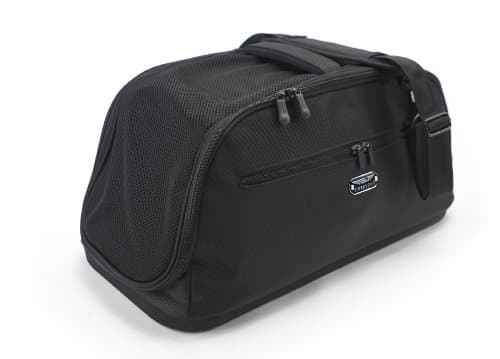
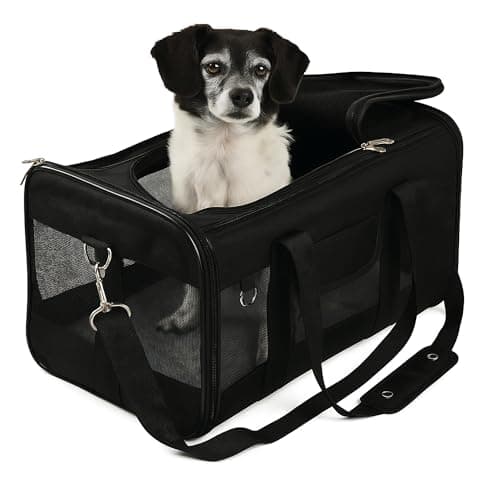
This choice gets made on the wrong axis almost every time. People compare the under-seat dimensions of a soft carrier and a backpack carrier, discover they are nearly identical, and conclude it does not matter. It matters a great deal - just not in the air. Both forms spend the flight in the same place, flattened into the same footwell. The difference is the forty minutes at each end, with a boarding pass in one hand and a roller bag in the other. For most flyers the traditional soft carrier is still the right buy, and the Sherpa Original Deluxe is the one we would get. If your journey has stairs, a shuttle and a long concourse, the backpack is the better tool.
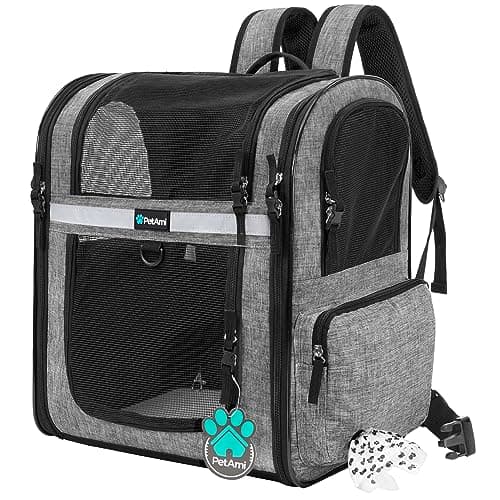
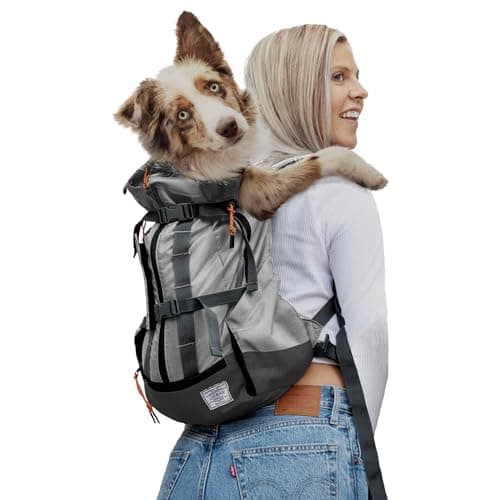
Before anything else, the trap. "Dog backpack carrier" describes two completely different products, and only one of them flies. A soft backpack carrier like the PetAmi is a normal in-cabin carrier with shoulder straps - it zips closed, it has a defined footprint, and it stows under a seat. A hiking carrier like the K9 Sport SackUrban 3 is a legs-out pack: the dog's legs come through four openings and the dog rides against your back. It is excellent at what it does, which is a trail, and it is not an under-seat carrier. We have ranked it here precisely so you can see the difference rather than discovering it at a gate.
We have not flown with any of these. The dimensions are the manufacturers' published figures and the airline limits are the published ones on our under-seat reference, which is dated and per-airline. Confirm your specific aircraft before you fly, because the limit that matters is the one on the plane you are actually on.
What actually decides it
1. What your hands are doing
This is the whole comparison in one line. A shoulder-carried soft carrier occupies one hand or one shoulder, permanently, for the entire time you are not seated - through check-in, security, a bathroom, a coffee, a gate change. A backpack occupies none. If you are travelling alone with a carry-on as well, the backpack is not a nicety, it is the difference between manageable and not. If you are travelling with another adult who can hold things, the soft carrier's advantages come back.
2. How the two behave at security
Identical, and worth knowing in advance: the dog comes out of the carrier and the empty carrier goes through the X-ray, while you carry or walk the dog through the metal detector. The form factor changes nothing about the procedure, but it changes how easy it is - a backpack set down on the belt is simpler to re-shoulder on the far side than a shoulder bag you were already juggling. The procedure in full is on TSA screening with a dog.
3. Which one actually compresses
Under-seat gaps are shorter than the published allowance on plenty of aircraft, so compression is the real-world spec. The Sherpa spring-wire top frame pushes down, which is exactly the feature that gets a carrier into a gap it technically should not fit. The Sleepypod Air compresses at both ends, which is why it is the pick for someone who flies different aircraft and cannot predict the footwell. Rigid-backed backpacks compress least - the structure that makes them comfortable to wear is the structure that will not yield.
4. Ventilation, and where the dog's face is
A soft carrier sits beside you at knee height and you can see into it. A worn backpack puts the dog behind you, which is fine walking and not fine if the dog is panicking and you cannot see it. For an anxious or first-time flyer, visibility is worth more than free hands. Mesh area matters on both; a hot jet bridge is the worst moment of the trip for a dog, and the PetAmi is ventilated on multiple panels for that reason.
5. The weight ceiling nobody checks
Soft backpack carriers top out lower than people expect - the PetAmiis listed to 18 lb, and that is typical of the category. Traditional soft carriers go a little further by size band. If your dog is near the top of any of these numbers, the binding constraint is usually not the carrier at all but the airline's own combined weight limit and its fit test. That is the subject of carriers for large dogs, and the answer there is often that the dog does not fly in the cabin.
6. What you do with it after the flight
A backpack carrier earns its keep on the trip rather than the flight: a city, a trail, a train platform. The K9 Sport Sack is the extreme version of that - a genuine hiking carrier sized by back length - and if the holiday is the point rather than the flight, owning one of each is a legitimate answer. The wheeled option is a third form again, covered on carriers with wheels.
Which is wrong for you
Skip the backpack if your dog is anxious in the air, if it is near 18 lb, or if you are flying with another adult - the visibility and the compression of a soft carrier are worth more than free hands in those cases. Skip the traditional soft carrier if you are solo with a roller bag and a long connection, which is the scenario it handles worst. Do not buy a legs-out hiking pack for a flight. It is not an under-seat carrier, no matter how the listing is titled.