Under $50, buy the Kurgo Journey Air Dog Harness — it is the one we would put on a dog that hikes in warm weather, because the mesh panels do a job that foam padding cannot. If your dog carries its own small load or you want a handle you can genuinely haul on, the OneTigris Tactical Dog Harness is the tougher build. The budget pick is the rabbitgoo No-Pull Dog Harness, which is a lot of harness for very little money as long as you are honest about where it is going. And the sentence that frames the whole page: the money above $50 buys hardware and published specification, not comfort.
That is worth unpacking before any product, because it is the actual decision. Our top pick in the category overall is the Ruffwear Front Range, which Ruffwear listed at $59.99 on its own product page when we read it on 1 November 2026 — a ten-dollar step up from this band. What that ten dollars gets you is a 300D recycled ripstop shell, an anodized 6061-T6 aluminum rear V-ring instead of a plastic or steel D-ring, ITW Nexus buckles, and — the part that actually matters — a published girth ladder you can buy against, from 13-17 in at XXS to 32-42 in at L/XL. None of the four harnesses below publishes anything that precise where we could read it, and that is the real cost of shopping in this band.
What that ten dollars does notbuy is a more comfortable harness for a dog that hikes in heat, which is why our pick here is not simply "the cheapest thing that looks like a Front Range". Read the criteria first, then the picks.
The five things that decide a trail harness
These are in weighted order. We score against a published rubricand we do not test gear — these judgements come from the makers' published specifications, the listing detail, and owner reports of how each harness fails.
1. Adjustment points (weighted highest)
A harness with two adjustment points fits dogs shaped like the fit model. A harness with four fits your dog. On the trail that distinction becomes chafe: a strap that sits a half-inch too far forward rubs the armpit for eight miles, and that is the single most common reason a harness ends up in a drawer. Every pick below has at least four adjustment points, which is the floor for this page rather than a feature.
2. Where the straps sit, and what they are made of
Look for padding on the chest plate and across the sternum, and for webbing that is bound or rolled at the edges rather than cut raw. In this band you are mostly choosing between air mesh (lighter, cooler, dries fast, abrades sooner) and padded nylon or Cordura-style fabric (tougher, hotter, slower to dry). This is a genuine trade and not a quality ladder — the right answer depends on whether your problem is heat or thorns.
3. Two leash points, and what each is for
A back clip is the hiking attachment: it keeps the line out from under the dog's feet and it is where a shock load belongs. A front clip is a steering attachment for a dog that pulls, and it is not a load-bearing point on any harness in this band. Three of the four picks have both. Our standing position, repeated on hiking harness vs walking harness, is that a front clip is a training tool rather than trail equipment.
4. A handle you can actually use
A webbing loop on the back is not the same thing as a load-bearing handle. On a scramble, a stream crossing or a lift into a truck bed, a real handle is stitched into the structure of the harness and sits over the shoulders; a decorative one is sewn to the top panel and will tell you the difference at the worst moment. Two picks here have genuinely useful handles, and we say which.
5. Reflectivity and hardware honesty
Reflective stitching is cheap to add and worth having, because a lot of hiking finishes at dusk. Hardware is where this band saves money: plastic side-release buckles and a stamped D-ring are normal under $50. They are fine for the loads a walking dog puts through them; they are not what you want for lifting a 70 lb dog off a ledge. If that is your use case, the Ruffwear Web Master Support Harness exists for exactly that and it is not in this band.
The four, side by side
| Harness | Adjustment | Leash points | Handle | Build | Best for |
|---|
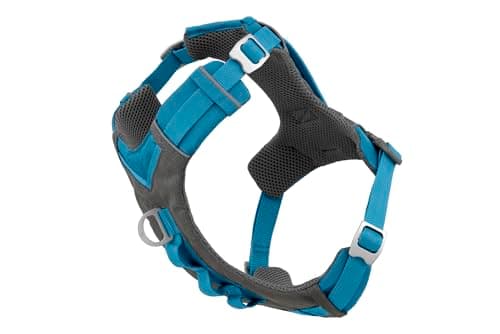
| Kurgo Journey Air Dog Harness | Four points | Front + back | Yes, padded | Air-mesh panels, reflective stitching | Warm-weather hiking |
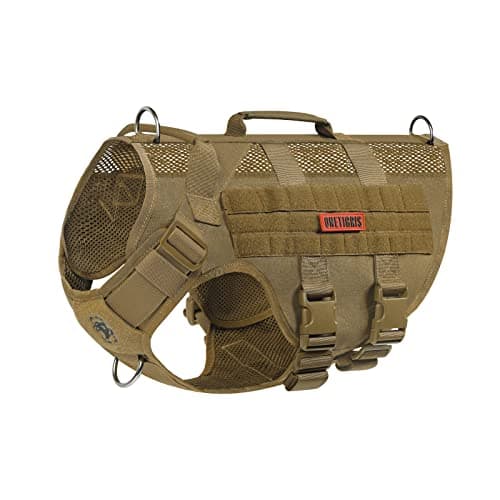
| OneTigris Tactical Dog Harness | Adjustable, four points | Back | Yes, top handle | MOLLE webbing panels, padded | Dogs that carry gear |
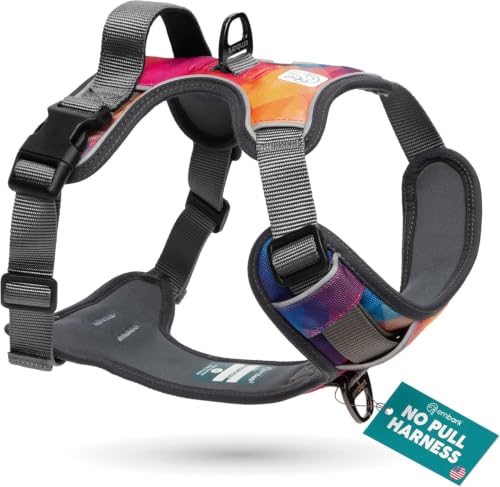
| Embark Adventure No-Pull Dog Harness | Four points | Front + back | Yes, control handle | Padded chest, reflective | Mid-budget all-rounder |
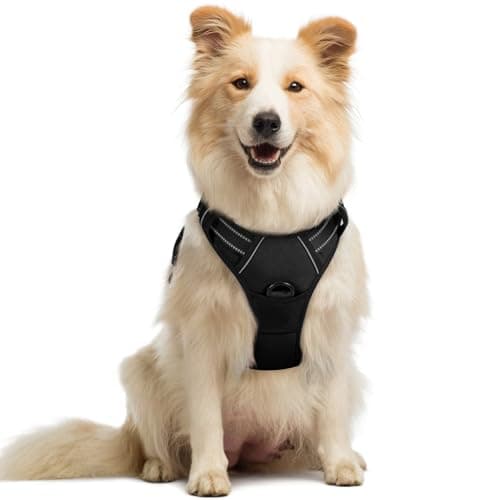
| rabbitgoo No-Pull Dog Harness | Four points | Front + back | No | Padded, reflective, plastic hardware | Budget everyday and light trails |
Live prices sit in the table below with their own "as of" date — we never type a price into prose. The $50 ceiling is the headline; the number in the table is the one that counts at checkout, and if a pick has drifted over the line since the last price check the table will show it.
The picks, and the honest con on each
Kurgo Journey Air Dog Harness — the one to buy
It is the closest thing in this band to the shape of a premium trail harness: four adjustment points, front and back leash attachments, reflective stitching, and a padded handle that the Front Range — our overall category pick — does not have at all. The air-mesh panels are the reason it wins here. A foam-padded harness on a dog working uphill in 80°F is a heat-retention layer across the chest, and mesh is measurably better at the one thing that matters there.
The con: the airy build that wins in summer is the one that wears faster in cold, wet, abrasive conditions. If your hiking is winter scrub and granite rather than summer singletrack, the Embark Adventure No-Pull Dog Harness or a step up to the Ruffwear Front Range Dog Harness is the more durable buy. We cover the same trade from the other direction on Ruffwear alternatives.
OneTigris Tactical Dog Harness — for a dog that carries
The rugged pick. MOLLE webbing panels on both flanks let you attach small pouches, which makes this the sensible choice if your dog carries its own water or waste bags on day hikes and you do not want a full saddlebag pack. The top handle is stitched into the structure rather than onto the panel, and the build is the toughest in the band.
The con: it is a single-clip harness — back attachment only — so it does nothing for a dog that pulls, and the rugged construction is heavier and hotter than the mesh options. If the dog does not actually carry anything, you are paying in weight and ventilation for panels you will never clip to. For a real load, a dedicated pack is the better answer: our saddlebag roundup ranks those, and the standing rule there is 10-15% of bodyweight for a conditioned adult dog.
Embark Adventure No-Pull Dog Harness — the middle option
A solid mid-budget no-pull harness with a genuine control handle, front and back clips and a padded chest. If you want one harness that handles trails, sidewalks and a dog that still pulls when it sees a squirrel, this is the most complete feature set in the band.
The con: it is the middle option in the literal sense — the rabbitgoo No-Pull Dog Harness saves real money and the Ruffwear Front Range Dog Harness buys real durability, and this sits between them without winning either argument outright. Buy it because the handle plus two clips is the combination you want, not because it is a compromise.
rabbitgoo No-Pull Dog Harness — the budget pick
Four adjustment points, front and back clips, padding and reflective trim at a price that makes the others look expensive. For a dog whose hiking is a park trail and a fire road, this is enough harness, and we would rather see a well-fitted cheap harness than a badly fitted expensive one.
The con: plastic clips and a lighter build. That is fine for the loads a walking or trotting dog generates and it is not what you want for scrambles, for a dog that lunges hard at wildlife, or for anything involving lifting. Treat it as the sidewalk and easy-trail answer it is.
Fit beats everything on this page
A $50 harness fitted properly outperforms a $90 harness fitted by eye, so do this before you buy anything:
- Measure chest girth.Soft tape around the deepest part of the chest, just behind the front legs, snug but not tight. That number — not your dog's weight — is what harnesses are sized by. Weight is the worst predictor of harness fit and it is the figure most listings lead with; a 40 lb beagle and a 40 lb whippet are not the same shape anywhere that matters.
- Check the band on the exact size you are buying.In this band the published sizing is thin, so read the size chart on the listing in front of you rather than trusting the brand's S/M/L to mean what another brand's does. If your dog is between sizes, go up and take up the slack on the adjusters.
- Two fingers, flat. You should be able to slide two flat fingers under any strap. Tighter than that is a chafe point at mile six; looser is a harness a frightened dog can reverse out of.
- Walk it before you hike it. Thirty minutes on pavement tells you where it rubs while you are still ten minutes from home.
- Then check it again at the trailhead. Harnesses loosen. Our hiking checklist has this as a pre-walk item for a reason.
When NOT to buy a harness in this band
- Your dog escapes harnesses. Four adjustment points make a harness that fits, not one a panicking dog cannot back out of. The feature that actually stops it is a third strap behind the rib cage, and nothing under $50 has one — our escape-proof roundup covers the geometry.
- You need to lift or spot the dog. Scrambles, stream crossings, a dog with a bad hip going into a truck bed. That is a load-bearing handle and reinforced hardware, and it starts above this band.
- It is going in the car. No harness here is crash-tested and none of the makers claims it is. Clipping a walking harness to a seat belt keeps a dog out of the footwell; it is not restraint in a 30 mph stop. Use a tested harness for that, and see car seats under $100 if the dog is small.
- Your dog is very small or very oddly shaped. This is where published girth ladders earn their premium, and it is why our small-dog harness page leads with Ruffwear despite the price.
Everything else — a healthy adult dog, four to ten miles, dirt and rock and the occasional creek — is well served by fifty dollars. Pair it with a decent leash, keep wax on the pads if you hike hot or icy ground, and spend the money you saved on a first aid kit you will probably never open.