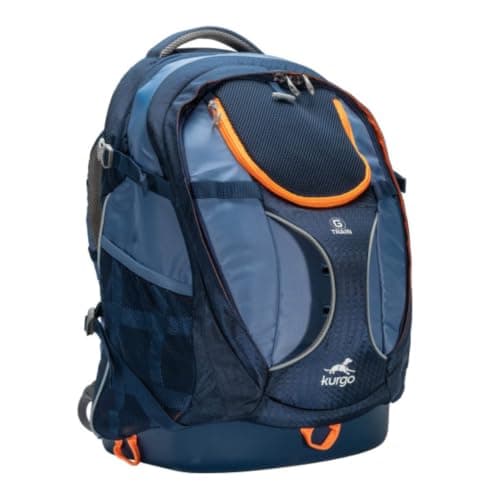
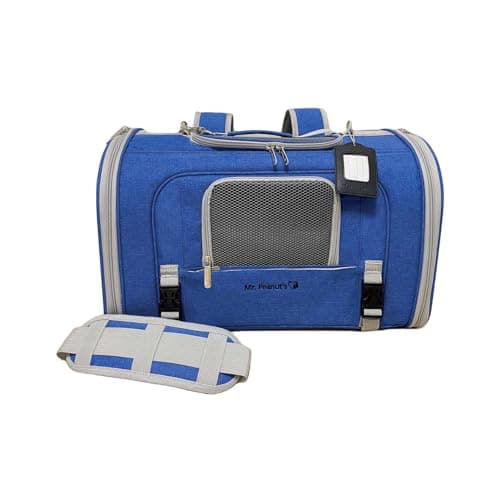
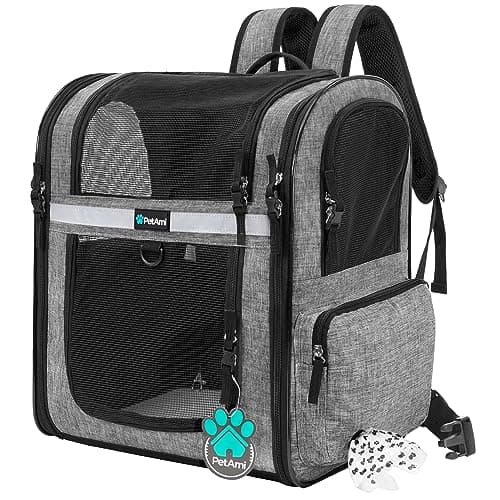
If you are switching to save money but still want load-carrying comfort, buy the Petsfit Padded-Waist Dog Backpack Carrier. If you want morepack rather than less — the dog plus the day's water, bowl and layers — buy the Kurgo G-Train Pet Carrier Backpack. If the trip is a flight rather than a trail, buy the Mr. Peanut's Monterey Series Horizontal Backpack Carrier, which is an airline-compliant carrier that happens to wear as a backpack. And if the honest use is a city errand twice a month, the PetAmi Ventilated Dog Backpack Carrier is the sensible purchase.
Before any of that, the fair version of what you are replacing — because the K9 Sport Sack tops our dog backpack carrier roundup and deserves to. What it is known for is a legs-out design: the dog sits upright with its front legs through the pack rather than folded into a bag, which is why these packs look nothing like a commodity carrier and why dogs tend to settle in them. The suspension is built like a hiking pack rather than a tote, so the load is bearable for hours instead of minutes. And the sizing is fitted to the individual dog rather than to a weight bracket, which is the single reason it fits dogs that generic packs do not.
It is worth being precise about that sizing claim, because it is both the brand's biggest advantage and the most common source of a bad purchase. When we read k9sportsack.com/pages/sizing on 15 November 2026, the page was headed "Shop by length of back" — and it also sorted the carriers by weight, into Small (5-25 lb), Medium (25-40 lb) and Large (40+ lb), offered a sizing quiz, and printed no numeric back-length ranges and no per-model weight ceiling on that page. So the measurement that makes the system work is the one you have to go and find. Model names visible there were the Urban 3, the Air, the Kolossus and the Trainer, which is the other thing people trip over: "K9 Sport Sack" is a product line, not a product, and the Urban 3 we rank is one member of it.
Two genuine limitations follow from the design, and they are the real reasons to switch rather than price. A legs-out pack gives a frightened dog nowhere to hide— some dogs want to be enclosed, and for those dogs this shape is wrong at any price. And a pack fitted to one dog's proportions does not carry over to a second, differently shaped dog, which matters in a two-dog household.
The five reasons people substitute
| Why you are switching | What you actually need | Buy |
|---|
| Price, but the dog is heavy | Waist support, which is what makes weight bearable | Petsfit Padded-Waist Dog Backpack Carrier |
| Price, and the carries are short | Ventilation and easy loading, not suspension | PetAmi Ventilated Dog Backpack Carrier |
| You carry the dog and the kit | A hip belt and real storage | Kurgo G-Train Pet Carrier Backpack |
| It is a flight, not a hike | Published under-seat dimensions, not a trail harness | Mr. Peanut's Monterey Series Horizontal Backpack Carrier, or EliteField Deluxe Rolling Backpack Carrier for a long terminal |
| The dog will not ride behind you | Eye contact, or an enclosed space to hide in | Outward Hound PoochPouch Front Carrier (front) or PetAmi Ventilated Dog Backpack Carrier (enclosed) |
Live prices for all six picks are in the table below with their own "as of" date. We have not quoted a price for the K9 Sport Sack from the maker's own site; our K9 Sport Sack review carries its live price so you can compare the real numbers rather than our prose.
The six, and the honest con on each
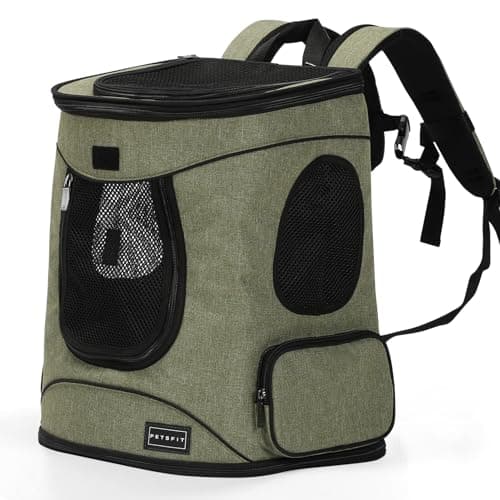
1. Petsfit Padded-Waist Dog Backpack Carrier — the closest swap on comfort
If what you valued about the original was that it did not wreck your shoulders, this is the alternative to buy. It is the only other pack here with real padded waist support, and a waist belt is the single biggest comfort difference in this category: it transfers load off your shoulders onto your hips, which is the difference between an hour and fifteen minutes. It also publishes an 18 lb ceiling, which the cheap end of this category quietly omits, and Petsfit's soft-carrier line has a long enough owner record that the materials are a known quantity.
The con: it is a softer structure than the premium packs, so it sags a little under a heavy dog, and the dog is enclosed rather than legs-out — which some dogs prefer and some do not. The waist belt is also bulk you carry on short trips where it does nothing. If your dog is under about 8 lb, the support system is sized for a load you do not have and a simpler bag is lighter.
2. Kurgo G-Train Pet Carrier Backpack — the one to buy if you want more, not less
Not everyone leaving the K9 Sport Sack is trading down. If you carry the dog and the water, the bowl, the layers and the first aid kit, the G-Train is the most gear-like pack in this group: a proper hip belt, real storage compartments, ventilated panels, and Kurgo hardware that is the same hardware on its car and trail gear. The hip belt is what turns two miles into six. Our K9 Sport Sack vs Kurgo G-Train comparison takes these two head to head if this is the choice you are actually making.
The con: it is the most expensive carrier in this group — so as a cost-motivated alternative it fails completely — and it is heavy empty: you feel the pack before the dog is in it. The hip belt is wasted on short bursts. If you carry the dog for ten minutes at a time, you are paying for suspension you will never load.
3. Mr. Peanut's Monterey Series Horizontal Backpack Carrier — the right answer if the trip is a flight
This is the substitution people most often get wrong. A trail pack is engineered around your back; a flight is decided by a box under a seat. The Monterey is built as an airline-compliant carrier that happens to wear as a backpack, which is the correct order of priorities for a plane. It publishes both under-seat orientations — 18.9 x 9 x 11.4 in upright and 18.9 x 11.4 x 9 in on its side — rather than a vague airline badge, is listed for pets up to 13 lb, weighs 2.8 lb empty, and has a pliable frameless top over a plywood-stiffened floor, so it compresses into a tight space without sagging. Self-locking zips and mesh on all four sides.
The con: it is priced well above the commodity carrier backpacks and the premium buys airline engineering rather than capacity, so it is the wrong purchase for a trail. At 18.9 in long it is also longer than the under-seat space on some narrow-body aircraft — check your aircraft against our airline under-seat dimensions reference before you buy. And if your dog is over about 13 lb or over 16 in lying down, the rounded ends mean there is no slack in either number.
4. PetAmi Ventilated Dog Backpack Carrier — the budget pick
The sensible first backpack carrier, and the right purchase for a lot of people who were about to spend four times as much. Four-way entry means you can load a reluctant dog the easy way instead of the designed way — a genuinely underrated feature — mesh on multiple faces keeps airflow up, which is the main welfare issue in an enclosed carrier, and it publishes an 18 lb ceiling. It is also enclosed rather than legs-out, which makes it the cheap answer for a dog that wants to be in a den.
The con: padded shoulder straps but no real hip belt, so a long carry lands entirely on your shoulders and you will feel it. The enclosed shape suits a dog that settles; an anxious dog gets less to look at than in a legs-out pack, which is the trade you are making. Do not buy this one for hiking miles with a heavy dog — that is exactly the job the premium suspension exists for.
5. EliteField Deluxe Rolling Backpack Carrier — for a route with wheels in it
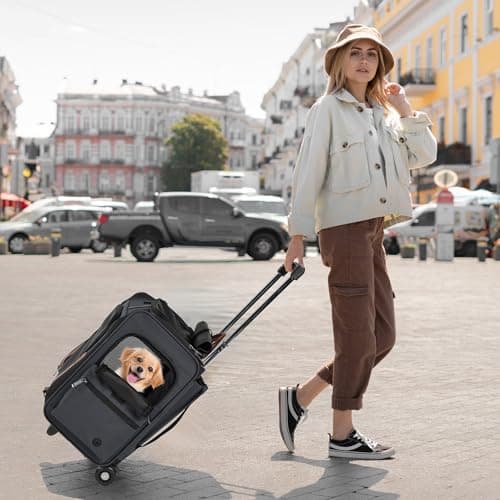
The alternative for an airport rather than a trailhead. Wheels and padded backpack straps on one bag, listed at 18 x 13.5 x 9 in — and 9 inches of height is the lowest profile here, which matters because height is the dimension a wheeled carrier usually fails. You roll the concourse and wear it up the stairs, so curbs, escalators and shuttle steps stop deciding your route. Waterproof fabric, scratch-resistant Textilene mesh, three mesh doors and a roll-down rain curtain over the top one.
The con: EliteField publishes the exterior dimensions but no pet weight ceiling— its guidance is to check your pet's size yourself, so this is a carrier you measure your dog against rather than trust. It is also 5.6 lb empty, which is a chunk of your own allowance gone before the dog is in it, and carrying a wheeled bag on your back means carrying the wheels too. If your route is smooth floor end to end, a dedicated roller is lighter; our wheeled carrier roundup covers that case.
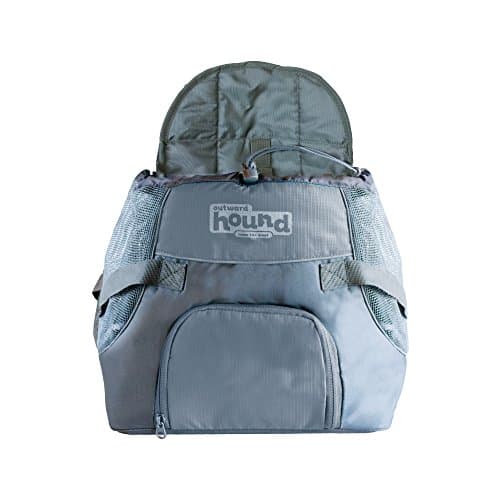
6. Outward Hound PoochPouch Front Carrier — for the dog that will not ride behind you
The cheapest way into carrying a small dog, and the right shape for a specific problem: a dog that panics when it cannot see you. Front-worn means constant eye contact, and you can see and adjust the dog without taking the pack off, which matters on a busy street. Legs-out opening, adjustable straps, small sizing. For an anxious puppy on short calm outings this beats every back-worn pack on this page, and it costs a fraction of any of them.
The con: front-loading throws your balance backwards and gets tiring far faster than a back-worn pack — this is a ten-minute carrier, not a trail carrier. It is small sizing only, so genuinely for little dogs and puppies, and past about 10 lb or past a short walk it is the wrong tool. If what you need is distance with a small dog, go back to the top of this page. And if the anxiety is the whole problem rather than the carrier, our ThunderShirt alternatives page covers the drug-free options and is honest about how little published evidence any of them has.
Three things no alternative changes
Measure the dog, not the breed. Every good outcome in this category comes from two numbers: back length from the base of the neck to the base of the tail, and weight. Back length is the one almost nobody publishes a ladder for — including, on the page we read, the brand best known for using it — so measure your dog first and then go looking for a carrier that states a figure you can compare it against. Our guide to measuring a dog for a carrier is the five-minute version.
A carrier backpack is for the last mile, not the whole walk. The point of this category is the gap between a dog that can walk the whole trail and a dog that should not be on it — small breeds on long days, short-legged dogs on rocky sections, seniors who can enjoy an outing but not finish one, puppies before their joints are ready. A dog that rides the entire time is a dog that did not need to come, and a dog carried in heat is a dog in an enclosed space with reduced airflow: watch for panting, check the mesh is not pressed against your back, and stop more often than you think you need to.
And none of these is a car restraint. A carrier backpack is not crash-tested and no maker here claims it is. If part of the trip is in a vehicle, the dog needs a restraint that was designed for it — that is a different product, and our crash-tested harness roundup is where that decision lives. Our guide to carrying a large dog covers the case none of these packs can: a dog too big for any of them.