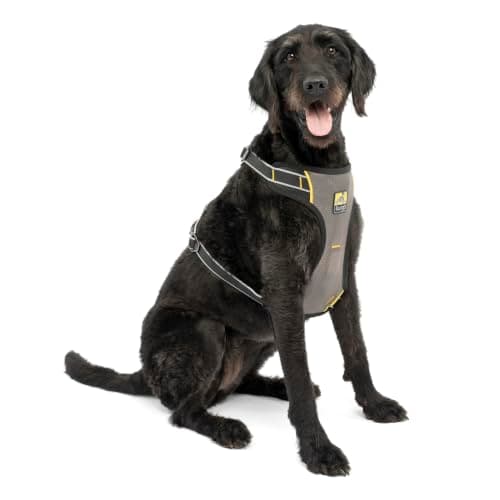
The verdict: the Kurgo Impact is the car harness to buy if you want real hardware and a published test history at a mid-range price — and it is not the safest restraint on the market, which Kurgo is more honest about than most of its competitors. Kurgo publishes that the harness is a single piece of 4,000 lb tubular webbing with reinforced bar tacking and all-steel nesting buckles, that it was tested at an established university facility using the Federal Motor Vehicle Safety Standard for child restraint systems with simulated dogs, and that it passed at Calspan in 2020 for dogs up to 108 lb. Most harnesses sold as "crash tested" publish none of that.
The reason to read on is the sizing, which is the weakest part of the product and the thing most likely to make your purchase useless: Kurgo sizes this harness by the dog's weight and publishes no chest girth at all. Two 50 lb dogs can be built completely differently, and a car harness that does not fit snugly is a car harness that lets a dog move in a crash.
The number that changed, and why it is the best thing about this harness
Kurgo's own product page carries two crash-test results, not one. The Impact initially passed at the University of Michigan in 2016 for dogs up to 130 lb, and it passed again at Calspan in 2020 for dogs up to 108 lb, under what Kurgo describes as current PPSC testing guidelines — because, in Kurgo's own words, it has since refined its dog dummy and its testing standards. So the headline figure went down, and the company left the old number on the page with an explanation instead of quietly deleting it.
That is the single most useful thing on this page. In a category where "crash tested" is a marketing phrase with no legal definition behind it, a maker that shows you its working — the lab, the standard it borrowed, the weight the dummy represented, and the revision that made the claim smaller — is telling you something you can actually weigh. You will still see 130 lb quoted on retailer and reseller pages; that is the 2016 result, and the current one is 108 lb. Use 108.
Note what the standard is, too, because it is widely misread: there is no federal crash standard for dog restraints. Kurgo borrowed the child restraint standard, which is a reasonable and well-defined test to borrow, and ran simulated dogs against it. It is not a government certification of the harness, and Kurgo does not claim it is.
What it is not: not CPS, and not a walking harness
Kurgo's page does not mention the Center for Pet Safety. We checked, because the two ideas get conflated constantly. CPS runs the voluntary third-party certification program that the Sleepypod Clickit leads on; Kurgo publishes its own independent testing instead. Both are more than most brands do, and they are not the same claim. If published third-party certification is the thing you want, the honest answer is the Sleepypod Clickit Sport, and our Clickit versus Impact head-to-head sets out what the extra money buys.
Kurgo explicitly recommends the Impact as a car travel safety harness only. That sentence is on its own product page, and it is not a disclaimer to skim past. The Impact has a leash attachment on the back, and a maker that tells you not to walk the dog in its own harness is telling you about padding, bulk and where the load goes. Buy it as a piece of car equipment that lives in the car; if you want one harness for the trail as well, that is a different product and our hiking harness roundup and the hiking versus walking harness explainer are where that decision lives.
The hardware, and what it means in a crash
- A single piece of 4,000 lb tubular webbing."Single piece" is the important half. Load in a crash finds seams and stitched joins first; a continuous run of webbing has fewer places to start failing, and reinforced bar tacking is the stitching pattern built to take shear rather than to look neat.
- All-steel nesting buckles and hardware. Nesting buckles are the ones that interlock so the load passes through metal rather than through a plastic catch. This is the difference between a restraint and a tether with clips on it, and it is the clearest physical reason the Impact costs more than a basic strap.
- A padded chest plate. Spreading the load across the chest rather than concentrating it on a strap is the entire mechanism of a car harness. A dog decelerating from highway speed on a narrow band is a dog being injured by its own restraint.
- It works with the car's own seat belt.The harness is the part that spreads the load; the vehicle restraint system is the part that stops the dog. Check what is in the box on the listing you buy and confirm you have the seat belt loop or tether you need — Kurgo's feature list on the page we read names the back leash attachment and does not itemize the box contents. Our seat belt tether page covers what a good one looks like and how short it should be.
- A lifetime guarantee, and a 45-day return window. Kurgo says it will repair or replace the harness free of charge for a manufacturing defect. A lifetime guarantee on a safety part is a company taking a position on its own build quality.
- Spot clean or hand wash, air dry. Not a machine-wash part, which matters on a muddy trip. Do not tumble dry webbing you plan to trust in a crash.
The sizing problem, in detail
Kurgo publishes four weight bands — Small 10-25 lb, Medium 25-50 lb, Large 50-75 lb and X-Large 75-108 lb — and advises sizing up if your dog is at the edge of a range. It publishes no chest girth figures. That is the weakest possible way to size a harness, and on a safety part it is a real criticism rather than an inconvenience.
Think about what a weight band actually describes. A 45 lb barrel-chested bulldog and a 45 lb deep-chested lurcher are the same number and nothing like the same harness. A harness sized by weight will fit one of them properly and leave the other with slack or with straps that will not close — and slack is the failure. In a crash the dog travels until the restraint catches it; every inch of looseness is an inch of acceleration before anything starts spreading the load.
So measure, order, and then fit it before you trust it: two fingers under every strap and no more, the chest plate centered, and no strap that can be pulled over the dog's shoulder or head. Then re-check after the first long trip, because webbing settles and buckles creep. Note also that Kurgo's size selector on its own page has at times listed fewer sizes than the chart — Small, Medium and X-Large on the day we read it — so if your dog is a 60 lb Large, confirm the size is actually available before you plan around it. If your dog is above 108 lb, you are outside the current test result and a secured crate or a cargo-area setup is the honest answer instead.
Who should buy it, and who should not
Buy it if you want crash-tested hardware at a mid budget and you are willing to measure your dog and fit it properly. It is the value pick in the category: real steel, real webbing, a published test history, and a lifetime guarantee, for meaningfully less than the certified premium option. For most people driving a dog between 25 and 75 lb to places, this is the correct purchase.
Do not buy it if you want the single most-validated restraint regardless of price — that is the Sleepypod, and we are not going to pretend otherwise to sell you the cheaper one. Do not buy it as a walking harness; Kurgo says not to. Do not buy it for a dog above 108 lb, and do not buy it for a dog that travels in a crate anyway — our crate versus harness page works through which of those your dog should be in, and for many large dogs the answer is the crate. And do not buy any harness expecting it to make a loose dog in a car legal: the state-by-state rules differ, and a restraint is for the crash, not for the ticket.
One more honest note on the whole category, which we make on are dog car seats safeas well: no dog restraint sold today is as well-validated as a child seat, the testing landscape is voluntary and inconsistent, and the gap between the best and the worst products is enormous. The Impact's published history puts it firmly in the serious half of that field. It does not put it beyond the physics.