The verdict in one line: buy the Tractive Smart Dog GPS Tracker unless you specifically want the collar itself to be the tracker. It costs less, it clips onto the collar your dog already wears, it works on dogs from about 9 lb up, and Tractive publishes its subscription as from $5 / month on its own product page — which is more than Fi does anywhere we could read on 2026-10-25, where the Amazon listing title says simply Membership Required. Buy the Fi Series 3+ Smart GPS Dog Collar if your dog is big, your trips are long, and you want to stop thinking about charging: Fi lists up to 3 months of battery life against the two weeks Tractive publishes for its standard tracker.
Everything else people argue about online — app design, which one "feels" more accurate, which health graphs look better — matters far less than those two facts and one more: on a traveling dog, the failure you should be designing against is a flat tracker at the moment the dog runs. That is the case for Fi. The failure you should be designing against second is a subscription you did not price. That is the case for Tractive.
They are not the same shape, and that is the whole comparison
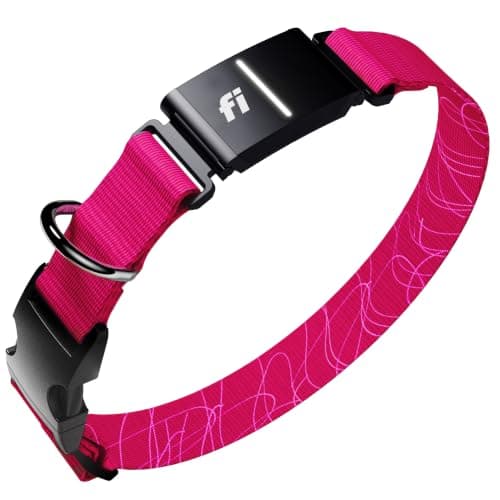
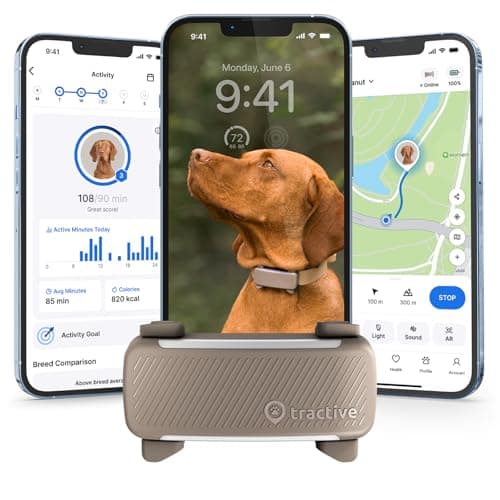
Tractive sells a small module that threads onto a collar. You keep the collar you like, the dog keeps wearing what it is used to, and if the tracker dies you replace a $79 box rather than the whole neck. Fi sells a collar with the tracking built into it, charged on a base station, with an LED night light in the band. Nothing dangles, nothing works loose, and there is no module to catch on a crate door or a seat belt tether — which is a real advantage on a dog that spends time in a travel crate.
The cost of that integration is flexibility. With Fi you are buying a collar, so you are replacing a collar — and sizing by neck measurement rather than threading a box onto whatever the dog already wears. If your dog travels in a martingale or an escape-proof setup chosen for a specific reason, a tracker that rides on top of it is the easier fit.
Battery: weeks against months
This is Fi's strongest card and it is not close. Fi's own site lists up to 3 months of battery life. Tractive publishes up to 2 weeks for its standard DOG 6 tracker with Power Saving Zones enabled, and our own Tractive reviewrecords about six days without them. Tractive's newer XL models, for dogs above 44 lb and above 55 lb, are published at up to 6 weeks — so if battery is your objection to Tractive and your dog is large, the XL is the answer before Fi is.
Read all of those numbers as best cases. Live tracking is what drains a cellular tracker, and the week you actually need it — a dog that bolted at a rest stop, a half hour of watching a dot move — is the week the battery falls short of the published figure. The practical difference on a two-week road trip is that a Tractive needs a cable and a charging habit in the travel bag, and a Fi mostly does not. The practical similarity is that both are dead weight if you forgot.
Small dogs: Tractive has a floor, and Fi has a neck
Tractive states its standard DOG 6 tracker is only for dogs above 9 lb, with the XL models limited to dogs above 44 lb and 55 lb respectively. So a 7 lb dog is outside Tractive's own guidance, and a 30 lb dog has exactly one Tractive option rather than three.
Fi does not have a weight floor in the same way — it has a neck size, because it is a collar. In practice a collar-integrated tracker is a lot of hardware on a very small neck, and the sizes retailers stock skew toward medium and large dogs. For a genuinely small traveling dog — the kind that flies under a seat in a carrier — neither of these is really the product, and an AirTag in a collar holder is the honest answer: a small dog in a carrier is rarely lost in a field, it is lost in a building, and Bluetooth finding is better at buildings than GPS is.
The subscription, which is the real price of both
Neither of these is a one-time purchase and neither works without a plan. A cellular tracker with no subscription is a plastic box.
- Tractive publishes a number. Its own product page shows the device at $79 plus a subscription from $5 / month, with the plan chosen after purchase. You can do the three-year arithmetic before you spend anything.
- Fi does not, where we could read it.Fi's own pages would not serve us on 2026-10-25, and the Amazon listing title says only "Membership Required". Secondary coverage quotes figures and we are not printing them, because a membership price is exactly the kind of number this site refuses to repeat second-hand. Fi does offer a one-month free trial with a device, so the plan can be tried before the billing starts — but price it at Fi's checkout before you buy the collar.
Run the arithmetic over three years, not over the checkout. On a published $5-a-month plan a Tractive costs its device price plus roughly a hundred and eighty dollars of service across three years; a membership at three times that rate turns a $129 collar into a materially different purchase. This is the same trap as a connected temperature monitor, where the device price on the listing is the smaller half of what you will pay. If a monthly fee is unacceptable in principle, both of these are the wrong product and our no-monthly-fee tracker page exists for exactly that buyer.
Features that are not the deciding factor (and one that is)
Both do the thing you are buying: live GPS location over a mobile network, a virtual fence or safe zone, and an alert when the dog leaves it. Both layer health and activity tracking on top — Tractive publishes heart and respiratory rate monitoring and has added scratch monitoring; Fi leads on AI-driven health and behavior insights and runs a lost-mode "Search Party" that alerts nearby Fi owners. Those are nice. None of them is why a traveling dog needs a tracker.
The feature that genuinely decides it for travel is coverage, and it is not really a feature of either product: both are useless where there is no cell signal. A dog that bolts off a trail in a valley with no bars is a dog whose tracker cannot report, and that is the single most likely place for a traveling dog to disappear. We wrote a whole page about that gap, and the honest answer is a radio-linked system, not a better cellular collar. Check coverage for the areas you actually travel in before you choose between these two, because in a dead zone the comparison does not matter.
Side by side
| Tractive Smart Dog GPS Tracker | Fi Series 3+ Smart GPS Dog Collar |
|---|
| Shape | Module that threads onto your own collar | The collar is the tracker |
| Published battery | Up to 2 weeks (DOG 6, Power Saving Zones); up to 6 weeks on the XL models | Up to 3 months (Fi's own site) |
| Smallest dog | Above 9 lb for the DOG 6; above 44 lb and 55 lb for the XL models | Sized by neck; stocked sizes skew medium and large |
| Subscription | Published: from $5 / month on Tractive's own page | Required; no maker figure we could read on 2026-10-25 |
| Device price at resolution | The cheaper of the two | Roughly double the Tractive |
| Night visibility | No light | LED night light in the collar |
| If it fails | Replace a module, keep the collar | Replace the collar |
What neither of them is
Neither is a car restraint.This needs saying because people do it: a GPS collar is not a load-bearing part and must never be the thing a seat belt tether clips to. A collar takes a dog's whole body weight through its neck in a crash. That job belongs to a crash-tested harness — see the Kurgo Impact review or the crash-tested harness roundup.
Neither replaces a microchip. A chip is permanent, needs no battery and is what a shelter scans; a tracker is active and needs power and signal. They solve different halves of the same problem and our microchip comparison sets out why you want both. Neither replaces an ID tag with a phone number on it, either — the fastest route home is usually a stranger reading a tag.
Neither stops a dog escaping. They tell you it happened. A collar the dog can back out of undoes both products, which is why the tracker decision sits downstream of the harness and collar decision, not upstream of it.