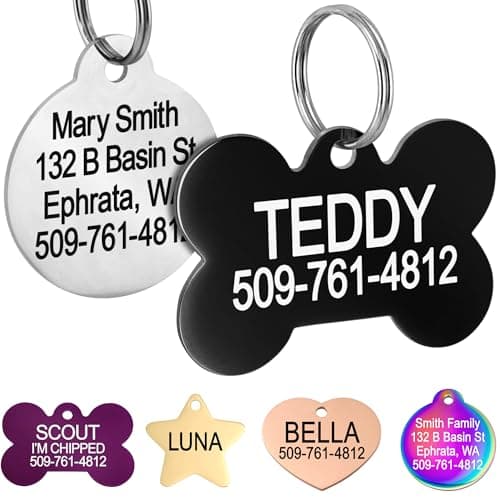
For all the money spent on GPS trackers and AirTags, the thing that most reliably reunites a lost dog with its owner is still a phone number on a collar and a registered microchip. Both work when the finder is a stranger with no app, no smartphone and no idea what the plastic box on the collar is.
Travel changes the problem in two ways. Your home address stops being useful, and the number you need on the tag is the one you will actually answer while in transit — which may not be your usual one if you are abroad. That is why an updatable tag has a real place in a travel kit alongside a permanent engraved one.
There is also a small, genuinely annoying travel-specific problem: tags jingle, and a jingling collar in a hotel room at 3am wakes everyone. Hence the last pick on this list, which is not a tag at all.
A tag is the second half of a plan whose first half is the dog staying attached to you. If your dog has ever backed out of a harness, fix that first: escape-resistant harnesses are ranked on the one structural feature - a third body strap - that makes the reverse-and-duck escape impossible.
Choosing a travel ID tag
What to actually put on it
A mobile number, not a landline. Two numbers if the tag has room — yours and a traveling companion's, or a friend at home who always answers. The dog's name is optional and some people deliberately omit it so a stranger cannot call the dog away. The word "microchipped" is worth the space: it tells a finder to take the dog to a vet or shelter rather than rehoming it.
Engraved for permanence, QR for flexibility
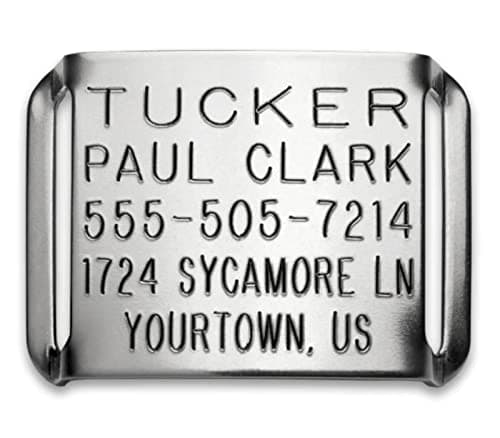
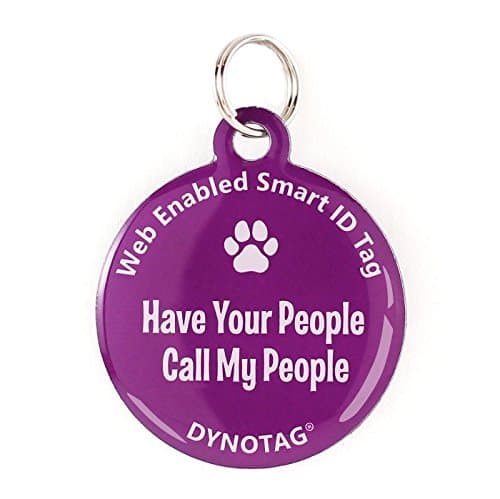
A deep-engraved stainless tag (GoTags) is unbeatable for reliability — it works with no phone, no signal and no service. A QR tag (Dynotag) lets you update the contact details and add a temporary address from a hotel room, which is exactly the problem travel creates. They are complements, not alternatives: run both if you can.
Never rely on a QR tag alone
It needs the finder to have a smartphone, a signal, and the inclination to scan an unfamiliar code. In a city that is a fine bet; on a rural roadside at dusk it is not. And it depends on a service continuing to exist, which an engraved number does not. Pair it with something engraved.
Sliding tags solve two problems at once
A tag that slides onto the collar strap (Boomerang Tags) cannot be lost to a failed split ring, which is how most dangling tags disappear, and it makes no noise. The trade is that it is sized to a specific collar width and is slightly harder for a stranger to read than a tag they can lift and turn.
Aluminum wears, steel does not
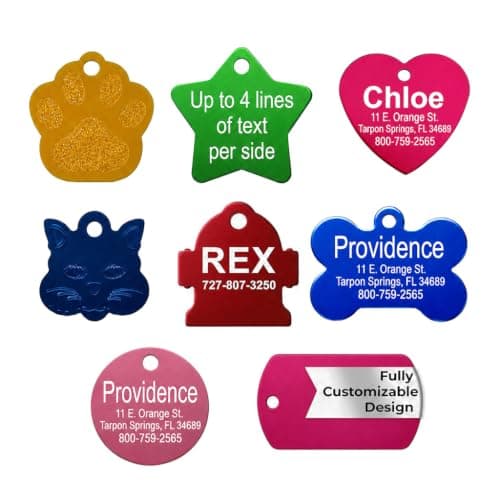
Cheap anodized aluminum tags (Providence Engraving) are excellent value and become hard to read within a year or two of hard use, because the engraving is shallow and the surface abrades. That makes them ideal as spares and second-contact tags, and a poor choice for the one tag you rely on. Check readability every few months whichever you buy.
Silence is a real travel feature
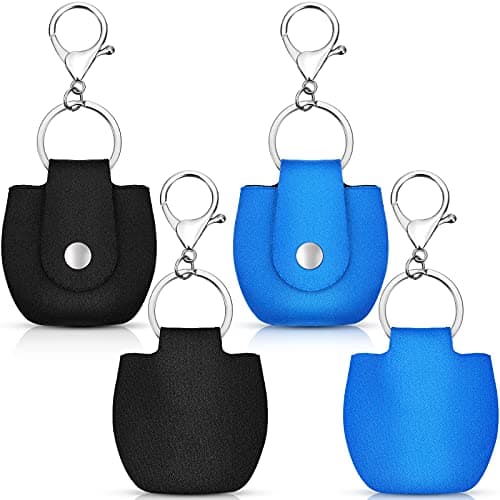
A jingling collar in a hotel, a rental, a tent or a train carriage is a genuine problem for everyone within earshot. A silencer pouch (Weewooday) wraps existing tags for pocket change. The trade-off is honest: tags inside a pouch are less visible to a finder, so this is a hotel-room measure rather than a permanent setup for a dog that roams.
The five-minute job that matters more than any tag
Check your microchip registration is current and points at a phone number you will answer. A chip registered to a number you had three phones ago is functionally not registered. Do this before the trip, not after something happens.
What we would actually buy
One engraved stainless tag (GoTags) as the permanent one, plus a QR tag (Dynotag) you re-point at your destination details before each trip. A silent slider (Boomerang Tags) if your dog loses dangling tags. Cheap aluminum spares (Providence Engraving) for the second collar. And a silencer pouch if hotels are in your future.