Searching for a large-dog airline carrier usually ends in disappointment, and it is worth understanding why before you spend anything. No carrier makes a 40 lb dog eligible for the cabin. The under-seat space is roughly 18 x 11 x 11 inches on the most generous US airlines and tighter on several others, and every bag sold as a "large airline carrier" is competing for the last two or three inches inside that box.
So the real question is not which carrier is biggest. It is which airline will take your dog, and only then which carrier uses that airline's allowance best. Those two answers come in that order, and taking them backwards is how people end up owning an expensive bag that gets refused at the gate.
The weight rule is the actual gate
Most US airlines cap the combined weight of pet plus carrier, and the common figure is 20 lb. American Airlines and JetBlue both publish that limit, and Southwest works to a similar ceiling. A soft carrier weighs 3-5 lb by itself, so a 20 lb combined cap means a dog of roughly 15-17 lb - not 20.
United and Delta are the outliers. Neither publishes a hard in-cabin weight number; both apply a functional test instead. The dog has to travel in a carrier that fits fully under the seat, and it has to be able to stand up and turn around inside it. That is a judgment, and it gets made at check-in and again at the gate. In practice this is why nearly everyone flying a 20-25 lb dog in the cabin is flying United or Delta.
Confirm the current rule on the airline's own page before you book - these change without much notice. Our under-seat dimensions and fee table is there to give you the shortlist, not the last word.
Where the useful inches actually come from
Given a fixed box, a carrier can only buy your dog room in three ways, and only two of them are honest.
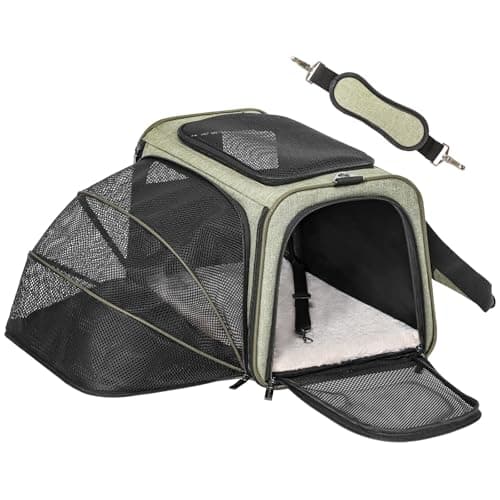
- Expansion on the ground.A side panel that unzips into a bay adds real floor area in the terminal, at the gate and in the hotel room at the other end. It is zipped shut for taxi, takeoff and landing, so it does nothing for the under-seat check - but it transforms the four or five hours around the flight, which is most of the dog's day.
- Structure that holds its shape. A carrier with a spring frame or a rigid base keeps its full internal height when it is wedged under a seat with a bag next to it. A floppy one collapses onto the dog. Two carriers with identical printed dimensions can differ by a couple of usable inches.
- Simply being bigger than the limit.This is the dishonest one. Plenty of listings say "airline approved" at 19 or 20 inches long. Soft sides flex, so an inch over survives more often than not; two inches over is a gamble with a gate agent who has seen the trick before.
Measure the dog before you shop - standing height at the shoulder, and length from chest to the base of the tail. Our measuring guide walks through the method, and it is the step that decides whether any of the rest of this is worth reading.
Two neighbouring cases, both with answers that differ from this one. A flat-faced dog is sorted on ventilation rather than on the weight ceiling - carriers for French bulldogs - and the default in-cabin pick gets a long-form write-up of its own in the Sherpa Original Deluxe review.
The short answer
Quick picks
#ad · Live prices from the Amazon Product API, as of October 21, 2026. Where we have no verified live price we show none — we would rather leave a gap than print a number that has rotted.
In detail
The picks, in full
Long layovers and connections
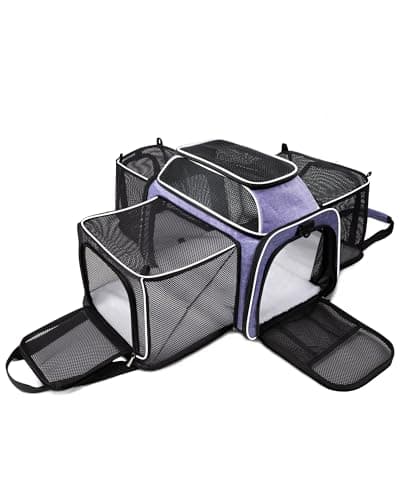
Petsfit Expandable Airline-Approved Carrier
Two-side expansionSoft-sidedFleece pad includedAirline-approved footprint
Zips flat for the plane, expands to a room once you land. The best answer to a long layover.
- Fits under seat
- 8
- Ventilation
- 8
- Build quality
- 7
- Dog comfort
- 9
- Value
- 8
Pros
- +Both sides unzip into extra floor space, so a dog stuck in a carrier for a five-hour layover can actually turn around
- +Collapses to a standard under-seat footprint for the flight itself
- +Fleece mat and a safety leash clip come in the box, which the cheaper carriers skip
Cons
- −The expansion panels are the first thing to wear — the zips take the stress
- −Bulkier when packed than a plain soft carrier of the same rated size
Don't buy this if…
…you only ever fly direct short-hauls. The expansion is the whole point of paying more, and on a 90-minute flight you'll never unzip it.
Long layovers on a budget
BATOTOR 4-Sides Expandable Pet Carrier
Four-side expansionFive opening doorsSoft-sided and foldableFleece pad included
The most expansion per dollar in the category — all four sides unzip, not just one or two.
- Fits under seat
- 8
- Ventilation
- 8
- Build quality
- 6
- Dog comfort
- 9
- Value
- 9
Pros
- +Four expanding panels means a dog can turn around and stretch out at the gate, which two-side carriers only half-manage
- +Five opening doors let you load the dog whichever way the seat, the aisle or the security bin forces you to
- +Comes in under the Petsfit, MASKEYON and Pecute expandables while offering more expansion panels than any of them
Cons
- −Four zippered panels are four more seams to fail — that is the trade you make for the expansion
- −Listed for cats and small dogs, and the listing publishes no weight limit — measure your dog against it rather than assuming
Don't buy this if…
…your dog is anywhere near the top of a small-dog weight range. Four expanding sides do not add height, and height is what a mid-size dog runs out of first.
Guaranteeing the under-seat fit
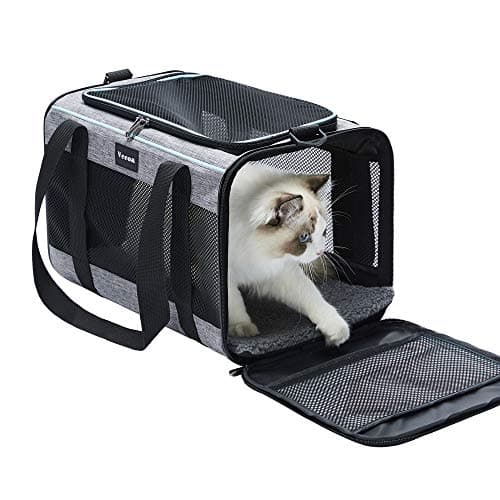
Vceoa Airline-Approved Carrier (17.5 x 11 x 11)
17.5 x 11 x 11 in listedSoft-sidedUp to ~16 lbMesh panels
Sized deliberately to the common under-seat opening. The one to buy if the fit number is all you care about.
- Fits under seat
- 9
- Ventilation
- 7
- Build quality
- 6
- Dog comfort
- 6
- Value
- 9
Pros
- +Vceoa lists the exterior at 17.5 x 11 x 11 inches — squarely inside most US airlines' hard-sided-adjacent under-seat limits when the top is pressed
- +Cheapest carrier we'd recommend for a small dog
- +Soft top gives the extra centimeter of squish at the seat edge
Cons
- −Basic materials; this is a fit-first carrier, not a comfort-first one
- −No boarding guarantee — its case rests entirely on the published dimensions
Don't buy this if…
…your dog is over about 15 pounds. It's built to the seat opening, not to a big dog, and a cramped dog is a stressed dog.
Most in-cabin flyers
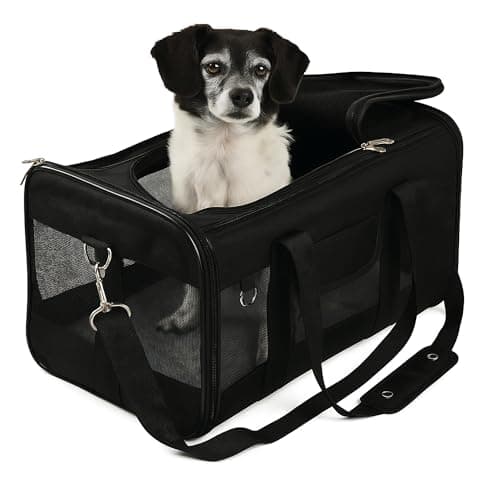
Sherpa Original Deluxe Travel Pet Carrier
Soft-sidedSpring wire frameGuaranteed On Board programS / M / L
The default in-cabin carrier, and the only one with a program that gets you rebooked if a specific airline turns it away.
- Fits under seat
- 9
- Ventilation
- 9
- Build quality
- 8
- Dog comfort
- 8
- Value
- 8
Pros
- +The Guaranteed On Board program reimburses your ticket if an airline on its approved list denies boarding — no other carrier here offers that backstop, though Sherpa limits it to flights within and between the US and Canada
- +The spring-wire top frame pushes down, so it squashes into a tight under-seat gap that a rigid carrier won't
- +Mesh on three panels, which is the ventilation an anxious dog needs on a hot jet bridge
Cons
- −Sizing runs small for the weight it lists — a dog at the top of a size's range is a squeeze
- −The base is soft; larger dogs get a floppier floor than a structured carrier gives
Don't buy this if…
…your dog is at the very top of a size band. Sherpa's dimensions are honest but tight, and the carrier that fits the dog but not the seat is the classic gate-agent problem. Measure and size up.
Cargo travel, and chewers that need to fly
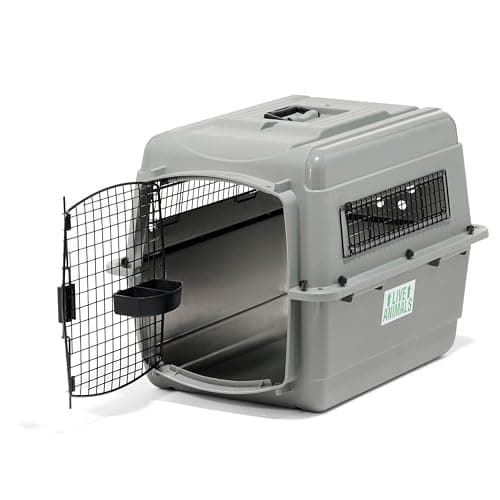
Petmate Sky Kennel
Hard plastic shellMetal door and fastenersVentilation on four sides28 in size listed for 15-30 lb pets
Hard plastic with metal hardware, built for an aircraft hold — which makes it quietly excellent against chewers too.
- Escape resistance
- 8
- Build strength
- 9
- Portability
- 4
- Ventilation
- 7
- Value
- 8
Pros
- +Built to airline hold requirements, which means metal hardware and a shell that does not flex open
- +Solid plastic gives a chewer nothing to grip in the way wire bars do
- +Four-sided ventilation is a published airline requirement and a genuine welfare feature in a hot hold
Cons
- −Does not fold at all — it splits into two halves and still takes serious storage space
- −Solid sides mean less airflow than a wire crate on a hot day outside a plane
Don't buy this if…
…the crate is for a hotel room and nothing else. A soft crate folds to a slab and this does not.
When the cabin is off the table
If your dog cannot stand and turn inside a carrier that fits under the seat, the cabin is out. That is not a rule you can argue with; it is the physical space. From there you have three routes, and they are not equally good.
Checked as excess baggage, or in cargo
A hard kennel in the hold on the same aircraft as you. It is heavily restricted: fewer airlines offer it each year, temperature embargoes shut it down in summer and winter, and it is closed entirely to snub-nosed breeds on most carriers. Read flying with a dog in cargo before assuming it is available on your route, and the cargo crate requirements before buying the kennel.
Drive it
For anything inside about a day's drive this is usually the better trip for a big dog, and it is nearly always cheaper once you have paid two pet fees. If you go this way the restraint question becomes the safety question - start with crash-tested harnesses, and weigh the whole decision in flying versus driving.
A dedicated pet shipper
Worth a quote for international moves and for dogs too large for any hold booking you can make yourself. It is expensive, and it is not something we rank: we have no pricing data we could verify, so we publish none.
Buy to the strictest leg
A carrier that clears United does not automatically clear JetBlue, whose published height allowance is several inches lower. If your itinerary includes a connection on a different airline, or you fly a mix over the year, buy to the lowest ceiling you will face. This is the most common reason people end up owning two carriers.
The same logic applies to wheels. A wheeled carrier solves the terminal problem for a heavy dog, but the wheel housing counts toward the height, and on some models it is exactly why the bag will not go under the seat. If you are considering one, the wheeled carrier roundup covers which designs keep the profile down.
What to do at the gate with a big dog
- Check in at the counter, not the kiosk. The pet has to be added to the booking by an agent anyway, and you would rather have the size conversation there than at the gate with a boarding queue behind you.
- Arrive early and walk the dog long. A tired dog settles in a tight carrier; a fresh one does not, and the dog that will not settle is the one gate agents notice.
- Do not expand the carrier on board. The expansion bay is for the terminal and the hotel room. Under the seat it stays zipped.
- Know your empty carrier weight. If an agent weighs pet plus carrier, the difference between a 4 lb bag and a 7 lb bag is occasionally the whole decision.
The dog has to fit the carrier, too
Every airline that publishes an in-cabin rule includes some version of "the animal must be able to stand up and turn around". That is not a formality - it gets checked, and it is the humane minimum in any case. A 22 lb dog crammed into a carrier that only clears the seat by compressing the dog is a refusal waiting to happen, and a miserable flight if it is not.
If the numbers do not work, they do not work. The honest conclusion for a genuinely large dog is that the cabin is not available - and the alternatives, a planned hold booking or simply driving, are better than a marginal cabin attempt that fails at the gate.
How we picked
We do not test the gear
We compiled the manufacturers' published dimensions and specs, cross-checked them against airline under-seat limits and published safety certifications, read the owner reviews, and scored each product against a published rubric. The scores are judgments from that research — they are not measurements we took, because we do not own a lab and we are not going to pretend we do. Where we could not verify a fit or a claim, we say so on the page.
Questions
Frequently asked
What is the biggest dog that can fly in the cabin?+
Roughly 20-25 lb, and only on airlines that publish no hard weight cap. American Airlines and JetBlue both publish a 20 lb limit for pet plus carrier combined, which after a 3-5 lb bag means a dog of about 15-17 lb. United and Delta publish no weight number and apply a fit test instead: the carrier must fit fully under the seat and the dog must be able to stand and turn inside it. Confirm on the airline's own page before booking.
Are there airline-approved carriers for 30 lb dogs?+
Not for the cabin. The under-seat space on US airlines is about 18 x 11 x 11 inches at its most generous, and a 30 lb dog cannot stand and turn in a carrier that size. Listings advertising a 30 lb capacity are describing what the fabric will hold, not what an airline will accept. For a dog that size the realistic options are the hold, a pet shipper, or driving.
Does the pet carrier count as my carry-on?+
On most US airlines the carrier counts as your carry-on or your personal item, so you are effectively down to one other bag. That is a real trip-planning cost people forget when they compare a pet fee to a checked bag fee. Check your airline's exact wording, because a few treat it as the personal item only.
Can I put two small dogs in one carrier?+
Some airlines allow two small animals in one carrier if both fit comfortably and can still stand and turn; others require one pet per carrier. Because it varies, and because the fee structure varies with it, confirm this with the airline directly rather than assuming - a second pet is usually a second fee even where one carrier is allowed.
Is a soft or hard carrier better for a large in-cabin dog?+
Soft, almost always. Soft sides flex under the seat, and that flex is where the last inch of tolerance comes from. A hard-sided carrier at the same external dimensions has thicker walls and less usable interior. Hard kennels are for the hold, where rigid construction is a requirement rather than a drawback.
Receipts
Sources
We do not run a testing lab, and we do not pretend to. Product dimensions and safety claims come from the manufacturer's own listing; airline limits come from the airline's published policy, with the date we checked it. Where we could not verify something, we say so on the page rather than quietly leaving it out. Read our full method.