A dog that slips a collar at a rest stop three states from home is a different problem from a dog that gets out of the garden. It has no route home, no familiar scent trail, and no neighbors who recognize it. You also have no local knowledge, no local network, and a departure time.
That is why the plan for this has to be made before it happens - and why the actions in the first hour are almost entirely different from what people instinctively do, which is drive around calling the dog's name.
The first hour
- Stay at the point of loss, and send others to search. Frightened dogs frequently circle back to where they last saw their person. If everyone leaves to search, the one place the dog is looking for is empty.
- Check the tracker immediately if the dog is wearing one, and start walking to the position rather than driving - a moving car is loud, fast, and easy for a frightened dog to avoid.
- Do not chase. A dog in flight mode runs from anyone approaching, including you. Crouch, turn side-on, look away, and let the dog come. Running towards a scared dog moves it further away every time.
- Put out scent.Leave your worn clothing, the dog's bed and its crate at the point of loss, with water. This is the single most effective low-tech action and it works overnight while you cannot search.
- Call it in. Local animal control, the nearest shelters, the local police non-emergency line, and any veterinary clinic within a few miles. Found dogs are handed to these places, not found by them.
- Post with a photo and the location. Local lost-pet groups on social media, the campground or hotel front desk, and the rest area or trailhead noticeboard. Use the photo you already have on your phone.
Who to call, in an unfamiliar place
- Animal control for the county you are in, not the town - jurisdictions are not obvious to a visitor and the county line is the usual boundary.
- Every shelter within about 30 miles. A dog can cover more ground than feels plausible, and a helpful stranger will drive it to a shelter rather than the nearest one.
- Veterinary clinics, which are where an injured found dog goes first and which have the scanner that reads your microchip.
- The microchip registry, to flag the chip as lost. Do this even if you are sure the details are current - it puts an alert on the number when a clinic scans it.
- The place you are staying, and the place you last stayed. Dogs are handed in at front desks constantly.
Leave a phone number that will work for the rest of the trip and after it, and check the phone. A missed call from an unknown number is the one you are waiting for.
The cheapest version of this plan is the one where the dog never gets loose. The most common escape on a trip is not a slipped collar but a dog reversing out of a two-strap harness in a car park - a mechanism, not bad luck, and one specific design prevents it. We rank the category on exactly that in best escape-resistant dog harnesses.
The short answer
Quick picks
#ad · Live prices from the Amazon Product API, as of October 21, 2026. Where we have no verified live price we show none — we would rather leave a gap than print a number that has rotted.
In detail
The picks, in full
Actual live GPS location
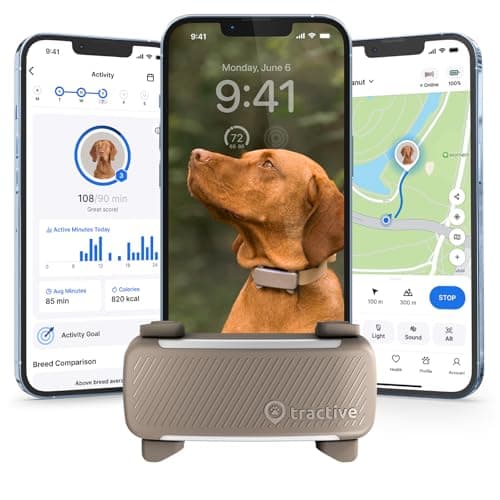
Tractive Smart Dog GPS Tracker
LTE + GPSUnlimited rangeWaterproofSubscription required
The real GPS pick. Unlimited range and live tracking — as long as you accept it needs a subscription.
- Location accuracy
- 9
- Battery life
- 8
- No subscription
- 2
- Size/weight
- 8
- Value
- 7
Pros
- +True cellular GPS: it reports live location anywhere there's a mobile signal, not just within Bluetooth range
- +Waterproof and light enough to ride on a collar all day
- +Live tracking and virtual fences are the features an escape-prone dog actually needs
Cons
- −Requires a paid subscription — the device price is not the real cost of ownership
- −Battery is measured in days or weeks, not months — Tractive lists up to two weeks with Power Saving Zones, and about six days without them
Don't buy this if…
…you won't pay a monthly fee. Without the subscription a cellular tracker is a paperweight — if you refuse the fee, an AirTag is the honest alternative.
The tag you actually rely on
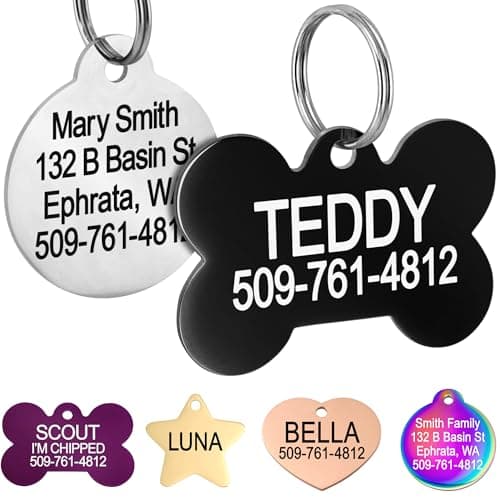
GoTags Personalized Stainless Steel Dog Tag
Stainless steelFront and back engravingMultiple shapesDeep engraving
Deep-engraved stainless. The engraving is still readable in three years, which is the only spec that matters.
- Legibility
- 10
- Durability
- 10
- Quietness
- 5
- Customization
- 8
- Value
- 8
Pros
- +Stainless resists the wear that turns cheap aluminum tags into unreadable discs within a year
- +Two-sided engraving fits a phone number plus a second contact, which is what you want when traveling
- +The engraving is cut deep rather than laser-marked on the surface
Cons
- −Steel is noisier against other tags than aluminum or silicone
- −Costs several times a basic aluminum tag
Don't buy this if…
…you change contact details often. Engraving is permanent; a QR tag you can re-point is the better shape for that.
Water, weather and real backcountry
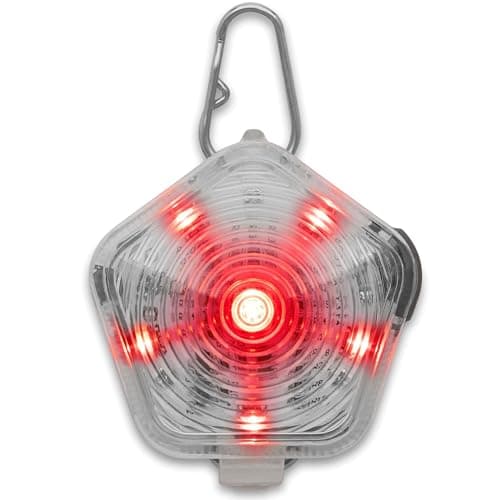
Ruffwear Beacon Safety Light
USB rechargeableWaterproof rating publishedMultiple modesClips to collar or harness
The one built to be lost in a river and keep working. Rechargeable, genuinely waterproof, visible a long way off.
- Visibility
- 10
- Runtime
- 8
- Attachment
- 8
- Weatherproofing
- 10
- Value
- 7
Pros
- +A published waterproof rating rather than a vague water-resistant claim, which is the difference for a swimming dog
- +Bright enough to track a dog across a dark field, not just to be seen by a car at ten yards
- +Clips to a collar or a harness ring and stays put through a shake
Cons
- −The most expensive option here for what is a single LED
- −A clip-on light swings and can end up under the dog's chin where you cannot see it
Don't buy this if…
…you just want to be visible on a suburban pavement. A cheap collar light does that fine.
The fifteen minutes of preparation
Everything above is faster if you do this before you leave:
- A current photo of the dog on your phone, standing, side-on, showing markings. Not a portrait of its face.
- A tag with a mobile number, not a home address. The address is where you are not. Our travel ID tag guidance covers what to engrave.
- A microchip registration you have actually checked, with a second contact who is not on the trip with you. See microchip versus GPS tracker.
- A tracker on the collar, charged. Charge it the night before travel days the way you charge a phone - a dead tracker is the most common failure of the whole system.
- A collar light for evenings. Both for prevention and because a lit dog is findable after dark.
- The dog's weight and any medication written down, in case somebody else has to hand it to a vet.
Prevention, because most of these are avoidable
Almost every travel escape happens in one of five moments:
- A car door opening at a rest stop. Clip the leash to the harness before the door opens, every time - see the stopping routine.
- A hotel room door. Crate or leash the dog before you answer it, and put the do-not-disturb sign out so housekeeping does not do it for you.
- An unfamiliar garden or campsite. Walk the boundary at dog height before you let the dog off anything.
- Fireworks, thunder or a gunshot in an unfamiliar place. A spooked dog with no home to run to is the classic long-distance loss.
- A collar the dog can back out of. Use a well-fitted harness for travel, and keep the tag on the collar underneath it.
If it goes past day one
Dogs are recovered days and weeks later far more often than people expect. Keep the scent station at the point of loss topped up if you can, expand the shelter calls outward rather than repeating the same ones, and re-post locally rather than nationally - the person who finds your dog is within a few miles of where it was lost.
If you have to travel home without the dog, leave a local contact who can collect it, keep the microchip registry alert active, and keep the phone number on the posters working. That is the situation the chip exists for, and it is the reason the ten-minute registration job matters more than any device you can buy.
How we picked
We do not test the gear
We compiled the manufacturers' published dimensions and specs, cross-checked them against airline under-seat limits and published safety certifications, read the owner reviews, and scored each product against a published rubric. The scores are judgments from that research — they are not measurements we took, because we do not own a lab and we are not going to pretend we do. Where we could not verify a fit or a claim, we say so on the page.
Questions
Frequently asked
What should I do first if my dog runs off while traveling?+
Stay at the point of loss and send anyone else to search. Frightened dogs often circle back to where they last saw their person, so that spot needs to be occupied. Check any tracker, approach on foot rather than by car, and never chase - crouch side-on and let the dog come to you.
Does leaving clothing out really help find a lost dog?+
It is one of the most effective low-tech actions available. Leave your worn clothing, the dog's bed and its crate at the point of loss along with water. Scent works overnight and in your absence, which is exactly when you cannot search, and dogs are frequently recovered at the scent station rather than by searchers.
Who do I call about a lost dog in an unfamiliar area?+
County animal control rather than the town, every shelter within about 30 miles, local veterinary clinics, the microchip registry to flag the chip as lost, and the hotel or campground front desk. Found dogs are handed in to these places rather than found by them, so being on their list matters more than driving around.
Should I chase my dog if it bolts?+
No. A dog in flight mode runs from anyone moving towards it, including its owner, and chasing routinely pushes a dog into traffic or further from the area. Crouch, turn side-on, avoid eye contact, and let the dog approach. Calling in a normal happy voice works better than shouting.
How do I stop my dog escaping while traveling?+
Most travel escapes happen in five moments: a car door at a rest stop, a hotel room door, an unfenced garden or campsite, a loud noise like fireworks, and a collar a dog can back out of. Clip the leash before the door opens, contain the dog before you answer a door, check boundaries at dog height, and travel in a well-fitted harness with the tag on the collar underneath.
Receipts
Sources
We do not run a testing lab, and we do not pretend to. Product dimensions and safety claims come from the manufacturer's own listing; airline limits come from the airline's published policy, with the date we checked it. Where we could not verify something, we say so on the page rather than quietly leaving it out. Read our full method.