The short answer: almost certainly yes, and it is unlikely to be the worst part of the flight for your dog. A dog's middle ear equalises through a Eustachian tube the same way a human's does, so the same pressure change acts on it. What we will not do is tell you how much it hurts, because we could not find a veterinary evidence base that answers that — and the pages that confidently tell you either way are, as far as we can establish, not citing one either.
What is firmly established is the size of the change, because the FAA sets it. Under 14 CFR 25.841(a), a pressurised cabin must be equipped to provide a cabin pressure altitude of not more than 8,000 feetat the aircraft's maximum operating altitude in normal operation. So a dog cruising at 38,000 feet is experiencing roughly the air pressure of a mountain road, not of the outside of the aircraft. That is a real change from sea level and it is the same change every human passenger absorbs without incident.
The part that actually matters is descent, not cruise. Pressure rises on the way down, which pushes the eardrum inward and needs the Eustachian tube to open to equalise. People do that by swallowing or yawning on cue. A dog does it when it swallows, and you cannot ask it to.
What we could verify, and what we could not
Verified
- Cabin pressure altitude is capped at 8,000 feet in normal operation, and at 15,000 feet after any probable failure condition on aircraft certified above 25,000 feet (14 CFR 25.841).
- Airlines publish their own in-cabin pet requirements — Delta, for example, requires the kennel to fit fully under the seat in front of you, to be leak-proof, and to have ventilation on three sides domestically and four internationally — and the dog must stay in it for the whole flight.
Not verified, and we are not going to pretend otherwise
- How common ear pain is in flying dogs. We found no study, veterinary association statement or airline incident data giving a rate, and we are not going to repeat a number that traces back to a content farm.
- Whether giving a dog something to chew or lick during descent helps it equalise. It is a plausible mechanism — swallowing is what opens the tube — but we have no source demonstrating it in dogs, so we are not selling it to you as a fix.
- Whether short-nosed breeds are more affected. They have well-documented airway problems that make flying riskier overall, which is a separate and better-evidenced concern; we cover it on flying with a snub-nosed dog.
Three things that are more likely to bother your dog than its ears
Noise
A cabin at cruise is loud, and it is louder near the floor where the carrier is, and a dog's hearing is more sensitive than yours across a wider range. Taxi, takeoff thrust and gear retraction are abrupt, unexplained noises. This is the stressor to prepare for.
Confinement in an unfamiliar bag
The dog is in a zipped bag under a seat for hours with people's feet around it. A dog that has slept in that bag at home for two weeks treats it as its own place; a dog meeting it that morning does not. The plan for this is how to get a dog used to a carrier, and it is the highest-value thing you can do for any flight.
Heat and air at the gate
The uncomfortable part of many flights is on the ground, not at altitude: a packed jet bridge, a long taxi with the air conditioning on low, a bag between two seats with no airflow. Ventilation on more than one face of the carrier is a real feature for this and it is also an airline requirement.
So what do you actually buy?
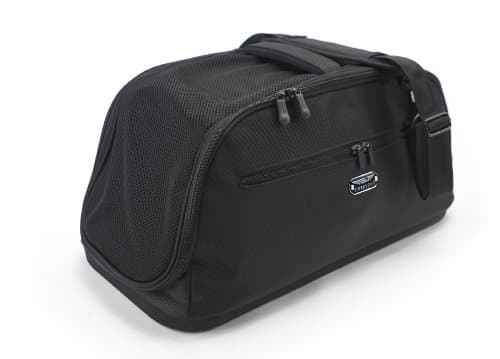
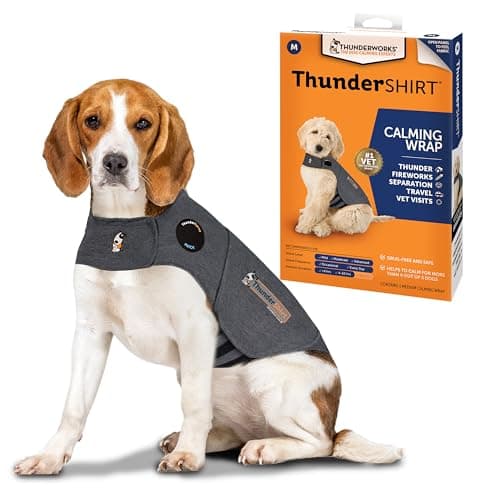
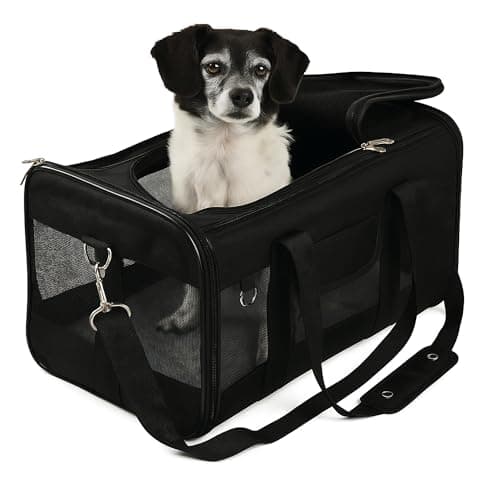
Not an ear product. There is no dog ear-pressure device we would recommend, and putting anything in a dog's ear canal before a flight is a conversation with a vet, not a purchase. What helps is the carrier the dog already likes, ventilation on more than one side, and — for a dog that struggles with confinement rather than with altitude — a pressure wrap it has already worn at home. Those are the three picks below, and two of them are ranked properly on our airline carrier roundup.
One genuine warning: if your dog has an ear infection, a recent ear surgery, a ruptured eardrum or any middle-ear disease, that is the case where flying and ear pressure stop being an internet question and become a veterinary one. Get it looked at before you fly, not after.
What about the hold?
The same pressurisation rule applies to the aircraft, and airlines carry animals only in compartments they state are pressurised and temperature controlled. The real risks in hold travel are heat on the ramp, delays and handling rather than ear pressure, and we work through them honestly on flying with a dog in cargo.