Travel dehydrates dogs through a mechanism nobody plans for: not heat, but absence of opportunity. At home a dog drinks in small amounts, many times a day, from a bowl that is always in the same place. On the road that bowl is in a bag, the dog is in a crate or a carrier or a back seat, and the number of times water is actively offered drops to two or three. The dog is not refusing water. It is not being asked.
Layer a warm car, dry cabin air, or a hot afternoon on top of that and you get a dog running a deficit by mid-afternoon on day one. It is entirely preventable, and preventing it is mostly a matter of having a container you can operate with one hand while holding a leash.
How much water a dog actually needs
The working guideline used across veterinary sources is roughly one ounce of water per pound of body weight per day. That makes the mental arithmetic easy:
| Dog weight | Rough daily need | In cups |
|---|
| 10 lb | ~10 oz | ~1.25 cups |
| 25 lb | ~25 oz | ~3 cups |
| 50 lb | ~50 oz | ~6 cups |
| 75 lb | ~75 oz | ~9.5 cups |
Treat that as a baseline for an average day, not a target to hit exactly. Heat, activity and diet all move it — a dog on wet food takes in a meaningful amount of water with meals, a dog on dry kibble does not, and a hot day of hiking can push the requirement well above the line. The useful thing about the number is the reverse calculation: a 50 lb dog that has had one bowl at a rest stop has had a fraction of what it needs, and now you can see that.
How to check, in about ten seconds
Two field checks. Neither requires equipment and both are worth doing at every stop on a hot day.
- Skin tent. Gently lift the loose skin at the scruff of the neck and let go. On a well-hydrated dog it drops straight back. If it returns slowly, or stands up in a visible tent, that is a loss of skin turgor and a sign of dehydration.
- Gums.Healthy gums are moist and slick. Tacky or dry gums, alongside a slow skin tent, indicate a more meaningful deficit — in clinical terms, semi-dry mucous membranes with normal turgor sit around 4–5% dehydration, while dry membranes with a mild loss of turgor sit around 6–7%.
Alongside those: sunken-looking eyes, thick ropey saliva, lethargy, and loss of appetite. Panting on its own is not a dehydration sign — it is how a dog sheds heat — but a dog that is panting hard and has tacky gums is a dog to stop for now, in shade, with water. Severe dehydration is a veterinary problem, not a bottle problem; if a dog is genuinely unwell, offering water is a stopgap on the way to a vet, not the treatment.
The rule that beats every product
Offer water on a schedule rather than on demand. A dog that has been asleep in a crate for three hours will not ask, and by the time it does ask you are behind. On a drive that means water at every stop, whether or not the dog seems interested — roughly every two to three hours, which is the same cadence the road-trip checklist uses for toilet breaks anyway. On a flight it means water after security and again on arrival. On a trail it means before the dog looks thirsty, because a panting dog on an ascent is already using more than it took in.
Small and often beats large and rarely, particularly after exertion. A dog that gulps a liter after a hard hour is more likely to bring it straight back up.
All of the above assumes a dog that drinks when water is offered. If yours does not - or will not touch food on a travel day - the refusal case has its own fixes, and its own list of signs that mean stop and call a vet: when a dog will not eat or drink while traveling.
The short answer
Quick picks
#ad · Live prices from the Amazon Product API, as of October 21, 2026. Where we have no verified live price we show none — we would rather leave a gap than print a number that has rotted.
In detail
The picks, in full
Most people
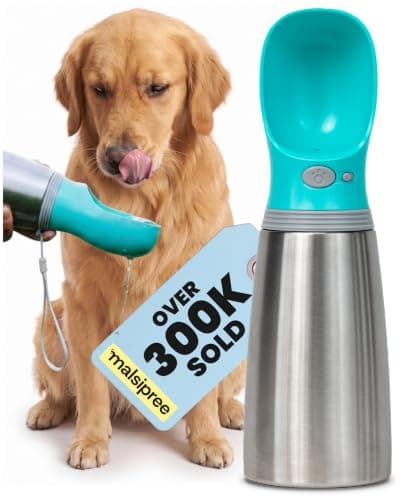
MalsiPree Insulated Dog Water Bottle (24 oz)
24 oz insulatedFlip-up troughWater-return buttonLock switch
The best-executed dog bottle — insulated, leak-locked, and the flip-trough design that wastes the least water.
- Leak resistance
- 9
- Capacity
- 8
- One-hand use
- 9
- Weight
- 6
- Value
- 8
Pros
- +Stainless insulation keeps water cold on a hot walk — most dog bottles are single-wall and warm fast
- +The flip-up trough and one-way return button let a dog drink and send the rest back into the bottle, wasting almost nothing
- +A physical lock switch means it rides in a bag without dribbling
Cons
- −Heavier and bulkier than a thin plastic bottle because of the steel insulation
- −The most expensive bottle here
Don't buy this if…
…you want the lightest thing for a short walk. The insulation and steel are the value on a hot, long day out — for a ten-minute stroll it's more bottle than you need.
Simplest one-handed drinking
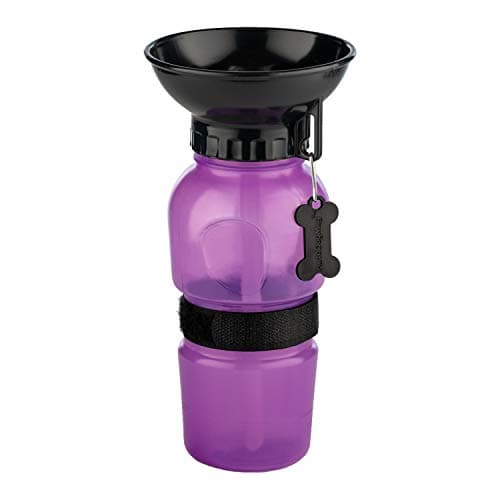
Highwave AutoDogMug
Squeeze-to-fill bowlOne-piece design~20 ozBPA-free
The mug-and-bowl-in-one — squeeze to fill the attached cup, release to draw it back. Genuinely one-handed.
- Leak resistance
- 8
- Capacity
- 7
- One-hand use
- 9
- Weight
- 7
- Value
- 8
Pros
- +The attached cup fills on a squeeze and empties back on release — the most intuitive one-handed design here
- +One piece, nothing to lose, nothing to assemble at a rest stop
- +A long-running, proven design people keep repurchasing
Cons
- −Wider and stubbier than a slim bottle — it doesn't slot into a bike cage
- −Single-wall, so no insulation on a hot day
Don't buy this if…
…you want something slim that fits a bottle cage or side pocket. The wide mug shape is the ergonomic win and the packing penalty.
Most people
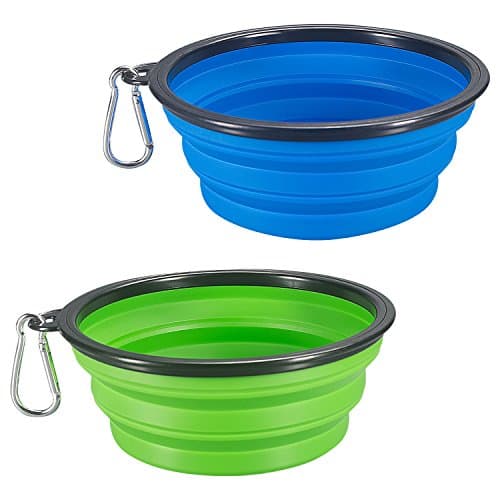
Comsun Collapsible Dog Bowl (2-pack)
Food-grade silicone2-packCarabiner clipDishwasher-safe
Two food-grade silicone bowls for pocket change. The default travel bowl, and it's hard to beat.
- Packability
- 10
- Leak/spill resist
- 6
- Capacity
- 8
- Durability
- 8
- Value
- 10
Pros
- +Two in the pack means one for food and one for water without a second purchase
- +Collapses flat and clips to a leash or bag with the included carabiner
- +Food-grade silicone that washes clean and doesn't hold odor
Cons
- −Soft walls tip if a big dog shoves the bowl around
- −No lid, so a full bowl doesn't travel with water already in it
Don't buy this if…
…you want a bowl you can pre-fill and carry. These collapse for transport but don't seal — for water on the move, a bottle-and-bowl combo is the tool.
Backpacking and the trail
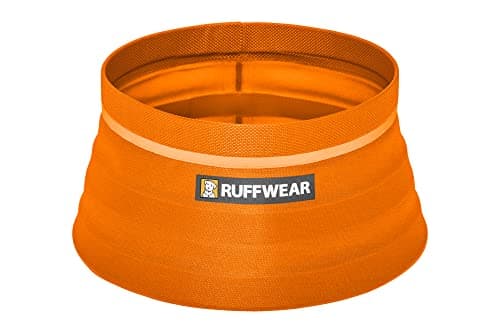
Ruffwear Bivy Collapsible Dog Bowl
Welded waterproof seamsUltralightPacks flatDoubles as dry storage
The trail bowl that doubles as dry storage — welded seams, genuinely waterproof, packs to nothing.
- Packability
- 9
- Leak/spill resist
- 8
- Capacity
- 7
- Durability
- 9
- Value
- 7
Pros
- +Welded seams make it actually waterproof, so it carries a measured ration of water, not just holds it at a rest stop
- +Ultralight and packs to a flat disc — the backpacker's choice
- +When it's not a bowl it's a dry pocket for kibble or a phone
Cons
- −The most expensive bowl here by a good margin
- −Deep and floppy — a determined dog can knock it over on flat ground
Don't buy this if…
…your trips are car-based and weight is a non-issue. You're paying for ultralight welded construction that only pays off in a pack — for the car, cheaper bowls are fine.
Bottle or bowl? You want one of each
These are two different tools and people routinely buy only one. A bottle carries water and delivers it one-handed, which is what you need standing on the shoulder of a road holding a leash. A bowl is what a dog drinks a real volume from at a stop, and it is what you use when the water source is a tap rather than something you are carrying.
The combination that covers almost everything is one insulated bottle with an integrated trough plus one cheap collapsible bowl clipped to the bag. Total cost is low, total weight is negligible, and there is no situation in normal travel it fails to cover.
What actually separates a good bottle from a bad one
- A return mechanism. The single most useful feature. A dog drinks some of what you pour and leaves the rest; a bottle that sends the remainder back inside rather than onto the ground roughly doubles your effective capacity on a long day.
- A real lock. A bottle that dribbles inside a bag is a bottle you stop packing. A physical lock switch, not just a screw cap, is what makes it live in the day bag permanently.
- Insulation, if it is hot. Most dog bottles are single-wall plastic and reach ambient temperature quickly. On a genuinely hot day a stainless insulated bottle is the difference between cool water at 3pm and warm water a dog declines.
- One-handed operation. Test it against the real scenario: leash in one hand, dog moving, standing up. Anything requiring two hands and a flat surface will get used less than you intend.
Capacity is the trade-off that decides the rest. Roughly 20–24 oz suits most day trips for a medium dog; going bigger adds weight you carry all day for water you may not use. For the full ranked field see the portable water bottle roundup and the collapsible bowl roundup.
By mode of travel
In the car
Water at every stop, offered rather than left out. Do not leave a full bowl loose in a moving car — it spills, and a dog leaning down to drink while the car is moving is a dog out of its restraint. Keep the bottle in the door pocket where you will reach it without unpacking anything, and remember that a warm cabin dehydrates faster than the outside temperature suggests. Water also matters more, not less, for a dog prone to car sickness: restricting water makes nausea worse, and the common instinct to withhold it is wrong.
On a plane
Cabin air is dry and the flight itself is the part where you can do least. Offer water right up to check-in, then again immediately after security — a collapsible bowl goes through the scanner empty without any trouble, and there is usually a fountain airside. On a long flight a few ice cubes in the carrier melt slowly and are easier for a dog to take than an offered bowl in a confined space. Avoid a full water dish clipped inside a carrier for takeoff; it will end up in the bedding. There is more on the day-of sequence in flying with a dog in the cabin.
On the trail and at camp
Carry your own and offer before the dog asks. Do not rely on the dog drinking from streams and puddles — standing water is a genuine risk, and a dog that has been drinking from it will keep doing so. On a multi-day trip a bowl with welded seams doubles as a way to carry a measured ration rather than only serving it. Our campsite gear guide covers where water sits in the rest of the setup, and the hiking checklist covers the day-trip version.
Heat, and when hydration is not the actual problem
Water is necessary but it is not a cooling system. A dog sheds heat mainly by panting, and panting is far less effective in humidity. On a hot day the interventions that matter are shade, timing and airflow — going early, stopping in shade, wetting the belly, groin and paws where the blood vessels are close to the surface, and a cooling vest or cooling mat if you are out in it repeatedly. Cold water helps a little; it does not substitute for any of that.
The signs that a dog has moved past "thirsty" into heat trouble — frantic panting, bright red gums or tongue, wobbliness, confusion, refusing to move — are an emergency. Stop, get the dog into shade, wet it down, and get to a vet. Do not spend that time trying to make it drink.
The three-item kit
- An insulated bottle with a return trough that lives permanently in the day bag, locked, so it is never a decision.
- A collapsible bowl clipped to the leash or the bag, for real-volume drinking at stops and taps.
- A schedule— every stop in the car, after security at the airport, before the ascent on a trail.
That is the whole thing. The gear is inexpensive and the failure is almost never the equipment; it is having left it in the boot.
How we picked
We do not test the gear
We compiled the manufacturers' published dimensions and specs, cross-checked them against airline under-seat limits and published safety certifications, read the owner reviews, and scored each product against a published rubric. The scores are judgments from that research — they are not measurements we took, because we do not own a lab and we are not going to pretend we do. Where we could not verify a fit or a claim, we say so on the page.
Questions
Frequently asked
How much water does a dog need per day?+
The commonly used veterinary guideline is roughly one ounce per pound of body weight per day — about 25 oz for a 25 lb dog, about 50 oz for a 50 lb dog. Treat it as a baseline rather than a target: heat, activity level and diet all move it, and a dog on wet food takes in a meaningful amount of water with meals that a dog on dry kibble does not.
How do I know if my dog is dehydrated?+
Two quick field checks. Lift the loose skin at the scruff and let go — it should drop straight back, and a slow return or a visible tent indicates lost skin turgor. Then check the gums: they should be moist and slick, not tacky or dry. Sunken eyes, thick ropey saliva, lethargy and loss of appetite are supporting signs. A dog that is genuinely unwell needs a vet, not just a bowl.
Should I restrict my dog's water on a car journey to avoid accidents?+
No. This is a common instinct and it is the wrong one. Dehydration makes car sickness worse, not better, and a dog in a warm car loses water faster than the outside temperature suggests. Offer water at every stop and plan the toilet breaks around it instead — roughly every two to three hours.
Can my dog drink from streams and puddles on a hike?+
Better not to rely on it. Standing water in particular carries real risk, and a dog that gets used to self-serving will keep doing it wherever you are. Carry your own water and offer it before the dog goes looking. On a long trip a waterproof welded-seam bowl lets you carry a measured ration rather than only serving at the source.
How do I give a dog water at the airport?+
Offer water up to check-in, then again immediately after security — a collapsible bowl goes through the scanner empty without any issue and there is usually a fountain airside. On a long flight, a few ice cubes in the carrier melt slowly and are easier for a dog to manage than a bowl in a confined space. Avoid a full clipped-in water dish for takeoff; it ends up in the bedding.
Is a dog water bottle better than a collapsible bowl?+
They do different jobs and the answer is one of each. A bottle carries water and delivers it one-handed while you are holding a leash. A bowl is what a dog drinks a real volume from at a stop, and what you use when the water source is a tap. Together they cost very little and cover essentially every travel situation.
Receipts
Sources
We do not run a testing lab, and we do not pretend to. Product dimensions and safety claims come from the manufacturer's own listing; airline limits come from the airline's published policy, with the date we checked it. Where we could not verify something, we say so on the page rather than quietly leaving it out. Read our full method.