Amtrak takes dogs, which surprises people, and it takes them on terms that are stricter than any airline on this site. The headline numbers, all from Amtrak's own published policy: a 20-pound limit on the combined weight of pet and carrier, a maximum carrier size of 19 in long x 14 in wide x 10.5 in high, trips of up to 7 hours on most routes, one pet per customer, dogs and cats only, and the dog must be at least eight weeks old. If your dog plus bag comes to 21 lb, this page stops being useful and the car starts.
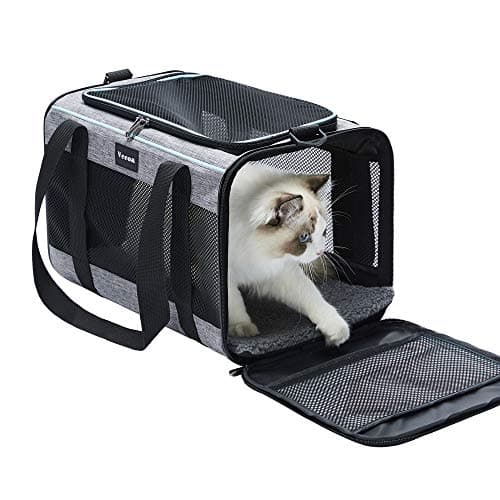
The number that catches people is not the weight, it is the height. Amtrak's 10.5-inch ceiling is lower than the under-seat allowance most airline carriers are built to - plenty of "airline approved" bags are 11 inches tall or more, which means the carrier you already own for flying may be the wrong shape for a train. The Vceoa carrier we rank for guaranteed airline fit is listed at 17.5 x 11 x 11 in: fine on length and width, half an inch over on height. Soft sides do compress, and that is genuinely how most people get through, but it is a thing to know in advance rather than at a platform.
Everything on this page is Amtrak's published policy as we read it on the date on this article, linked in the sources. Rail policies vary by route far more than airline policies do, so confirm your specific train. We have not travelled with a dog on Amtrak and are not pretending to - what follows is the policy, the arithmetic and the gear.
The rules that decide your trip
1. Twenty pounds, combined
Pet plus carrier, not pet alone. A 15 lb dog in a 3 lb carrier is comfortable; a 17 lb dog in the same bag is not eligible. Weigh the two together on a bathroom scale before you book, and favour a light carrier - with a ceiling this low, every ounce the bag weighs is an ounce the dog cannot. This is the single most common reason a booking goes wrong.
2. Nineteen by fourteen by ten and a half
Measure your carrier, do not trust the listing. The height is the binding dimension for most people, as above. The width allowance of 14 inches is actually generous compared with airline footwells, so a wide-and-low bag is the ideal shape for a train - the opposite of the tall compressible bags that win on aircraft.
3. Seven hours, on most routes
This is the rule that ends long-distance plans. Amtrak permits pets on trips up to seven hours on most routes, which rules out the great transcontinental journeys people imagine doing with a dog. A long trip can sometimes be broken into legs, but each leg is its own booking and its own pet reservation, and an overnight in between is a hotel - see staying in a hotel with a dog.
4. One pet per customer
Same arithmetic as the airlines: two dogs means two passengers. We walk through that in detail on flying with two dogs, and the logic transfers directly.
5. Which class, and which trains
Pets are permitted in Coach Class and Acela Business Class. They are not allowed in Acela First Class seating, First Class private rooms, or non-Acela Business Class - so the sleeper-car question that comes up constantly has a short answer: not in First Class private rooms. Amtrak also runs designated pet cars on a specific list of routes including the Cascades, Lincoln Service, Wolverine, Hiawatha, Blue Water, Illini, Saluki, Illinois Zephyr, Carl Sandburg, Pere Marquette and Missouri River Runner. Pets are not permitted in quiet cars on the Keystone and Pennsylvanian.
6. Cross-border services are out
Pets are not allowed into Canada on the Adirondack, Maple Leaf, Amtrak Cascades, Auto Train, Gold Runner or Amtrak Connection services. If a border crossing is the point of the trip, it is a driving problem instead - and the paperwork for that is on driving to Canada or Mexico with a dog.
7. Age and vaccinations
The dog must be at least eight weeks old, and you certify that it is up to date on all vaccinations. Nobody inspects a certificate at the gate, which is not a reason to travel without one - carry it, along with the rest of the folder on the documents checklist.
What the journey is actually like to plan
Reservations are limited and must be made in advance; the fee varies by route and is shown when you book. The dog stays in its carrier, and the carrier goes at your feet or under the seat - a train footwell is more generous than an aircraft one, which is the real comfort advantage of this mode. There is no equivalent of a jet bridge or a cargo hold, no pressure change, and you can get up and check on the dog whenever you like. For an anxious dog, a seven-hour train is a meaningfully gentler experience than a two-hour flight.
The honest weak point is the relief stop. Amtrak schedules are not built around dog breaks, and a seven-hour leg with no guaranteed off-train time is a long time for a dog that has drunk normally. Manage water deliberately rather than restricting it - our hydration guide covers the trade-off - and consider a portable potty for a dog that will not use an unfamiliar platform.