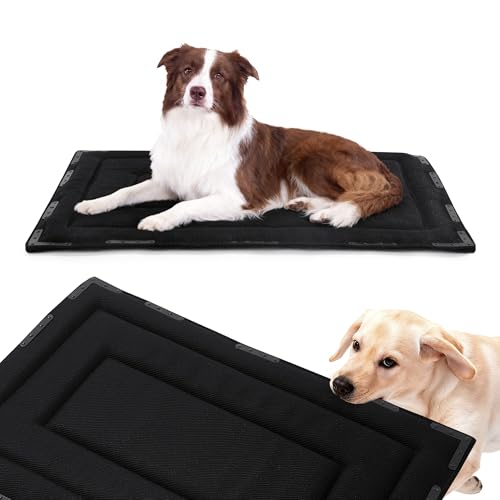
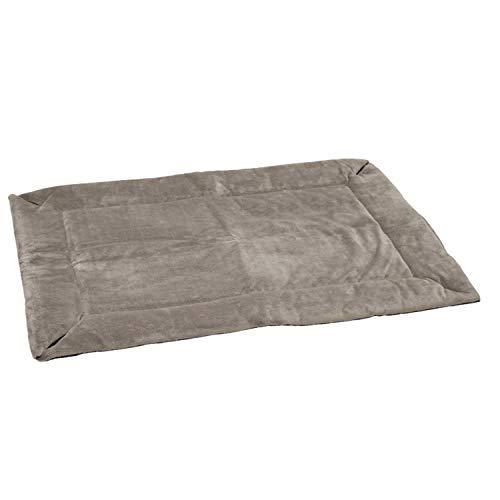
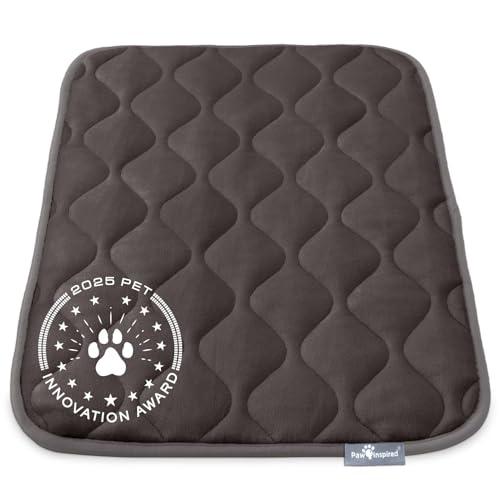
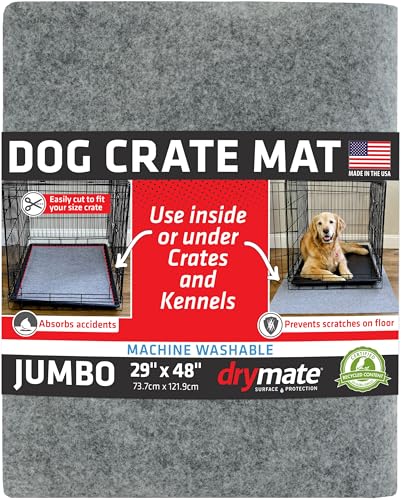
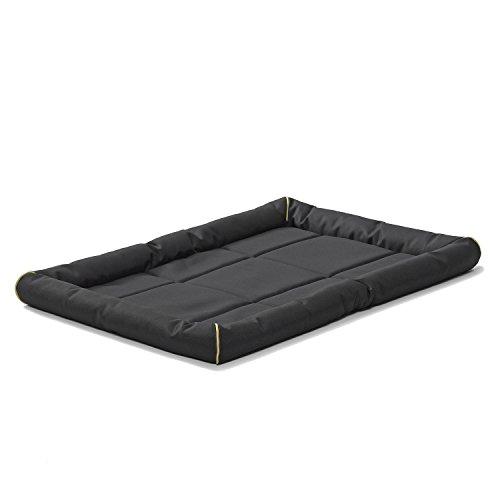
Buy the MidWest QuietTime MAXX Ultra-Rugged Dog Bed. It is sized by crate dimension rather than by dog weight, which is the only sizing system that works when the pad has to fit a crate floor you already own, and it is water and odor resistant and machine washable — the three specifications that decide whether a pad survives travel. If your dog chews bedding when the room is strange, buy the HOMBYS Chew Proof Foam Crate Pad instead and accept a harder night. For cold-weather trips with no power, the K&H Self-Warming Crate Pad. The budget pick is the Paw Inspired Washable Padded Crate Mat, and the Drymate Dog Crate Mat Liner is not a bed at all — it is the absorbent layer that goes underneath whichever pad you buy.
One honest framing before the rankings. Nothing in this category is tested, and the word “indestructible” appears on exactly one of these listings and is not true of any of them. There is no published bite test, no abrasion standard, no waterproof rating in millimeters anywhere in this roundup. What there is, on the better picks, is a published footprint in inches — and that turns out to be the most useful number in the category, because the single most common complaint about crate pads is that the pad does not fit the crate. So this page ranks on four things you can check.
What actually decides a crate pad
1. Footprint, in inches, against your crate floor
Crate sizes are nominal. A “42-inch crate” from two makers can differ by an inch and a half of internal floor, and a pad an inch too wide curls up the side walls into a ridge the dog then sleeps against. Three of the five picks here publish real inch dimensions — 41 x 28 in on the HOMBYS, 25 x 37 in on the K&H Large, 29 x 18 in on the Paw Inspired — and those are the ones you can buy with confidence. The MidWest is sold against crate sizes instead, which works because it is sized across the same range as MidWest's own crates, including the MidWest Homes for Pets iCrate we rank for puppies. Measure the internal floor of your crate before you order anything. Our dog crate size chart has the sizing conventions if you are buying the crate at the same time.
2. Where the liquid goes
This is the property that separates a travel pad from a bedroom pad, and it has three levels. Water resistant (the MidWest) sheds a spill if you catch it; leakproof-backed (the Paw Inspired) stops it reaching the crate pan; absorbent with a waterproof backing(the Drymate) holds it in the mat instead of letting it spread. In a hotel room or a rental car, that difference is a cleaning fee. A plastic tray, by contrast, spreads a spill across its whole area and then over the edge — which is why the absorbent liner is the better answer under a crate on somebody else's floor.
3. Chew resistance, honestly described
A dog that has never touched its bedding at home will sometimes shred it on night one in a strange room, because the crate is the only thing it can act on. The mechanism that actually resists this is not fabric, it is construction: a pad without a thread to pull is far harder to start. The HOMBYS replaces stitching at fourteen stress points with metal rivets, and that is a real design difference rather than a marketing word. It is still not indestructible, its own listing notwithstanding, and we rank it on the rivets rather than on the claim. If your dog has destroyed bedding before, buy that one and read our guide to crate training for travel — the pad is a symptom, the training is the fix.
4. Packed size, because it has to come with you
A crate pad that will not fit in the car with the crate is a pad you leave at home. Foam does not fold: the HOMBYS travels flat and that is that. A bolstered pad like the MidWest rolls, but thickly. The K&H self-warming pad and the Drymate liner are thin enough to disappear into a duffel, and the Drymate is explicitly cut-to-fit, which is useful when the crate goes in a cargo bay with an awkward floor shape rather than into a room.
The two-layer setup, which is what we actually recommend
Almost nobody sells it this way, so it is worth stating plainly. The best crate setup for travel is two layers: an absorbent liner on the crate pan, and a pad on top of it. The liner costs very little, catches anything that gets past the pad, protects the floor underneath — which in a vacation rental is the expensive part — and washes faster than the pad does. The pad is then chosen for comfort and durability rather than for being a sealed barrier, which widens your options considerably. The Drymate liner is on this page in that role, ranked fifth not because it is the worst product but because it is the one that is not a bed.
The five, at a glance
| Pad | Who it is for | Published size | Liquid behavior |
|---|
| MidWest QuietTime MAXX Ultra-Rugged Dog Bed | A folding wire crate used on the road | Sold by crate size; XL listed to fit 48-inch crates | Water and odor resistant, per MidWest |
| HOMBYS Chew Proof Foam Crate Pad | A crate-stressed chewer away from home | 41 x 28 in, fits a 42-inch crate floor | Wipeable, water washable per the listing |
| K&H Self-Warming Crate Pad | Cold-weather travel with no outlet | 25 x 37 in (Large); line runs to 14 x 22 in | No water claim — this is a thermal layer |
| Paw Inspired Washable Padded Crate Mat | Small and medium crates, and accidents | 29 x 18 in, listed for 30-inch kennels | Leakproof waterproof bottom, per the listing |
| Drymate Dog Crate Mat Liner | Under the pad, over somebody else's floor | 29 x 48 in, thin cut-to-fit | Absorbs and holds it; waterproof backing |
What a crate pad does not fix
A pad does not make a crate safe in a car, and it does not make a dog comfortable in a crate it has not been trained to. A crate in a vehicle has to be secured to the vehicle — an unsecured crate with a padded floor is still a projectile, and the pad changes nothing about that. And a dog that panics in a crate needs weeks of crate training, not better bedding.
Two layers, two wash cycles
The practical reason the two-layer setup wins on a trip is laundry. A soaked bolstered pad takes a day to dry and you have one; a thin absorbent liner washes in a motel sink and dries overnight, and the pad above it stays usable. If you are traveling for more than a weekend, pack two liners and one pad rather than two pads. And wherever the labels permit it, line dry — tumble-dryer heat is what delaminates a waterproof backing, which is the same failure that ends a cargo liner.
Pad, travel bed, or cooling mat?
Three products, three jobs, and they stack rather than compete. A crate pad is cut to a crate floor and chosen for durability and liquid behavior. A travel bed is chosen for packed size and weight, and it goes on a hotel floor or in a tent where there is no crate at all. A cooling mat is a summer layer that goes on top of either. If the budget covers one thing and the dog sleeps in a crate every night of the trip, buy the pad.
Three cases where the cheap pad is the right call
A puppy. Anything you put in a puppy crate is consumable. Buy the leakproof budget mat, buy the absorbent liner, expect to replace both, and spend the money on the crate instead — our puppy travel crate roundup covers that half.
Two trips a year. A rugged pad earns its price over a season of weekends. For a dog that crates twice a year, the budget mat is genuinely the correct purchase and the upgrade is a waste.
A dog that has already destroyed one pad. Counterintuitively, go cheap and go thin until the crate training is solid — or go to the riveted pad and nothing in between. Spending premium money on a soft bolstered pad for a known chewer is how you buy the same product twice.