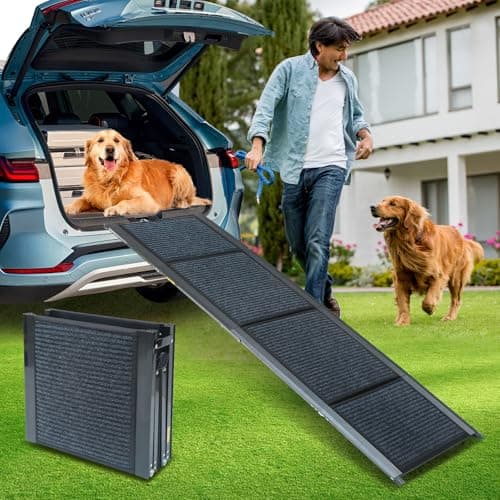
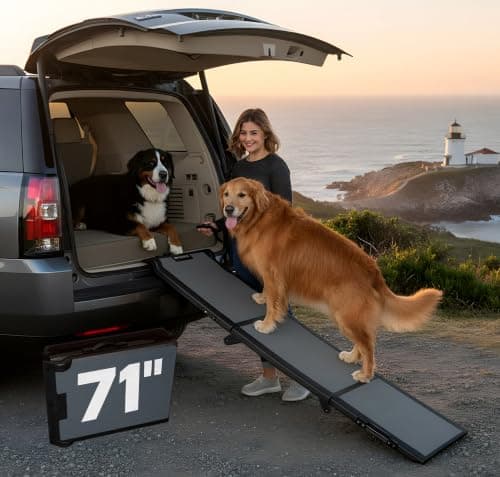
Under $100, buy the Pet Gear Tri-Fold Portable Pet Ramp if your dog is big, old or arthritic, and the PetSafe CozyUp Folding Pet Steps, 25 in if your dog refuses ramps or you park where a ramp will not fit. The budget pick is the PawStep Portable Folding Dog Ramp, which is the sensible way to test whether your dog will walk a ramp before spending more. One measurement decides all of it, and you need to go and take it now: the height from the ground to the surface the dog has to reach.
That number rules most of this out, because length is what makes a ramp gentle — the same reach over a longer ramp is a shallower angle, and angle is the whole reason you are buying mobility gear. The consequence for this price band is blunt: under $100 you can have a 71-inch tri-fold, or a shorter ramp, or steps. What you cannot have is the extra-long telescoping ramp that a lifted SUV or a pickup bed genuinely needs — that starts above the band, and it is on our main ramp roundup. If your tailgate is thirty inches up and your dog has bad hips, the honest advice is to spend more rather than buy a short ramp and a steep angle.
Take the measurement, then read the table
- Up to about 16 in — a low sedan sill, a bench seat with the door open, a sofa in a rental. Steps reach this comfortably.
- Up to 25 in — a tall back seat, a crossover bench, most hotel beds. The PetSafe CozyUp Folding Pet Steps, 25 in band: PetSafe publishes 25 in of height on the larger size and 20 in on the smaller.
- Above 25 in — SUV load floors, lifted vehicles, pickup beds. Ramp territory, and the longer the better. In this band that means the 71-inch tri-fold, and above the band a telescoping ramp.
| Pick | Shape | Published reach / length | Published limit | Ground needed |
|---|
| Pet Gear Tri-Fold Portable Pet Ramp | Ramp, folds in three | 71 in long (listed) | Listing-level; see the ramp roundup for the band | About 6 ft |
| PawStep Portable Folding Dog Ramp | Ramp, folding aluminium | Shorter than the tri-fold — a steeper angle for the same reach | Listed to 250 lb | About 4-5 ft |
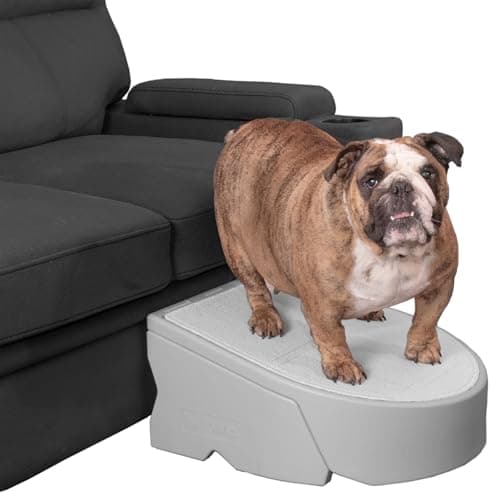
| Pet Gear StRamp Stair and Ramp Combination | Stairs one side, ramp the other | 16 in high (retailer listings) | 150 lb (retailer listings; varies by model) | About 2.5 ft |
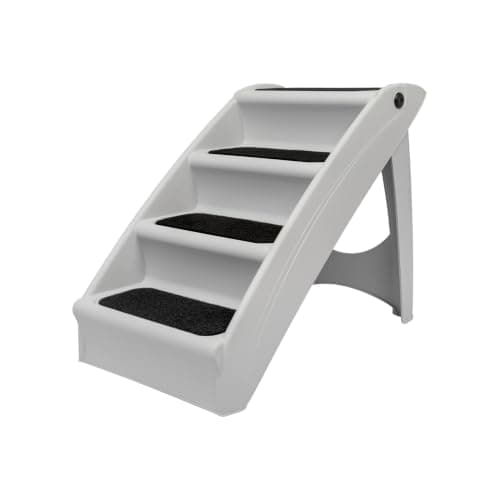
| PetSafe CozyUp Folding Pet Steps, 25 in | Folding steps | 25 in high, 28 x 18 in footprint | 200 lb (150 lb on the 20 in size) | About 2 ft |
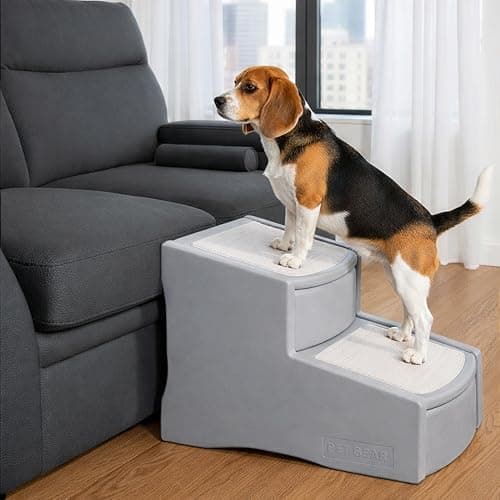
| Pet Gear Easy Step II Pet Stairs | Two steps | Height not published on the listing | 150 lb (listed) | About 2 ft |
Prices are live from our daily price check with the date stamped under the table below. Where a maker publishes no figure, this page says so rather than estimating one.
Ramp or steps? Three cases where steps win
The dog refuses the ramp
Lots of dogs will not walk one. It flexes, it sounds hollow, it is narrow, and one bad slip teaches a dog never to try again. Those same dogs will hop a step without thinking, because hopping onto something is a movement they already own. This is the best reason to buy steps, and it is the argument for the stair-and-ramp hybrid: you find out which your dog accepts without buying twice.
There is nowhere to put a ramp
A 71-inch ramp needs roughly six feet of clear ground. Fine on a driveway; not fine parallel parked, at a busy trailhead, or in a tight garage — and the "side door" version of this search is exactly that problem, because a ramp into a rear door sits at an angle across a traffic lane. Steps need two feet and work at the door you are standing at.
It has to do more than one job on the trip
A step set that also reaches a hotel bed or an RV bunk is doing work no ramp does. PetSafe lists the CozyUp for bed, couch and car, and on a trip it will be used for all three — see our hotel guide and the RV guide.
Our steps vs ramp comparison is the full version of that decision, including why the pet-steps category is mostly furniture sold with a car in the photo.
Using it so the dog actually uses it
- Train it on the flat first.Lay the ramp on the ground, walk the dog over it for treats, then raise it a few inches at a time. A dog's first experience of a ramp should not be at full angle beside a running engine.
- Brace it. Most slips are the ramp moving, not the dog. Push it firmly against the bumper and stand on the low end the first few times.
- Spot the dog. A hand under the hips on the way up is the difference between confidence and a fall, especially for a senior dog — travelling with a senior dog covers the rest of that routine.
- Then restrain the dog. Getting in is step one; being held in place is step two. Pair this with a tested harness or a barrier, and protect the surfaces with a hammock cover.
A note on joints, because it is the reason most people are on this page: if a specific diagnosis is behind the purchase, ask your vet which movement they want the dog to stop making. Repeated hopping and repeated landing are different loads, and that answer decides ramp versus steps more reliably than any product page.
One warning about shopping this band for a tall vehicle: a short ramp against an SUV load floor is a ladder. If that is your vehicle, read best dog ramps for SUVs, which ranks on length because length is what sets the angle.