Skip to content
Paw & Passport

HUB 04 · Outdoor & Adventure

Ruffwear Front Range Harness: Review

The default travel harness, and deservedly so - four adjustment points, real hardware and an ID pocket. It is also not a car restraint, not escape-proof and not a lifting harness, and all three of those get it bought by the wrong people.

By Stephen V.Updated How we research
#ad

We earn a commission when you buy through our Amazon links, at no extra cost to you. It never affects our rankings, and we say so when the cheaper product is the better buy. How this works.

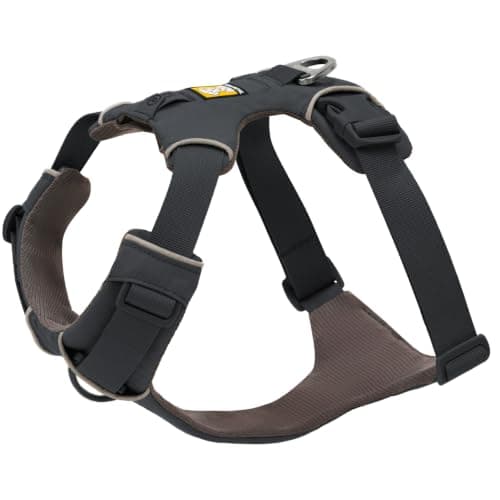
Buy it as the everyday travel harness: four points of adjustment, a 300D recycled ripstop shell with a DWR and PU coating, ITW Nexus Airloc buckles, an anodized 6061-T6 aluminum V-ring on the back and an ID pocket that keeps tags quiet in a carrier.

If you need a rigid handle for lifting, or a third strap because your dog backs out of things, that is the Ruffwear Web Master Support Harness — and our head-to-head sets out exactly what the extra money buys.

The verdict: the Front Range is the right harness for almost every dog that travels, and it is bought for three jobs it cannot do. What Ruffwear publishes is unusually complete for this category — a 300D polyester ripstop shell at 100% recycled content with a nonfluorinated DWR and a PU coating, PE foam padding, a recycled knit mesh lining, ITW Nexus Airloc side-release buckles, an anodized 6061-T6 aluminum V-ring on the back, four points of adjustment, an ID pocket and reflective trim with a loop for a light. At $59.99 on Ruffwear's own site that is a lot of specified product.

The three jobs it cannot do are the reason this page exists: it is not a car restraint, it is not escape-proof, and it has no lifting handle. Ruffwear does not claim any of them. The internet treats the Front Range as a do-everything harness anyway, and the gap between those two facts is where dogs get hurt or get loose.

What Ruffwear publishes, and why the detail is worth paying for

Read the spec list next to the harnesses that look identical in a photograph and the price stops being mysterious:

  • 300D polyester ripstop shell, 100% recycled, with a nonfluorinated DWR and a PU coating.Ripstop is the weave that stops a small tear becoming a long one. The DWR is why a wet harness is merely damp rather than a sponge against the dog's chest, and nonfluorinated is the part worth noticing — Ruffwear has moved off PFAS chemistry, and it says so on the product page rather than in a sustainability report.
  • Four points of adjustment.Two girth, two chest. This is the single biggest functional difference between this and a cheap harness, because a harness that fits a dog's actual shape does not ride, chafe or rotate on a long day.
  • An anodized 6061-T6 aluminum V-ring on the back. A named alloy and a named heat treatment on the part that takes the load. Anodizing is corrosion protection, which matters on a harness that goes in salt water.
  • ITW Nexus Airloc side-release buckles. A named industrial buckle rather than an unbranded plastic clip. Buckles are the thing that fails on a cheap harness, usually in cold weather.
  • An ID pocket. Small feature, genuinely good for travel: it holds tags against the harness so they do not jingle all night in a hotel room or a carrier. It does not replace tags — travel ID tags are their own problem and a dog in an unfamiliar city needs readable contact details on it.
  • Reflective trim and a light loop.The loop is sized for Ruffwear's own light, and any clip-on safety light will use it. Reflective trim is passive and needs headlights; a light is active. On a November rest stop at 5pm, you want the second one.
  • Girth sizing with a published method. Measure around the widest part of the rib cage and size up if you are between: XXS 13-17 in, XS 17-22 in, S 22-27 in, M 27-32 in, L/XL 32-42 in. Published girth ranges are not something every maker in this category manages — our Kurgo Impact review is largely about a maker that sizes a safety part by weight alone.
  • Hand wash with mild detergent, air dry. Made in Vietnam. Both stated.

Ruffwear also notes the harness was recently revised for easier girth-strap adjustment and more recycled content in the shell, webbing and lining. If yours is a few years old, the one in the shop is not identical to it.

What it does not publish

No weight, and no strength rating for either leash point. We made the same criticism of the Web Master, where the missing number is a lifting limit on a harness sold on its handle. Here it lands somewhere subtler. The rear attachment is an anodized aluminum V-ring; the front attachment is nylon webbing with a TPU tube — a soft part, reinforced, and the one a strong puller is clipped to all day on a front-clip setup. Ruffwear publishes no breaking strength for either, so there is no way to tell you how much margin the front attachment has. Our read is that the rear ring is the one to trust with a shock load and the front one is for steering, which is how front clips are meant to be used anyway.

Nothing about cars, and nothing about crash testing.That silence is correct and it should be read as a limit. Two strong leash points are not a vehicle restraint: a crash harness has to spread deceleration load across the chest and stay anchored to the car's belt system, and the ones with published testing are a different kind of product — see crash-tested harnesses and crate versus harness in the car. Clipping a seat belt tether to a walking harness is one of the most common mistakes in dog travel, and the Front Range is probably the harness it is most often done with.

No escape-proof claim. Two straps and four adjustment points make a well-fitting harness, not an inescapable one. A dog that reverses hard out of a harness needs a third strap behind the ribs, which is what the Web Master has and why our escape-proof roundup ranks that one instead. This matters more on a trip than at home: a spooked dog in an airport car park has nowhere familiar to run to.

And the L/XL band is coarse. One size covers 32-42 inches of girth where every band below it covers four or five. Large dogs are the ones most likely to need the adjustment range and most likely to end up at one end of the webbing, so measure before you assume the big size fits a big dog.

Front Range, Front Range Flex, and the rest of the line

"Front Range vs Front Range Flex" is the single most common comparison people search for around this harness, and we are going to be unsatisfying about it on purpose: Ruffwear's product page carried only a link to a Front Range Flex collection, with no specification we could read on 1 November 2026. The Flex exists. We are not going to describe a material, a strap count or a fit difference we did not see published, because that is precisely how wrong specs get copied around the internet. If you are choosing between them, the measurements on the Flex's own page are the ones to trust.

The comparison we can make is the one that matters most often, and it has its own page: the Front Range against the Web Master. Short version — the Front Range is the harness for walking, traveling and ordinary trail days; the Web Master adds a third strap and a rigid handle for lifting a dog over obstacles and for dogs that back out of things, and it costs more and carries more bulk for it. Our head-to-head works through the decision, and hiking versus walking harness covers the category-level version of the question.

Who should buy it, and who should not

Buy itif you want one harness for the dog that travels with you: walks at rest stops, hotel corridors, airport curbs, day hikes, and the leash-pulling phase of a young dog's life. It is the best-specified harness at its price, the adjustment range means it actually fits, the ID pocket and light loop are quietly useful on the road, and Ruffwear's durability record is the reason it is the default rather than the price. It is also what our hiking harness roundup ranks at the top of the field.

Do not buy it as a car restraint — that is a different product with published testing, and this one has none. Do not buy it for a dog that escapes harnesses; buy the third strap. Do not buy it if you need to lift or spot your dog on scrambles, where the handle is the whole point. Do not buy it expecting a fix for fear: a harness changes where the leash attaches, not what the dog thinks about the trip, and the honest options for that are in our calming gear roundup and our ThunderShirt review, where the published evidence gets read properly — and if the thing frightening your dog is noise rather than the place, our dog ear protection roundup covers that and is equally honest about how little of it is measured. If your dog is a hard, consistent puller, understand that a front clip is a steering aid rather than a training program — the leash and the handler are doing most of that work.
The short answer

Quick picks

#ProductBest forScorePrice
01
Ruffwear Ruffwear Front Range Dog Harness
Ruffwear Front Range Dog Harness

The default trail harness. Comfortable, well-made, and the one most experienced hikers land on.

Most hiking dogs
8.2
$59.99Amazon

#ad · Live prices from the Amazon Product API, as of November 22, 2026. Where we have no verified live price we show none — we would rather leave a gap than print a number that has rotted.

In detail

The picks, in full

01
Ruffwear Ruffwear Front Range Dog Harness

Most hiking dogs

Ruffwear Front Range Dog Harness

Padded chest + bellyTwo leash pointsReflective trimID pocket
8.2/10

The default trail harness. Comfortable, well-made, and the one most experienced hikers land on.

Fit & adjust
9
Durability
8
Control/handle
7
Comfort
9
Value
8

Pros

  • Foam-padded chest and belly panels spread load comfortably over a long day out
  • Front and back leash points — the front ring genuinely helps with a puller
  • Ruffwear's fit and durability are the reason it's the trail-community default, not the price

Cons

  • No rigid grab handle — for lifting a dog over obstacles you want the Web Master instead
  • Costs more than the no-name harnesses that look similar in a photo

Don't buy this if…

…you need to physically lift or spot your dog on scrambles. The Front Range is a walking-and-hiking harness; for hand-of-God lifts, step up to the Web Master's handle.

$59.99View on Amazon

Price as of November 22, 2026. Prices change — Amazon's at checkout is the one that counts.

#ad · we may earn a commission from this link to Ruffwear Front Range Dog Harness

Sizing, fitting and living with it

  • Measure the rib cage, not the dog.Ruffwear's method: a tape around the widest part of the rib cage, and size up if you fall between two bands. Breed names are not measurements, and a 60 lb dog can land in S, M or L/XL depending on build.
  • Use all four adjustment points before you judge the fit. Two chest, two girth. A harness that rotates or rides up is almost always an unadjusted harness rather than a wrong size.
  • Two flat fingers under every strap. Snug enough that it cannot rotate around the body, loose enough that two fingers slide under. Re-check after the first long day — webbing settles.
  • Front clip to steer, rear ring to pull against. The rear V-ring is anodized aluminum and the front attachment is reinforced webbing with a TPU tube. Neither has a published strength figure, so put shock loads through the metal one.
  • Put the tags in the ID pocket for travel. Quiet tags in a hotel room and in a carrier, and nothing to catch on crate wire. Keep readable contact details on the dog.
  • Add a light, do not rely on the reflective trim.Reflective needs someone else's headlights. On dark mornings at a rest area, use the light loop.
  • Hand wash, air dry. Ruffwear says mild detergent and air drying. Do not tumble-dry a harness with foam padding and a DWR finish; both come off in heat.
  • Rinse it after salt water. Anodizing protects the V-ring and salt still works on hardware and webbing. A freshwater rinse after a beach day is the whole maintenance routine — our portable shower page covers doing that away from a tap.
  • Check the buckles in the cold. Side-release buckles are the part that gets brittle and gritty. If one feels wrong on a winter trip, that is a replacement, not a one-more-hike.
  • Do not clip a car tether to it. Worth repeating as a buying instruction, because it is the single most common misuse of this harness.

Priced out, or shopping the rest of the range? Ruffwear alternatives matches each flagship product — harness, coat, life jacket, pack, light and bowl — to its closest substitute, and names the two we would not switch away from.

How we picked

We do not test the gear

We compiled the manufacturers' published dimensions and specs, cross-checked them against airline under-seat limits and published safety certifications, read the owner reviews, and scored each product against a published rubric. The scores are judgments from that research — they are not measurements we took, because we do not own a lab and we are not going to pretend we do. Where we could not verify a fit or a claim, we say so on the page.

Questions

Frequently asked

Is the Ruffwear Front Range worth the money?
For a dog that travels, yes. At $59.99 on Ruffwear's own site you are buying four points of adjustment, a 300D recycled polyester ripstop shell with a nonfluorinated DWR and a PU coating, PE foam padding, a recycled knit mesh lining, ITW Nexus Airloc buckles, an anodized 6061-T6 aluminum V-ring, an ID pocket and reflective trim with a light loop. The harnesses that look identical in a photograph publish none of that, and the buckles and the fit are what fail first on them.
Can I use the Front Range as a car harness?
No. Ruffwear's product page says nothing about car use or crash testing, and that silence is the answer. A car restraint has to spread crash load across the chest and anchor into the vehicle's belt system; two strong leash points do not do that job. Clipping a seat belt tether to a walking harness is one of the most common mistakes in dog travel. Our crash-tested harness roundup covers the products that publish testing, and our crate-versus-harness page covers whether your dog should be in a harness in the car at all.
Is the Front Range escape-proof?
It is not, and Ruffwear does not claim it is. It is a two-strap harness with four adjustment points, which makes it a well-fitting harness rather than an inescapable one. A dog that reverses hard out of harnesses needs a third strap behind the ribs - that is the Web Master, and it is what our escape-proof harness roundup ranks for exactly this reason. Worth taking seriously on a trip, where a loose dog is in a place it does not know.
What size Ruffwear Front Range do I need?
Measure around the widest part of the rib cage and buy to that: XXS 13-17 in, XS 17-22 in, S 22-27 in, M 27-32 in, L/XL 32-42 in, sizing up if you are between bands. Note that L/XL is a single 10-inch range where the smaller bands cover four or five inches each, so large dogs should be measured rather than assumed. Ruffwear also recently revised the girth-strap adjustment, so a new one adjusts a little differently to an older one.
Front Range or Front Range Flex?
We will not pretend to know. On 1 November 2026 Ruffwear's Front Range product page carried only a navigation link to a Front Range Flex collection, with no specification we could read, so there is no honest spec comparison to make here - and inventing one is how wrong numbers spread. The Flex exists; check its own page for materials, strap count and sizing. The comparison we can make with published figures on both sides is Front Range against Web Master, which has its own page on this site.
Front Range or Web Master for hiking?
Front Range for ordinary trail days, Web Master if you need to lift. The Web Master adds a third strap behind the ribs and a rigid handle built for hoisting a dog over obstacles or spotting it on a scramble, and it costs more and carries more bulk for that. The Front Range is lighter, cooler and perfectly adequate for most hiking, which is why it is the default. Our head-to-head page works the decision through, and note that Ruffwear publishes no lifting limit for the Web Master either.
Does the front leash clip stop pulling?
It helps you steer; it does not train the dog. A front attachment turns a pulling dog back toward you instead of letting it lean into the chest, which makes a walk manageable while the actual training happens. Note that the front connection is reinforced nylon webbing with a TPU tube rather than the anodized aluminum V-ring on the back, and Ruffwear publishes no breaking strength for either - so for a dog that hits the end of the leash hard, use the rear ring.

Keep reading

Receipts

Sources

We do not run a testing lab, and we do not pretend to. Product dimensions and safety claims come from the manufacturer's own listing; airline limits come from the airline's published policy, with the date we checked it. Where we could not verify something, we say so on the page rather than quietly leaving it out. Read our full method.