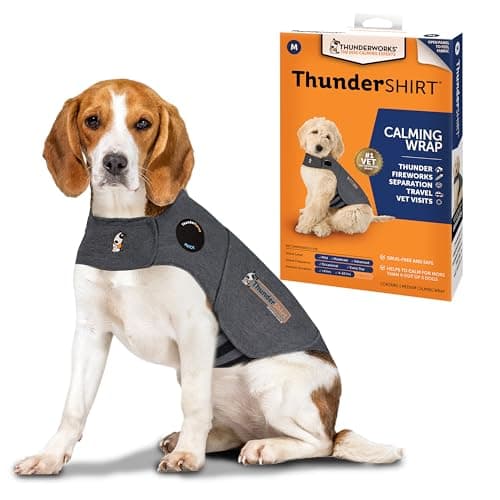
The verdict: buy it for ten dollars' worth of hope and a realistic chance of a small improvement, not for a calm dog. The ThunderShirt is the only drug-free travel calming product on this site with peer-reviewed research behind it, which is genuinely to its credit — and that research is modest. The 2018 Veterinary Evidenceknowledge summary reviewed four studies of pressure vests and concluded that they "may have small but beneficial effects on canine anxiety", that owners "should not expect their dog's anxiety to be fully alleviated or prevented", and — said plainly in the same bottom line — that a vest may have no beneficial effect at all.
The reason to read on is the thing that decides whether you are in the group it helps: fit. The one published study on this specific product split dogs into three groups — vest fitted snugly per the manufacturer's instructions, vest fitted loosely, and no vest — and only the snug group showed a measurable difference. ThunderShirt, meanwhile, sizes the vest by your dog's weight, tells you to size downif you are on the cusp, and markets it with "no training required". The mechanism is snugness and the maker hands you a weight band. That gap is this review.
What the research actually found
Four studies sit behind this product class, and they are small. They are also the only numbers in this category that were not written by a marketing department, so they are worth reading properly:
- King et al., 2014 (Journal of Veterinary Behavior, 9:215-221)— the one on the ThunderShirt itself. Dogs diagnosed with an anxiety disorder were left alone for 15 minutes in three groups: the vest fitted snugly to the maker's guidelines, the vest fitted loosely, and no vest. The snug group showed a smaller rise in heart rate than the other two. Maximum heart rate did not differ between any group. The snug group also showed less tongue-flicking and yawning — two recognized stress signals — and no difference in pacing or panting.
- A 2013 open-label trial on pressure wraps for thunderstorm phobia, 18 dogs, with owner-reported improvement in the high eighties percent. Read that number with its design in mind: open-label means no blinding and no control group, so it measures what owners believed about a wrap they knew their dog was wearing. Veterinary Evidence's reference list identifies the garment in that trial as the Anxiety Wrap rather than the ThunderShirt, so it is evidence about pressure wraps generally, not about this one.
- Cottam and Dodman, 2009 — a storm-phobia cape tested against a placebo cape, the only study in the set with a placebo arm, and the reason the whole class is discussed cautiously.
- Pekkin et al., 2016 — a pressure vest measured against behaviour, salivary cortisol and urinary oxytocin in noise-phobic dogs, i.e. the attempt to find a hormonal signal rather than an owner opinion.
Put together, the honest summary is the one the 2018 review wrote: four studies of variable quality, a possible small benefit, and no promise. For a $40-50 drug-free garment with no notable side effects, a possible small benefit is a perfectly reasonable thing to buy. For a dog with genuine travel panic, it is not a plan, and we would rather send you to your vet than sell you a vest.
What ThunderShirt publishes, and what it does not
Read against most of the pet calming market, ThunderShirt is restrained. Its own product page describes the mechanism as applying gentle, constant pressure, compares it to swaddling an infant, calls the design patented, and backs it with a 60-day satisfaction guarantee. It lists the vest at $49.99 on its own site (embroidery $10 extra; the Amazon listing we re-verified on 1 November 2026 was in stock at a little under that). It says the wrap is lightweight, breathable and machine-washable. There is no percentage success claim on the page we read— the evidence it offers is "vet recommended", "millions of dogs", fifteen-plus years, and customer testimonials.
Three things it does not publish, each of which matters more than the marketing:
- Any chest or girth measurement. The size chart in the page text is weight only: XXS under 8 lb, XS 8-14, S 15-25, M 26-40, L 41-64, XL 65-110, XXL over 110 lb — with the advice to size down if your dog is on the cusp of a band, and a note that the Polo styles run smaller. Weight is the wrong variable for a garment whose effect depends on contact: a 30 lb barrel-chested terrier and a 30 lb whippet are the same band and nothing like the same shape. (We make the same criticism of weight-only sizing on a safety part in our Kurgo Impact review — there it is dangerous, here it is just the difference between working and not working.)
- How long a dog should wear it.No wear-time guidance appeared on the page we read. Veterinary commentary on this product class flags caution in hot weather and for elderly or medically unwell dogs, which is exactly the guidance you would want from the maker of a snug garment that covers a dog's torso on a long summer drive.
- Any acknowledgement that fit is the mechanism."No training required" is true about training and misleading about fitting, because the one study on this vest found the effect only in the group whose vests were snug.
How it actually fits into a travel day
This is where the product earns its place on a dog-travel site rather than a general pet site. A pressure vest is, practically speaking, the most travel-compatible calming mechanism there is: it is drug-free, so it raises no questions with an airline and interacts with nothing your vet has prescribed; it works inside a carrier, which a diffuser or a plug-in cannot; it goes under a coat and over nothing structural; and it washes, which matters after eight hours of a stressed dog. Our calming gear roundup ranks it first in that field for those reasons.
Two cautions specific to travel. Do not put it on under a car harness. A restraint spreads crash load across the chest and a layer of fabric between the harness and the dog changes how that harness sits; dress the dog in one or the other, and if it is a choice, the restraint wins — crate versus harness covers that decision. And do not count on it in a hot vehicle: a snug torso wrap is an insulating layer, and our keeping a dog cool guide is the constraint it has to fit inside.
Who should buy it, and who should not
Buy it if your dog is mildly to moderately anxious in the car or at an airport, you can buy it weeks before the trip, and you will measure and fit it snugly rather than hanging it on the dog. At this price, with a 60-day guarantee, a possible small improvement is worth the gamble — and a dog that settles under pressure is a real phenomenon, not a marketing invention.
Do not buy it the week of the flight. A new garment on travel day is one more novel stressor at the worst possible moment, and the correct sequence is the one we set out for carriers in getting a dog used to a carrier: short relaxed wears at home until the vest is boring. Do not buy it for a dog with severe noise phobia or genuine panic, which is a veterinary problem — we say the same thing about calming a dog for a flight. Do not buy it expecting the hearing-protection effect of an ear cover; that is a different product and our dog ear protection roundup ranks those, with the same caution about the evidence behind the compression tier. And do not buy the loose-fitting bargain version of this idea: the loose group in the study did no better than no vest at all.