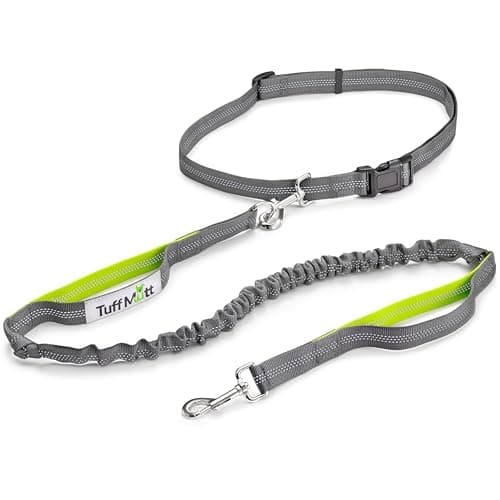
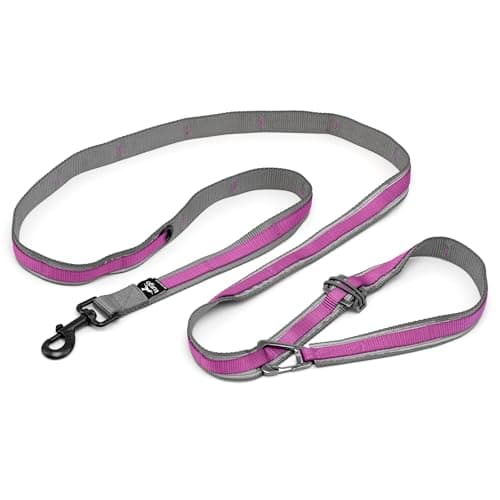
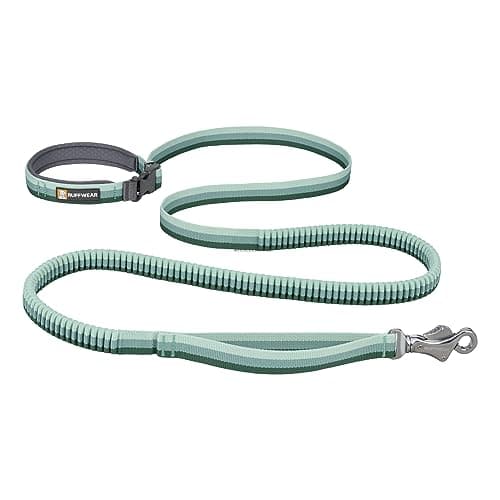
Buy the Ruffwear Roamer Bungee Dog Leash (5.5-7 ft). Its Wavelength webbing stretches along its length, so a sudden lunge arrives at your hips as a pull rather than a jolt, and it carries two handles — a traffic handle by the clip and a padded adjustable handle — so you can shorten up for a passing horse without unclipping. For running, the budget pick is the Tuff Mutt Hands-Free Bungee Waist Leash: a bungee Tuff Mutt lists at 48 in stretching to 60 in, with a handle at hip level and a second one near the collar. If you want one leash that does six jobs, take the Kurgo Quantum 6-in-1 Dog Leash.
The thing nobody tells you about hands-free: the leash stops being a thing in your hand and becomes part of your balance. Every force the dog generates now arrives at your centre of mass. On a flat gravel path that is a convenience. On a loose descent with a dog that spots a squirrel, the difference between webbing that stretches and webbing that does not is the difference between a stumble and a fall. That is why this page ranks on give and handle position, and why it puts a different leash first from our hiking leash roundup, which ranks the same category against the national park six-foot rule.
The four things that decide a hands-free leash
1. Shock absorption (weighted highest)
Two of these four have give in the line: the Roamer through stretch webbing along its whole length, the Tuff Mutt through a conventional bungee section. Two do not: the Quantum is flat nylon webbing and the Hitch Hiker is 7 mm kernmantle rope. Flat webbing worn at the waist sends the whole jolt into your hips, which Kurgo does not pretend otherwise about — it is the honest trade for six configurations in one leash.
2. Where the handles are, and how many
A hands-free leash without a second handle near the clip is a leash you have to take off your waist to control the dog, which is the opposite of the point. The Roamer and the Tuff Mutt both have two grips at two distances. The Quantum gets there by reconfiguring — a carabiner adjustment, so learn it at home rather than at the trailhead.
3. Whether the dog can switch sides
The Tuff Mutt's glide clip lets the dog cross the belt from your left to your right. That is the selling point on a wide path and the hazard on a narrow one, where a dog swinging in front of your feet is a trip you did not see coming. If your routes are exposed, you want a fixed attachment point.
4. What it does when you stop
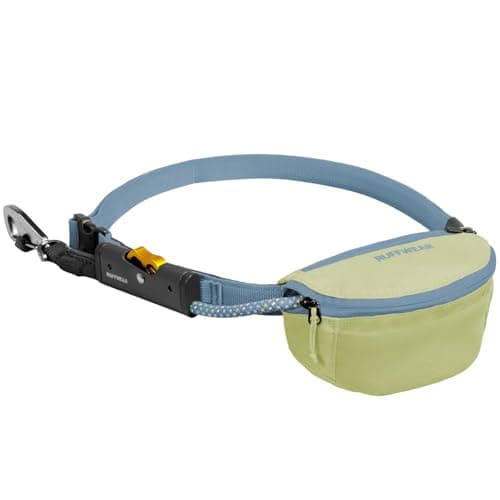
A leash that goes around a tree is a leash that covers the water stop and the lunch break without a second piece of gear. The Quantum has a tether mode; the Hitch Hiker is sold as a leash and a hitching system in one, with a HitchLock adjuster that locks the rope under tension. Both are for when you are standing right there — federal rules bar leaving a pet tied and unattended outside designated areas.
The four, side by side
| Leash | Who it is for | Give in the line | Length (published) |
|---|
| Ruffwear Roamer Bungee Dog Leash (5.5-7 ft) | A dog that pulls, on hills | Stretch webbing along the whole length | 5.5-7 ft; waist strap to 48 in |
| Tuff Mutt Hands-Free Bungee Waist Leash | Running, on a budget | Bungee section | 48 in, stretching to 60 in |
| Kurgo Quantum 6-in-1 Dog Leash | One leash for everything | None — flat nylon webbing | 48-72 in incl. handle, six configurations |
| Ruffwear Hitch Hiker Rope Leash (12 ft, adjustable) | Trail plus campsite | None — kernmantle rope | 12 ft, adjustable and lockable; belt to 49 in |
Those are published manufacturer figures, not measurements we took. Note the Hitch Hiker discrepancy we flag on its card: the live Amazon listing gives a total length of 36 ft, which contradicts Ruffwear's own 12 ft figure. We use Ruffwear's.
Three places a hands-free leash is the wrong choice
A national park. 36 CFR 2.15 caps a leash at six feet, and two of these four can exceed it — the Roamer at full stretch and the Hitch Hiker by a factor of two unless you lock it short. Our hiking leash roundup ranks on exactly that constraint, and dogs in national parks covers where a dog may legally walk at all.
A dog that has not been taught not to pull. Hands-free amplifies pulling into your spine rather than fixing it. Put the leash on a well-fitted hiking harness, never a collar, and work on the pulling separately.
Two dogs on one belt. Autocomplete asks for this constantly and we will not recommend it: two dogs on one waist attachment can generate opposing forces at the same moment, and that is how people go over. Two dogs want two handlers or two separate leads.
Clip it to a harness, not a collar
Every force in a hands-free setup runs through one attachment point, and on a collar that point is your dog's throat. Ruffwear states it plainly for its own hitching system: attach to a harness, never a collar. The same applies to every leash on this page. If you are also looking at a car, note that a walking harness is not a car restraint — see our crash-tested harness roundup for what is.