"Dogs can swim" is one of those things everybody knows and that is only partly true. Some breeds swim well and enjoy it. Some can stay afloat briefly and hate every second. Some - deep-chested, short-legged, heavy-headed, or brachycephalic - are genuinely poor swimmers whose body shape works against them, and a bulldog in deep water is in trouble almost immediately.
And even a strong swimmer has limits. Cold water saps strength fast, currents beat enthusiasm, and a dog that has been retrieving a ball for twenty minutes is a tired dog in deep water without knowing it.
Who needs a life jacket
Anyone on a boat, and that is not a judgment about the dog's swimming. A dog that goes over the side of a moving boat has to swim in water it did not choose, possibly after a fall, possibly disoriented - and you have to find it and get it back aboard. A jacket with a strong grab handle turns that from a crisis into a maneuver.
Beyond boats:
- Poor swimmers by build - bulldogs, pugs, dachshunds, corgis, and most heavy-headed short-legged breeds.
- Puppies and older dogs, for stamina reasons at both ends.
- Any dog in moving water, including rivers that look gentle from the bank.
- Any dog new to swimming, for the first several sessions, because confidence and competence arrive at different times.
- Dogs with arthritis or recovering from injury, where swimming is often recommended exercise and fatigue arrives sooner than expected.
What makes a jacket work: flotation that keeps the head up rather than merely keeping the dog level, a handle sited over the center of mass so a lifted dog does not tip, bright color, and a fit snug enough that it does not ride up over the head. The full ranking is in best dog life jackets.
Introducing a dog to water
Shallow, warm, still, and boring. Let the dog walk in of its own accord - never throw a dog into water, which is how dogs learn to fear it permanently. Get in yourself. Use a long line for control without pressure, and keep the first sessions short enough that the dog is not tired before it is confident. If your dog does not want to swim, that is a complete answer; plenty never do.
The short answer
Quick picks
#ad · Live prices from the Amazon Product API, as of October 21, 2026. Where we have no verified live price we show none — we would rather leave a gap than print a number that has rotted.
In detail
The picks, in full
Boating and open water
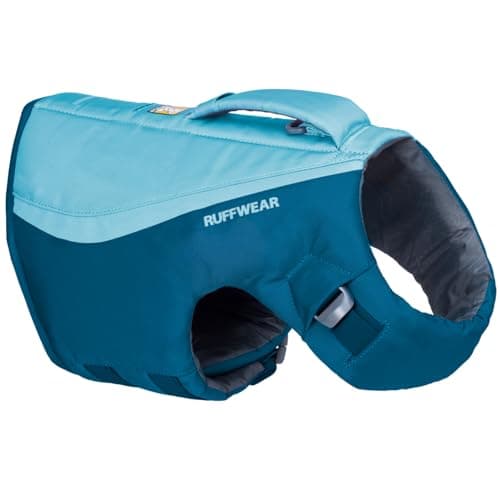
Ruffwear Float Coat Dog Life Jacket
Premium buoyancy foamTelescoping neck closureStrong lift handleReflective trim
The one to buy if the dog is actually on the boat every weekend. Better foam placement, better handle, better everything.
- Buoyancy
- 10
- Fit and adjustment
- 10
- Handle strength
- 10
- Visibility
- 9
- Value
- 6
Pros
- +The handle is positioned and reinforced for lifting a soaked dog out of water, which is where budget handles tear
- +Foam distribution keeps a dog level rather than nose-down, so it can swim in the jacket instead of fighting it
- +Neck closure adjusts telescopically, which is the difference between a jacket that fits a barrel-chested dog and one that does not
Cons
- −The most expensive jacket here by a wide margin
- −More coverage means more heat, and a dog will notice on a hot dock
Don't buy this if…
…your dog paddles in a lake twice a summer. The Granby covers that; the Float Coat is for boat decks and current.
First-time buyers and occasional swimmers
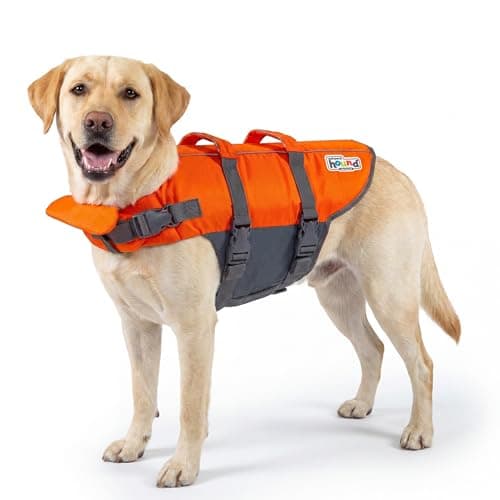
Outward Hound Granby Splash Dog Life Jacket
Front float for head supportGrab handleReflective accentsMultiple sizes
The one almost everyone should start with: bright, buoyant, cheap enough to buy before you know if the dog likes water.
- Buoyancy
- 8
- Fit and adjustment
- 7
- Handle strength
- 7
- Visibility
- 9
- Value
- 10
Pros
- +A front flotation panel lifts the chest, which is what keeps a tiring dog's head clear rather than just keeping it afloat
- +Priced so low that buying one for a dog who may hate water is a small bet, not a commitment
- +High-visibility orange with reflective trim — you can find the dog in chop, which is half the job
Cons
- −Materials and hardware are budget-grade; heavy season-long use wears the straps
- −Fit runs generous, so measure rather than buying by weight alone
Don't buy this if…
…the dog swims hard every weekend all summer. At that duty cycle a premium jacket lasts several times longer.
Trips that mix water and trail
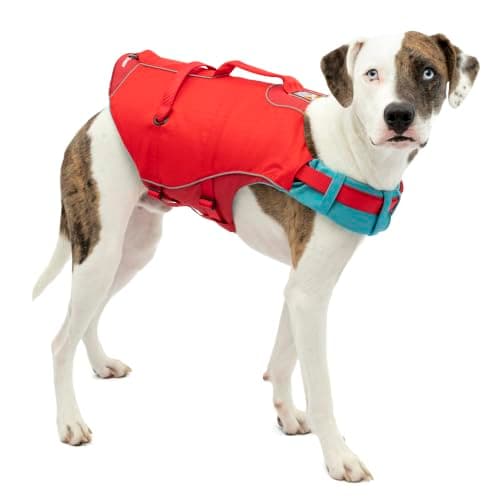
Kurgo Surf n' Turf Dog Life Jacket
Removable flotationGrab handleReflective trimMultiple sizes
The convertible: the flotation panels come off, so it works as a plain coat when the dog is out of the water.
- Buoyancy
- 7
- Fit and adjustment
- 8
- Handle strength
- 8
- Visibility
- 8
- Value
- 8
Pros
- +Detachable float panels mean one garment covers the paddle and the hike back, instead of two
- +Kurgo's travel-gear hardware is a step up from the budget field at a mid-tier price
- +Genuinely useful for people who car-camp near water but do not spend the whole day in it
Cons
- −A convertible is a compromise at both jobs — less buoyancy than a dedicated jacket, more bulk than a plain coat
- −More parts to lose, and the float panels are the parts
Don't buy this if…
…the dog is a serious swimmer. Removable foam is less foam; buy the dedicated jacket.
On a boat
- Jacket on before the boat leaves the dock, every time.
- Work out how you would get the dog back aboard before you need to. A wet dog is heavy and a boat side is high; a ramp, a swim platform, or a rehearsed lift by the jacket handle is the plan.
- Shade and water on board. A boat deck in the sun is hot fiberglass and reflected light, and there is nowhere to escape it.
- Watch the paws. Hot decks burn pads the same way asphalt does - the seven-second hand test applies on a boat too.
- Give the dog a fixed spot, low and out of the way of lines and gear, and settle it there rather than letting it move around under way.
The water itself
Blue-green algae
Cyanobacteria blooms in warm, still fresh water can be fatal to dogs within hours, and dogs are exposed both by drinking and by licking their coat afterwards. If water looks like green paint, pea soup, or has a scum on the surface, keep the dog out of it entirely - and check for posted advisories, which many lakes publish through the summer. If your dog has been in suspect water, rinse it thoroughly and call a vet at the first sign of vomiting, weakness or tremors.
Currents, tides and cold
Rivers that look calm from the bank move faster than dogs can swim against, and a dog chasing a ball downstream is not thinking about the return trip. In the sea, rip currents are the specific killer, and cold water shortens the time any dog can stay afloat regardless of how well it swims.
Saltwater and pool water
Dogs drink seawater while swimming and it makes them ill - offer fresh water constantly so the dog is not thirsty in the first place. Rinse salt and chlorine off afterwards, both for the skin and because the dog will lick its coat dry. A portable bottle at the waterline solves most of this.
Water intoxication, briefly
A dog that repeatedly retrieves from water, or bites at a hose or sprinkler, can take in enough water to dilute its blood sodium dangerously. It is uncommon but it is real, and the fix is simply to break up long retrieving sessions rather than letting a dog go for an hour.
Afterwards
- Dry the ears. Water trapped in the ear canal is the most common consequence of a swimming summer, particularly in drop-eared breeds.
- Rinse the coat - salt, chlorine, silt and whatever else was in the lake. A portable dog shower in the trunk is what makes this happen at the car rather than at home.
- Check between the toes and the pads for cuts from rocks and shells, which a wet dog will not show you by limping until later.
- Warm and dry the dog if the water was cold, particularly thin, small or old dogs.
If water is a regular part of your trips, a first aid kit that lives in the boat or the car is worth the space, and a collar light makes a dark-water evening far less anxious.
How we picked
We do not test the gear
We compiled the manufacturers' published dimensions and specs, cross-checked them against airline under-seat limits and published safety certifications, read the owner reviews, and scored each product against a published rubric. The scores are judgments from that research — they are not measurements we took, because we do not own a lab and we are not going to pretend we do. Where we could not verify a fit or a claim, we say so on the page.
Questions
Frequently asked
Can all dogs swim?+
No. Some breeds swim well, some stay afloat briefly and dislike it, and deep-chested, short-legged, heavy-headed or brachycephalic dogs are genuinely poor swimmers whose build works against them. Even strong swimmers tire, and cold water and currents shorten that time considerably.
Does my dog need a life jacket on a boat?+
Yes - regardless of how well it swims. A dog that goes over the side is swimming in water it did not choose, possibly disoriented, and you have to retrieve it. A jacket with a strong grab handle over the center of mass turns that into a manageable lift rather than an emergency.
How do I teach a dog to swim?+
Shallow, warm, still water, and let the dog walk in on its own. Never throw a dog in - that is how dogs learn to fear water permanently. Get in yourself, use a long line for gentle control, keep sessions short, and use a life jacket for the first several outings. If the dog does not want to swim, that is a complete answer.
Is blue-green algae dangerous to dogs?+
Yes, potentially fatally and within hours. Cyanobacteria blooms in warm, still fresh water are toxic, and dogs are exposed both by drinking and by licking their coat afterwards. Keep dogs out of water that looks like green paint or pea soup or has surface scum, check posted advisories, and see a vet immediately if a dog that has been in suspect water vomits, weakens or develops tremors.
Should I let my dog drink lake or sea water?+
No. Seawater makes dogs ill, and fresh water sources can carry bacteria, parasites and algal toxins. Carry your own water and offer it often, so the dog is not thirsty enough to self-serve. Rinse salt, chlorine and silt off the coat afterwards, because a dog will lick itself dry.
Receipts
Sources
We do not run a testing lab, and we do not pretend to. Product dimensions and safety claims come from the manufacturer's own listing; airline limits come from the airline's published policy, with the date we checked it. Where we could not verify something, we say so on the page rather than quietly leaving it out. Read our full method.