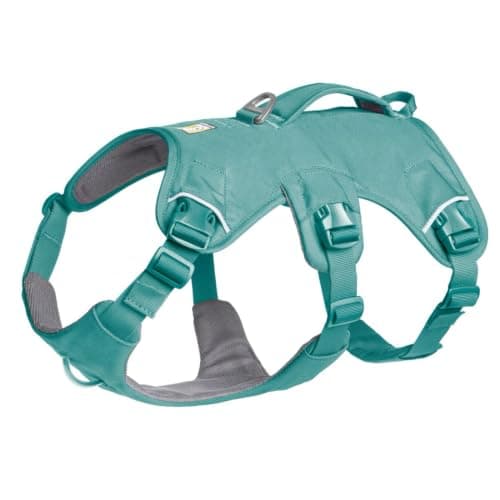
The verdict: for a large dog, stop looking at backpack carriers. Every backpack carrier in our registry is listed to roughly 18 lb or less, which our own backpack carrier roundup states on the page. A 60 lb dog is not a packing problem, it is a physics problem. What works instead, in order: a Ruffwear Web Master Support Harness so you can lift and spot the dog over the hard bits, a ramp so the hardest moment of the day — the tailgate — stops being a lift at all, and a stroller with a published capacity if the dog genuinely cannot cover the ground.
This page exists because the site ranks all five of these categories separately and none of those roundups tells you which category you are in. The thing that decides it is not the dog's condition. It is the dog's weight against a published number, and then yours.
One thing we will not do: tell you how to carry an injured dog in an emergency. A dog in pain bites, a spinal injury is made worse by the wrong lift, and the right technique depends on what is injured. That is a vet question and, on a trail, a first-aid kit and a phone call. What follows is about planned carrying — the senior dog on a long airport walk, the stiff dog at the end of a hike, the recovering dog that is not allowed stairs for six weeks.
The five mechanisms, by the weight each one actually takes
1. A support harness with a lifting handle — up to a dog you can lift
You are not carrying the dog, you are taking part of its weight at the moment it needs it: over a boulder, into a boot, up three steps. A rigid handle over the dog's centre of gravity turns an awkward bear-hug into a controlled lift, and a third belly strap stops the harness riding forward when you pull up. This is the right answer for most large dogs because most large dogs can still walk — they just cannot do the four hard moments in the day.
2. A ramp — removes the single worst lift entirely
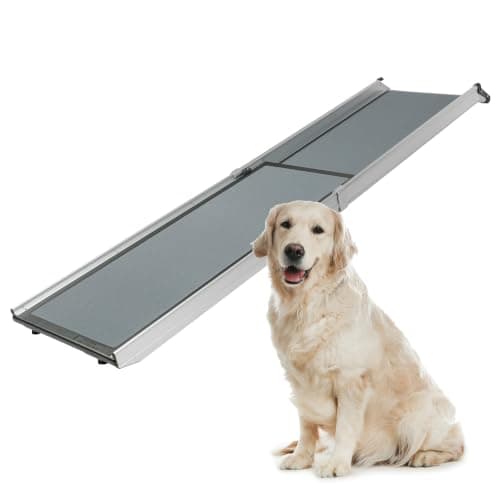
The tailgate is where owners hurt their backs and dogs hurt their shoulders, and it happens twice per stop, every stop. A telescoping ramp turns it into a walk. For a heavy dog this is the highest-value purchase on this page by a distance, and it is the one people buy last. Our car ramp roundup ranks the category; the pick here is the long telescoping one, because ramp angle is the thing that decides whether a nervous dog will use it.
3. A stroller — for the dog that cannot cover the distance
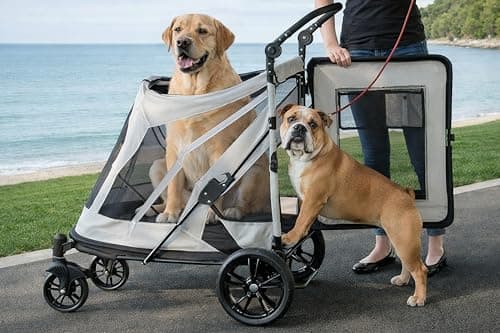
Unlike packs, strollers publish capacity. The No-Zip Expedition lists 150 lb, which is the only number in this comparison that covers a genuinely large dog. The costs are honest and worth stating: 26 lb of stroller before the dog is in it, a 32 x 22 x 23 in folded frame that is a real packing problem in a sedan, and kerbs. Our travel stroller roundup covers the smaller end of the category.
4. A backpack carrier — only under about 18 lb
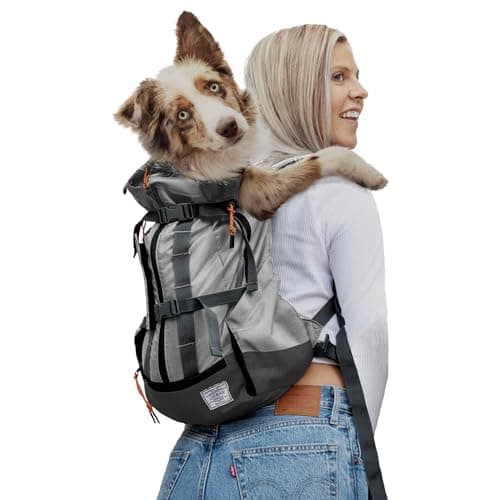
Worn on your back, dog's legs out, sized by the dog's back length rather than its weight. It is the best way to move a small dog a long way and it is simply not available for a large one. The limit is structural: the weight sits behind your shoulders and the pack is not built to hold more.
5. A sling — under about 15 lb, short distances
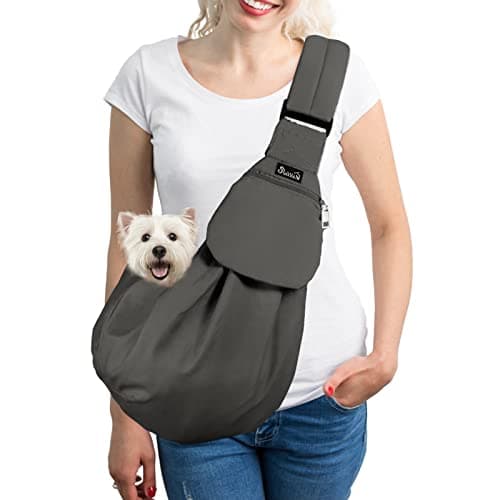
A padded strap over one shoulder with the dog across your front. Fast on and off, nothing to fit, and the asymmetric load is the limit — it is for ten minutes, not two hours. Covered properly in our sling roundup.
The numbers that decide it
Taken from each maker's published listing. Where a maker does not publish a capacity — which is most of the carry category — the table says so rather than guessing.
| Option | Published capacity | Who carries the weight | Folds or packs? | Right when |
|---|
| Ruffwear Web Master Support Harness | Not published; a lift you can make | You, in bursts | Worn, packs flat | Dog walks but needs help at obstacles |
| Pet Gear No-Zip Expedition Pet Stroller | 150 lb (listed) | The wheels | 26 lb, 32 x 22 x 23 in | Dog cannot cover the distance |
| PetSafe Happy Ride Extra Long Telescoping Dog Ramp | Not published here; extra-long telescoping | Nobody - the dog walks | Telescopes into a boot | The lift is into a vehicle |
| K9 Sport Sack Urban 3 | Sized by back length; pack class listed to ~18 lb | You, continuously | Worn; doubles as a daypack | Small dog, long distance |
| SlowTon Padded Dog Carrier Sling | Not published; small-dog class | One of your shoulders | Folds into a bag | Small dog, ten minutes |
So which one is it?
- Dog under 15 lb, short hops: sling.
- Dog under 18 lb, real distance: backpack carrier, sized on back length.
- Dog 18 to 25 lb: the awkward band. A pack is at or past its listing and a stroller is overkill. A support harness plus a ramp usually covers it.
- Dog over 25 lb that can still walk: support harness, plus a ramp for the vehicle. This is most big dogs, most of the time.
- Dog over 25 lb that cannot walk far:a stroller with a published capacity above the dog's weight. There is no wearable answer and anything claiming to be one is not publishing a number.