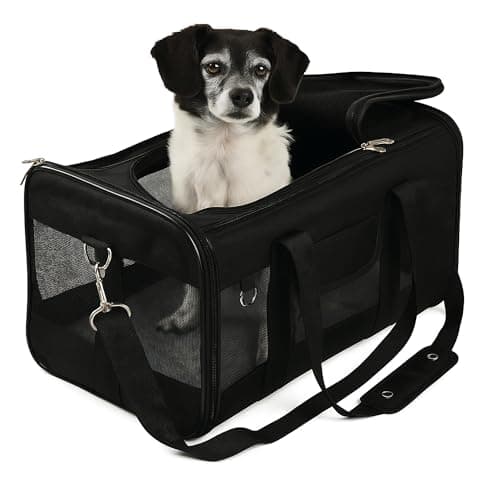
If you ask a hundred people who have flown with a small dog what carrier they used, the Sherpa Original Deluxe comes up more than anything else. It has been the category default for years, and unusually for a default, it earns the position on the merits rather than on inertia.
The reason is a single feature that no competitor matches: the Guaranteed On Board program. Sherpa maintains a list of airlines for which it will reimburse your ticket if the carrier is the reason you are denied boarding. Every other manufacturer in this market says "airline approved" and stops there. Sherpa is the only one attaching a consequence to the claim.
That does not make it the right carrier for every dog, and it does not make the carrier perfect. The sizing runs tight, the base is soft, and there is a specific kind of buyer who should be looking at something else entirely. This review covers all three.
What the Sherpa gets right
The spring-wire frame is the whole design
The top of the carrier is held up by a spring-wire hoop that pushes down under pressure and springs back afterwards. In practice this means the carrier can be an inch over an airline's stated height and still slide into the gap, because the top yields rather than jamming. Rigid carriers cannot do this. It is the single most useful property a cabin carrier can have, and it is why we recommend soft carriers over structured ones for the cabin in general.
Ventilation on three panels
Mesh on three sides matters more than the spec sheet suggests. The worst moment of a flight for a dog is usually not the air — it is a hot jet bridge, a stalled boarding queue or a taxi in summer. Airflow from multiple directions is what keeps that survivable, and it is also what several airlines specifically require of an in-cabin carrier.
The guarantee, read carefully
The Guaranteed On Board program applies to specific Sherpa models on a published list of airlines, and it has terms — you need the paperwork, the airline has to be on the list, and the denial has to be about the carrier. One limit is easy to miss and worth knowing before you rely on it: Sherpa's program page states the guarantee covers flights within and between the US and Canada only, so it does not back an international trip. Read the current version on Sherpa's site rather than assuming. Even with those conditions, it is the only financial backstop in the category, and for a domestic first-time flyer it removes the exact fear that makes people over-buy.
Where it falls short
The sizing runs small for the stated weight
This is the complaint that shows up most consistently in owner reports, and it is real. A dog at the top of a size band's weight range will be a squeeze. Sherpa's published dimensions are honest — the problem is that the weight ratings are optimistic relative to them. Measure your dog rather than weighing it, and if you are between sizes, size up. Our measuring guide walks through the two numbers that matter.
The soft base sags under a heavier dog
Below about 10 pounds this is a non-issue. Above it, the floor gives, and a dog that is already anxious ends up in a slight hammock rather than on a flat surface. A firm insert or a cut-to-size board fixes it for a few dollars, but you should know you may need to do that.
No expansion, and no wheels
The Sherpa is a fixed-volume bag you carry. If your travel day includes a long layover, an expandable carrier will treat the dog better on the ground. If it includes a mile of terminal, a wheeled carrier will treat you better. The Sherpa is deliberately the simple option, and simplicity is exactly why it lasts.
Who should buy it, and who should not
Buy it if your dog is comfortably inside a size band, you fly a handful of times a year, and you want the fit question settled by someone other than you.
Do not buy it if your dog is at the very top of a weight range — size up or look at a roomier carrier. Do not buy it if the trip is mostly a long layover; buy expansion instead. And if you fly monthly across varied aircraft, read our Sherpa versus Sleepypod comparison before you decide — that is the one case where paying several times more is defensible.